

Advanced Optical Materials
About Advanced Optical Materials
Advanced Optical Materials, part of the prestigious Advanced portfolio, is a unique journal for materials science research which focuses on all aspects of light-matter interactions.
News
01 Jun 2026
Daegu Gyeongbuk Institute of Science and Technology (DGIST)
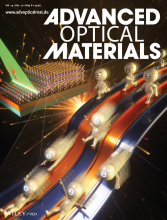
- Prof. Hyuk-Jun Kwon’s team at DGIST develops a high-performance photodetector (light-sensing sensor) in a two-dimensional semiconductor material using a single laser process
- Expected to enable next-generation flexible and image sensor applications without complex stacking or transfer processes
- Published in the international journal Advanced Optical Materials
13 Mar 2026
Osaka Metropolitan University
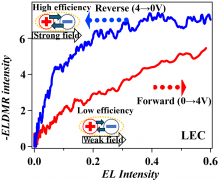
Researchers used electroluminescence-detected magnetic resonance to directly observe electron-hole pairs in operating light-emitting electrochemical cells. They found that ion-driven changes in the internal electric field strongly affect recombination efficiency. Lower-voltage, more stable electric fields promote light emission, a discovery that identifies electric field management as a key factor in improving organic optoelectronic devices.

24 Jun 2024
Daegu Gyeongbuk Institute of Science and Technology (DGIST)
- Professor Jin-ho Chang’s team at DGIST developed high-performance ultrasound-assisted photothermal therapy (ULTRA-PTT) technology using proprietary ultrasound-induced optical clearing technology.
- The team developed a handpiece based on ULTRA-PTT technology, demonstrating exceptional therapeutic effects in animal experiments.
- The related research is published in the prestigious international journal “Advanced Optical Materials.”

24 Jun 2024
Osaka Metropolitan University
Approach could have applications for microchemistry, quantum dots
12 Oct 2023
The University of Osaka
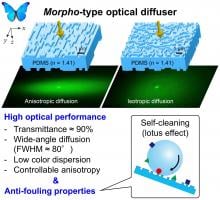
Researchers at Osaka University developed a nanostructured light diffuser that provides balanced lighting by diffracting blue and red light, and can be cleaned by simple rinsing with water. The diffuser consists of cheap materials and can be shaped with common tools. A protective glass coating maintains the diffuser’s optical performance yet adds durability. This work might improve the visual performance of everyday lighting displays.