

Physical Review D
About Physical Review D
Physical Review D (PRD) publishes leading research in elementary particle physics, field theory, gravitation, and cosmology.
- Website: https://journals.aps.org/prd/
- Current Issue: https://journals.aps.org/prd/recent
News
23 Mar 2026
Kavli Institute for the Physics and Mathematics of the Universe (Kavli IPMU)
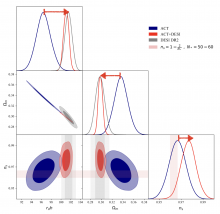
A team of researchers led by the University of Tokyo Kavli Institute for the Physics and Mathematics of the Universe (Kavli IPMU, WPI) Project Assistant Professor Elisa Ferreira has shown that a discrepancy in a key cosmic measurement in the early universe originates from a subtle statistical interplay between measurements of the cosmic microwave background (CMB) and baryon acoustic oscillations (BAO).
17 Oct 2025
Tohoku University
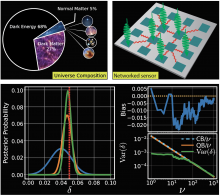
Researchers at Tohoku University have taken a major step forward in the global hunt for dark matter, an invisible substance that makes up about 27% of the universe, by designing a new type of quantum sensor network that could significantly improve our chances of detecting it.
21 Dec 2023
Kavli Institute for the Physics and Mathematics of the Universe (Kavli IPMU)
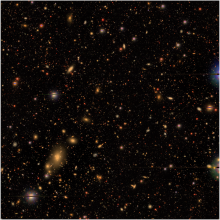
Kavi IPMU researchers have analyzed more than one million galaxies to explore primordial fluctuations that seeded the formation of the structure of the entire universe.
02 Nov 2023
Kavli Institute for the Physics and Mathematics of the Universe (Kavli IPMU)
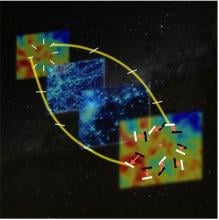
Future missions will be able to find signatures of violating the parity-symmetry in the cosmic microwave background polarization more accurately after a pair of researchers has managed to take into account the gravitational lensing effect, reports a new study in Physical Review D, selected as an Editors' Suggestion.
21 Jul 2022
Kavli Institute for the Physics and Mathematics of the Universe (Kavli IPMU)
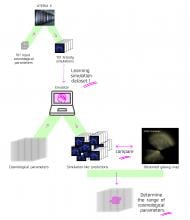
A neural network method machine-learning technique has enabled researchers to develop a very fast and highly efficient software program that can make theoretical predictions about structure formation in the universe.
08 Jun 2021
Kavli Institute for the Physics and Mathematics of the Universe (Kavli IPMU)
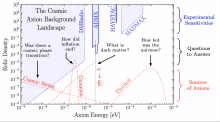
No one knows what happened in the Universe for its first 400,000 years, but a new paper suggests discovering the hypothetical particle axion could shed light on the early history of the Universe. What's more, current dark matter experiments may have already detected it in its data.

29 Mar 2021
Kavli Institute for the Physics and Mathematics of the Universe (Kavli IPMU)
A paper by the Kavli Institute for the Physics and Mathematics of the Universe (Kavli IPMU) Director Ooguri Hirosi and Project Researcher Matthew Dodelson on the string theoretical effects outside the black hole photon sphere has been selected for the “Editors’ Suggestion” of the journal Physical Review D. Their paper was published on March 24, 2021.
16 Feb 2021
Tohoku University
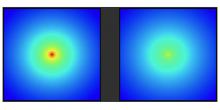
Our universe is dominated by a mysterious matter known as dark matter. Its name comes from the fact that dark matter does not absorb, reflect or emit electromagnetic radiation, making it difficult to detect.