

Publications of the Astronomical Society of Japan
About Publications of the Astronomical Society of Japan
Publications of the Astronomical Society of Japan (PASJ) publishes the results of original research in all aspects of astronomy, astrophysics, and fields closely related to them.
- Website: https://academic.oup.com/pasj
- Current Issue: https://academic.oup.com/pasj/issue
News

17 Mar 2025
Osaka Metropolitan University
Using AI image recognition, deep learning model efficiently and accurately finds structures related to star formation

28 Jun 2024
Tohoku University
Bringing us one step closer to solving the “missing satellites problem,” researchers at Tohoku University and abroad have discovered two new satellite galaxies.

01 Mar 2023
Osaka Metropolitan University
Osaka Metropolitan University scientists identified about 140,000 molecular clouds in the Milky Way Galaxy from large-scale data of carbon monoxide molecules, observed in detail by the Nobeyama 45-m radio telescope. Using artificial intelligence, the researchers estimated the distance of each of these molecular clouds to determine their size and mass, successfully mapping the distribution of the molecular clouds in the Galaxy in the most detailed manner to date.
08 Jul 2021
Osaka Prefecture University
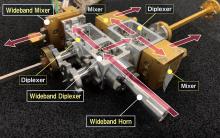
Researchers have used the latest wireless technology to develop a new radio receiver for astronomy. The receiver is capable of capturing radio waves at frequencies over a range several times wider than conventional ones, and can detect radio waves emitted by many types of molecules in space at once. This is expected to enable significant progresses in the study of the evolution of the Universe and the mechanisms of star and planet formation.
24 Mar 2020
National Astronomical Observatory of Japan (NAOJ)
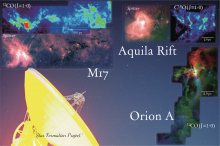
Astronomers have captured new, detailed maps of three nearby interstellar gas clouds containing regions of ongoing high-mass star formation.
30 May 2019
Kavli Institute for the Physics and Mathematics of the Universe (Kavli IPMU)
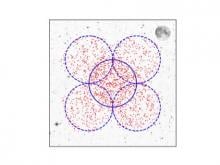
The Subaru Telescope has captured images of more than 1800 exploding stars in the Universe, some located 8 billion light years from Earth.