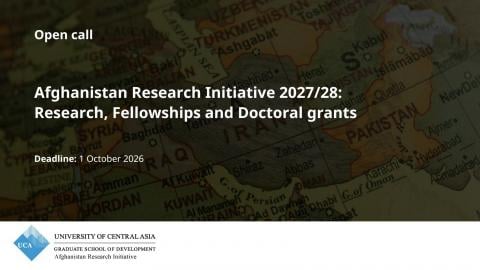
The Afghanistan Research Initiative (ARI) is a programme of the University of Central Asia (UCA), jointly supported by the International Development Research Centre (IDRC) and the Aga Khan Foundation Canada (AKFC). Grants for Research, Non-Resident Fellowship, and PhD Support are available.
The Afghanistan Research Initiative (ARI) is a programme of the University of Central Asia (UCA), jointly supported by the International Development Research Centre (IDRC) and the Aga Khan Foundation Canada (AKFC). The programme is implemented by UCA through its Graduate School of Development Afghanistan Research Initiative (GSD ARI).
Established following the collapse of the Afghan government in August 2021, GSD ARI seeks to sustain research capacity on Afghanistan, support students and scholars, foster collaboration among researchers, and promote the production and dissemination of independent research relevant to Afghanistan's development and future.
Through its 2027/28 Call for Applications; GSD ARI invites applications under three funding streams:
- Research Grants
- Non-Resident Research Fellowships
- PhD Support Grants
Applicants should carefully review the eligibility requirements for each funding stream before applying.
ARI welcomes proposals addressing one or more of the following thematic areas:
- Economic development, including livelihoods, poverty, labor markets, private sector development, entrepreneurship, finance, and economic resilience.
- Regional integration and sustainable trade, including regional cooperation, connectivity, trade, transportation, and economic corridors.
- Climate change, natural resources and environmental sustainability, including agriculture, water, energy, mining, biodiversity, climate adaptation, and disaster risk reduction.
- Governance, public policy and institutions, including public administration, service delivery, accountability, peacebuilding and state-society relations.
- Society, migration and inclusion, including education, health, gender, displacement, migration, demographic change, and social inclusion.
- Culture, history and heritage, including identity, languages, cultural heritage, religion, literature and historical research that contributes to understanding social cohesion, governance, development, or public policy in Afghanistan.
ARI operates an open, competitive, and transparent selection process. All eligible applications will be assessed against published eligibility and evaluation criteria by independent reviewers and the ARI Selection Committee.
ARI is committed to promoting inclusive research and encourages applications from women researchers, scholars from historically underrepresented communities, researchers based both inside and outside Afghanistan, including outside Kabul, and members of the Afghanistan diaspora. Applications from international researchers collaborating with scholars from Afghanistan are particularly encouraged where appropriate.
Applications will be evaluated on the basis of:
- Relevance to ARI's thematic priorities
- Originality and significance of the application (research, fellowship and doctoral support)
- Quality and rigor of the research methodology
- Feasibility of the proposed work plan
- Applicant's qualifications and research experience
- Potential academic, policy and societal impact
Meeting the eligibility requirements does not guarantee funding.
TIMELINE
|
Activity and timelines |
|
|
Call opens |
15 Aug 2026 |
|
Information session |
Aug/Sept 2026 |
|
Application deadline |
1 Oct 2026 |
|
Eligibility screening |
Sep/Oct 2026 |
|
Independent review |
Oct/Nov 2026 |
|
Notification of results |
Nov/Dec 2026 |
|
Program Commencement |
Jan 2027 |
For complete application guidelines, visit the website here.
Point of contact: [email protected]
Apply through the website here.