

The Astrophysical Journal
About The Astrophysical Journal
The Astrophysical Journal is an open access journal devoted to recent developments, discoveries, and theories in astronomy and astrophysics.
News

04 Sep 2026
Osaka Metropolitan University
Mapping interacting galaxies reveals how turbulence can suppress star formation
22 Jul 2026
Kavli Institute for the Physics and Mathematics of the Universe (Kavli IPMU)
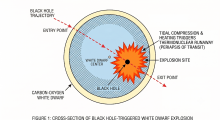
A new study including Kavli IPMU's Ken'ichi Nomoto suggests when primordial black holes trigger some Type Ia supernovae, it causes a chemical abundance trend.
17 Jul 2026
Hiroshima University
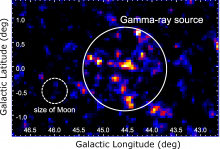
An accelerator of the highest-energy protons in our galaxy has been identified; it could help scientists better understand the nature of these fast-moving particles that fill the space between stars.
15 Jun 2026
Hiroshima University
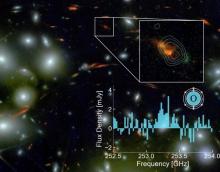
Astronomical observations provide new insights into how galaxies formed and grew during the Universe's first billion years
14 May 2026
Kavli Institute for the Physics and Mathematics of the Universe (Kavli IPMU)
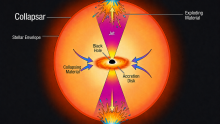
Researchers have cracked the mystery behind billions of supernova explosions around the Perseus constellation using new stellar and supernova models.

07 Feb 2025
Kavli Institute for the Physics and Mathematics of the Universe (Kavli IPMU)
Kavli IPMU researchers are part of an international team that has found dark matter dominating the halos of two supermassive black holes 13 billion light years away.

04 Feb 2025
National Taiwan University
An astronomer witnesses the gas flowing out from a galaxy 12 billion years ago, shutting down the star formation activity in the early Universe.

30 Aug 2024
Kavli Institute for the Physics and Mathematics of the Universe (Kavli IPMU)
A team including the Kavli IPMU has observed a pair of galaxies merging 12.8 billion years ago, forming one of the brightest objects in the early Universe. These results will help us understand the early evolution of galaxies and black holes.
01 Feb 2024
Hokkaido University
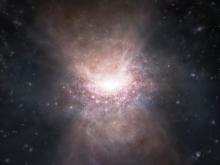
Theoretical predictions have been confirmed with the discovery of an outflow of molecular gas from a quasar when the Universe was less than a billion years old.
23 Mar 2023
Kavli Institute for the Physics and Mathematics of the Universe (Kavli IPMU)
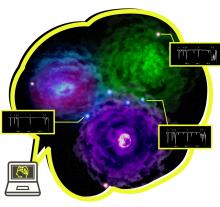
Machine learning and state-of-the-art supernova nucleosynthesis has helped researchers find that the majority of observed second-generation stars in the universe were enriched by multiple supernovae.
27 Oct 2022
Tohoku University
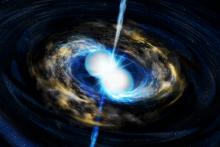
When two neutron stars merge, the resultant explosion forms heavy elements—many of which make up our Universe. A new study has, for the first time, identified the specific rare-earth elements produced in a neutron star merger.
18 Jan 2022
Kavli Institute for the Physics and Mathematics of the Universe (Kavli IPMU)
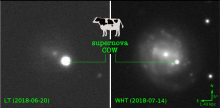
COW and GEP are new types of exploding stars. Researchers have succeeded in explaining the features of a new type of supernova which appears ten to a hundred times brighter at its peak, and with a much faster rise toward the peak compared to an ordinary supernova.
08 Feb 2021
Kavli Institute for the Physics and Mathematics of the Universe (Kavli IPMU)
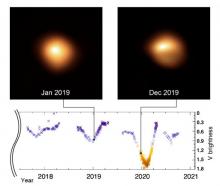
Betelgeuse is normally one of the brightest, most recognizable stars of the winter sky, marking the left shoulder of the constellation Orion. But lately, it has been behaving strangely: an unprecedentedly large drop in its brightness has been observed in early 2020 (Figure 1), which has prompted speculation that Betelgeuse may be about to explode.
02 Dec 2020
Kavli Institute for the Physics and Mathematics of the Universe (Kavli IPMU)
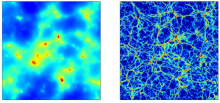
A research team including Kavli IPMU Principal Investigator Naoki Yoshida has, in a world first, succeeded in performing a 6-dimensional simulation of neutrinos moving through the universe.
13 Nov 2020
Kavli Institute for the Physics and Mathematics of the Universe (Kavli IPMU)
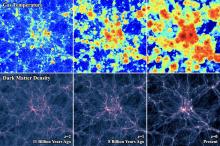
How hot is the Universe today? How hot was it before? A new study by an international team of researchers, including members of the Kavli Institute for the Physics and Mathematics of the Universe (Kavli IPMU), suggests that the mean temperature of gas in large structures of the Universe has increased about 3 times in the last 8 billion years, to reach about two million Kelvin today.
30 Mar 2020
Kavli Institute for the Physics and Mathematics of the Universe (Kavli IPMU)
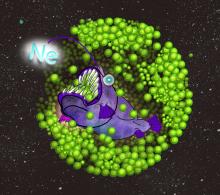
Neon inside a certain star core can eat so many electrons, it causes the star to collapse into a neutron star and produce a supernova.
14 Feb 2020
National Astronomical Observatory of Japan (NAOJ)
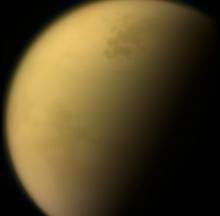
Planetary scientists using ALMA revealed the secrets of the atmosphere of Titan, the largest moon of Saturn.

05 Feb 2020
Kavli Institute for the Physics and Mathematics of the Universe (Kavli IPMU)
The origin of how the Universe created its voids and filaments can now be studied within seconds after researchers developed an artificial intelligence tool called Dark Emulator.
23 Dec 2019
National Astronomical Observatory of Japan (NAOJ)
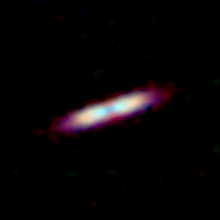
Astronomers using the Atacama Large Millimeter/submillimeter Array (ALMA) found a young star surrounded by an astonishing mass of gas.
16 Dec 2019
National Astronomical Observatory of Japan (NAOJ)
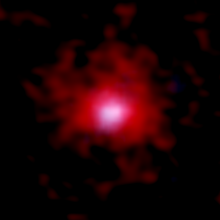
Researchers have discovered gigantic clouds of gaseous carbon more than a radius of 30,000 light-years around young galaxies using ALMA.
25 Nov 2019
National Astronomical Observatory of Japan (NAOJ)
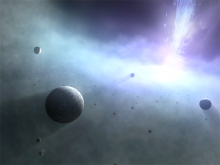
Theoreticians in two different fields defied the common knowledge that planets orbit stars like the Sun. They proposed the possibility of thousands of planets around a supermassive black hole.
14 Nov 2019
National Astronomical Observatory of Japan (NAOJ)
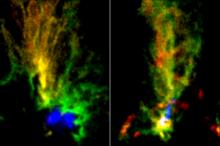
Two peacock-shaped gaseous clouds were revealed in the Large Magellanic Cloud by observations with Atacama Large Millimeter/submillimeter Array.
20 Mar 2019
National Astronomical Observatory of Japan (NAOJ)
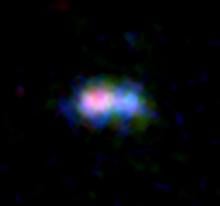
Researchers have detected a radio signal from abundant interstellar dust in MACS0416_Y1, a galaxy 13.2 billion light-years away in the constellation Eridanus. Standard models can’t explain this much dust in a galaxy this young, forcing us to rethink the history of star formation.
13 Mar 2019
National Astronomical Observatory of Japan (NAOJ)
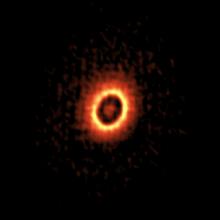
Researchers spotted the formation sites of planets around a young star resembling our Sun. Two rings of dust around the star, at distances comparable to the asteroid belt and the orbit of Neptune in our Solar System, suggest that we are witnessing the formation of a planetary system similar to ours.
13 Mar 2019
National Astronomical Observatory of Japan (NAOJ)
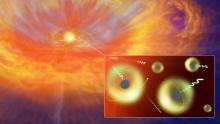
A team of experts in nuclear fusion and astronomy has computed high-accuracy atomic data for analyzing light from a kilonova, a birth place of heavy elements. They found that their new data set could predict kilonovae brightness with much better accuracy than before. This aids our understanding of the cosmic origins of heavy elements.
28 Feb 2019
National Astronomical Observatory of Japan (NAOJ)
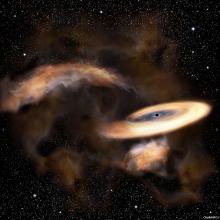
Astronomers have detected a stealthy black hole from its effects on an interstellar gas cloud. This intermediate mass black hole is one of over 100 million quiet black holes expected to be lurking in our Galaxy. These results provide a new method to search for other hidden black holes and help us understand the growth and evolution of black holes.
26 Feb 2019
National Astronomical Observatory of Japan (NAOJ)
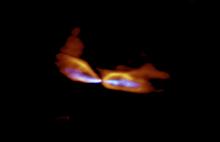
Astronomers have unveiled the origins of two different gas streams from a baby star. Using ALMA, they found that the slow outflow and the high speed jet from a protostar have misaligned axes and that the former started to be ejected earlier than the latter. These indicate that streams were launched from different parts of disk around the protostar.
30 Nov 2018
National Astronomical Observatory of Japan (NAOJ)
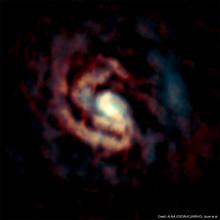
Based on computer simulations and new observations from ALMA, researchers have found that the rings of gas surrounding active supermassive black holes are not simple donut shapes. Instead, gas expelled from the center interacts with infalling gas to create a dynamic circulation pattern, similar to a water fountain in a city park.
27 Sep 2018
Kavli Institute for the Physics and Mathematics of the Universe (Kavli IPMU)
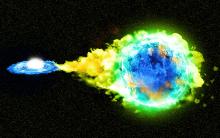
Researchers have found white dwarf stars with masses close to the maximum stable mass are likely to produce large amounts of manganese, iron, and nickel after it orbits another star and explodes.

14 Feb 2018
Tohoku University
Thermodynamics provides insight into the internal energy of a system and the energy interaction with its surroundings. This relies on the local thermal equilibrium of a system.