

Physical Review B
About Physical Review B
Physical Review B (PRB) is the largest and most comprehensive international journal specializing in condensed matter and materials physics phenomena.
- Website: https://journals.aps.org/prb/
- Current Issue: https://journals.aps.org/prb/recent
News
25 Aug 2026
Ehime University
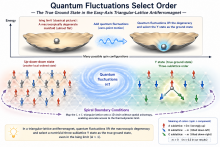
We study the ground state of the spin-1/2 XXZ antiferromagnet on the triangular lattice in the easy-axis regime using density-matrix renormalization group with spiral boundary conditions. The ordered state remains a nontrivial three-sublattice Y-like structure over a wide anisotropy range. Extrapolation shows incomplete sublattice polarization even in the Ising limit. Energy comparisons demonstrate that the Y state is favored over the up-down-down state, stabilized by quantum fluctuations from the degenerate Ising manifold.

27 Jan 2026
Singapore University of Technology and Design
Researchers have developed a new strategy to overcome a long-standing limitation in plasmonic loss by reshaping light–matter interactions through substrate engineering.
18 Sep 2025
Ehime University
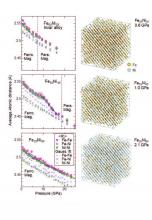
Element-selective atomic-scale observations of the magnetovolume effect in ferromagnetic Fe-Ni fcc-based alloys

11 Mar 2025
Osaka Metropolitan University
Scientists develop simplified formulas to quantify quantum entanglement in strongly correlated electron systems
10 Jan 2025
Ehime University
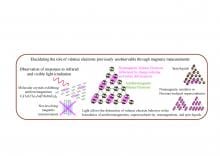
Quantum criticality induced by “lazy” valence electrons

21 Nov 2024
Ehime University
We have proposed methods for calculating topological numbers of two-dimensional lattice systems based on polarization and spiral boundary conditions.

30 Jan 2024
Osaka Metropolitan University
A theoretical framework for measuring the Reynolds similitude in superfluids could help demonstrate the existence of quantum viscosity
21 Sep 2023
Tohoku University
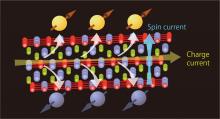
A recent discovery in spintronics could potentially transform future electronics. A group of researchers have revealed the key role of cobalt-tin-sulfur in reducing energy consumption, unlocking new possibilities for high-speed, low-power spintronic devices.
08 Nov 2022
Osaka Metropolitan University
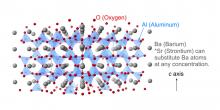
Osaka Metropolitan University scientists have discovered that, in the crystalline solid Ba1-xSrxAl2O4, a highly disordered atomic arrangement is formed in the AlO4 network at chemical compositions near the structural quantum critical point, resulting in characteristics of both crystalline and amorphous materials. This hybrid state, which the research team was the first to discover, can be created simply by mixing raw materials uniformly and heating them. These findings are expected to help with the development of hybrid materials for use in harsh environments, such as outer space, by applying the technique to a variety of materials.

31 May 2022
Osaka Metropolitan University
Dr. Nishikawa at Osaka Metropolitan University focused on the Kondo effect on minimal ferrimagnetism and attempted to elucidate it theoretically. As a result, they found that the Kondo effect occurred via multiple "quantum entangled states" depending on temperature and other factors. They also found that the Kondo effect suppressed electrical conductivity through minimal ferrimagnetism, when usually it is amplified in many other cases.
30 Jul 2020
Tohoku University
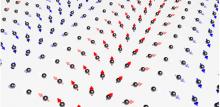
The electron is an elementary particle, a building block on which other systems evolve. With specific properties such as spin, or angular momentum, that can be manipulated to carry information, electrons are primed to advance modern information technology. An international collaboration of researchers has now developed a way to extend and stabilize the lifetime of the electron's spin to more effectively carry information.