

Sustainable Cities and Society
About Sustainable Cities and Society
Sustainable Cities and Society (SCS) is an international journal focusing on fundamental and applied research aimed at designing, understanding, and promoting environmentally sustainable and socially resilient cities.
News
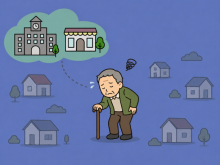
26 Jun 2026
Osaka Metropolitan University
Location Optimization Plan associated with higher caseloads in small municipalities
08 Jun 2026
Kanazawa University
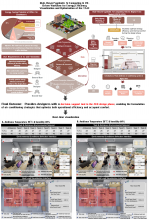
In the context of global decarbonization, reducing energy consumption in the building sector is an urgent issue. We have developed a next-generation building energy evaluation model that combines rule-based symbolic AI computing with VR technology. This model enables real-time visualization and simultaneous evaluation of the energy-saving effects and indoor thermal comfort during the design stage of a Zero-Energy Building. This approach will have a wide range of applications in the design of next-generation smart buildings.
20 May 2026
Singapore University of Technology and Design
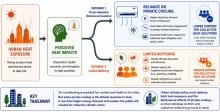
New research from Singapore University of Technology and Design and the Singapore-ETH Centre finds that private cooling may protect people from heat while reducing the perceived urgency of broader urban climate solutions — a pattern the researchers call “behavioural insulation”.
13 Jan 2026
National Taiwan University
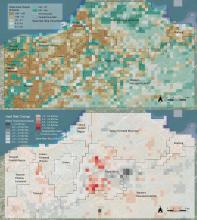
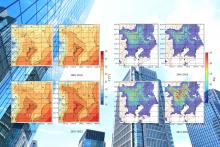
A decade-long study of Northern Taiwan's cities reveals that heat risk inequality evolves with urbanisation characteristics and the connection between green space deficit and heat risk was not a general phenomenon.
01 Sep 2025
Institute of Industrial Science, The University of Tokyo (UTokyo-IIS)
Researchers led by Associate Professor Hideki Kikumoto at the Institute of Industrial Science, The University of Tokyo fuse regional climate datasets and local weather observations to find a significant rise in urban temperatures and heatwaves in Tokyo

06 May 2025
National Taiwan University
Researchers from National Taiwan University reveal how electric scooter battery-swapping systems can enhance grid flexibility and support urban decarbonization.
03 Sep 2021
Hiroshima University
The COVID-19 pandemic has increased attention on links between public health and the planet’s health — areas traditionally addressed in separate science and policy circles. Now, an international research collaboration conducted the first comprehensive review of urban climate change responses and potential human health improvements.
16 Apr 2021
Hiroshima University
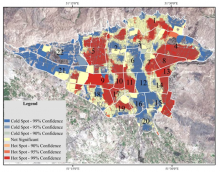
A person who owns a car or who has a college education may be less vulnerable to COVID-19, according to an analysis of cases in Tehran, Iran, one of the early epicenters of the pandemic. While such variables do not inherently lower a person’s risk, they do indicate an infrastructure of protection that persists despite how densely populated a person’s district might be.