

Journal of Fluid Mechanics
News
22 Jul 2026
Tohoku University
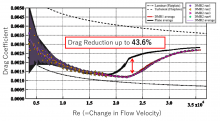
Logically, you would think a sleek surface has optimal aerodynamics – but recent research at Tohoku University turns this fundamental principle completely on its head. Applying an irregular microscale surface texture reduced the aerodynamic drag of a test model. The innovation has potential applications for designing fuel-efficient vehicles.
12 Feb 2026
The University of Osaka
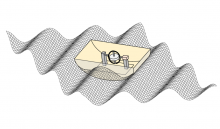
Research from The University of Osaka highlights a new model of a gyroscopic wave energy converter. The device was shown to be capable of absorbing up to half of incoming wave energy across a wide range of frequencies, meaning it could achieve the theoretical maximum efficiency. These results provide important design insights for more efficient and adaptable wave energy technologies.
22 Sep 2025
The University of Osaka
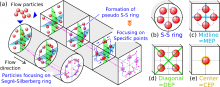
A joint team has uncovered how soft, deformable particles, like cells, behave in microfluidic channels. Using precisely fabricated hydrogel particles and simulations on the supercomputer "Fugaku," they demonstrated that particle softness dramatically alters their focusing patterns, deviating significantly from rigid particle behavior. These findings reveal distinct "phase transitions" in focusing, shifting from mid-edge to eight-point, diagonal-edge, and finally center focusing as deformability increases. This breakthrough, explained by a new theoretical model incorporating inertia and deformability, offers crucial insights for designing next-generation microfluidic devices for highly efficient cell sorting and other biomedical applications like early cancer detection. The ability to control particle focusing based on deformability opens exciting possibilities for advanced particle manipulation and separation technologies.