

Engineering & Technology Chemical Engineering
News

23 Aug 2023
An international team of researchers has developed novel bio-degradable rigid foams derived from pineapple waste, showcasing impressive properties. Starch and cellulosic materials are key components of the foams, which are processed via microwave gel formation and filler blending. The foams feature high strength, and rapid biodegradation, with potential for practical use from packaging, to construction, automotive, and aerospace.

19 Aug 2023
In a study recently published in the journal Nanoscale, researchers from Kanazawa University and AGC Inc. use three-dimensional atomic force microscopy to study the hydrated form and structure of commonly occurring oxide crystals.

03 Aug 2023
Dr. Zhang Yi, the lead scientist, and his team of researchers from Canada, Singapore, the UK, have successfully completed a study, comparing the efficiency of various bioreactors in producing Raspberry Ketone through Submerged Fermentation. This research marks the first time such a study has been conducted.

05 Jul 2023
A new method for connecting neurons in neuromorphic wetware has been developed by researchers from Osaka University and Hokkaido University. The wetware comprises conductive polymer wires grown in a three-dimensional configuration, done by applying square-wave voltage to electrodes submerged in a precursor solution. The voltage can modify wire conductance, allowing the network to be trained. This fabricated network is able to perform unsupervised Hebbian learning and spike-based learning.

18 Jun 2023
A team of researchers from universities in Thailand and Malaysia have collaborated to develop a unique kind of bioplastic sheet that is good for the environment and can decompose naturally. They made this bioplastic sheet using a byproduct of the bromelain industry which used the leftover pineapple stems from agricultural waste. This new type of bioplastic sheet has the potential to be used as single-use packaging material, as an alternative to the use of harmful plastic sheet, contributing to a more sustainable way of doing business and promoting a circular economy.

07 Jun 2023
Scientists from Thailand, France and Singapore have conducted groundbreaking research using both tiny cellulose nanofibers (CNF) and long pineapple leaf fibers (PALF) to create stronger materials. They added varying amounts of CNF to epoxy and found that 1% CNF greatly increased impact strength. PALF-epoxy composites showed significant flexibility and strength improvements. Combining CNF and PALF resulted in a remarkable increase in impact strength. The findings could revolutionize stronger material development.
11 May 2023
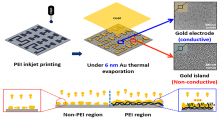
- DGIST Professor Hongki Kang’s team developed technology for selective photothermal layer formation and a transparent electrode based on a fine inkjet printing solution process.
- This has potential to efficiently measure various body signals through a flexible fine electrode array customized for patients.
- The research results are published in ACS Applied Materials & Interfaces.

06 Apr 2023
An international interdisciplinary team of researchers hailed from India, Malaysia, Singapore and Thailand has successfully developed a method of using chitosan from terrestrial insects to manufacture eco‐friendly polymer composite parts using the 3D printing method.

05 Apr 2023
We sat down with Dr. Ji Ha Lee to get to know her and her work on developing recyclable and degradable gels that can replace plastics as well as nanogels that can help with targeted drug delivery.

27 Mar 2023
An Osaka Metropolitan University joint research group has discovered that near-infrared absorbing dyes, which had previously been considered to have closed-shell electronic structures, have an intermediate electronic structure, between closed- and open-shell structures. They also found that as the wavelength of near-infrared light that can be absorbed becomes longer the contribution of open-shell forms increases within the dye. These newly discovered characteristics are expected to be utilized to develop new near-infrared absorbing dyes that can absorb longer wavelength near-infrared light.
24 Mar 2023
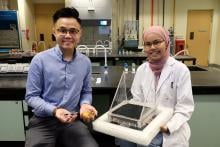
Scientists in Singapore converted fruit waste into a solar absorber called Mxene to develop an efficient and sustainable water desalination process.

14 Mar 2023
In a study recently published in the journal ACS Nano, published by American Chemical Society, researchers from Kanazawa University, Kanazawa, Japan, collaborating with University of Washington, Seattle, USA, used frequency modulated atomic force microscopy to reveal the molecular architecture of a genetically designed peptide and its self-organization that forms single-molecule thick crystals on atomically flat graphite surfaces, that offer a potential platform for hybrid technologies such as bioelectronics, biosensors, and protein arrays.

23 Feb 2023
Scientists from Oil Crops Research Institute (OCRI) of Chinese Academy of Agricultural Sciences (CAAS), Anhui Agricultural University (Anhui, China), Newcastle University in Singapore, and Huizhou Comvikin Biotechnology Co., Ltd (Guangdong, China) have developed a green and efficient approach to synthesize highly liposoluble and antioxidant L-ascorbyl esters by immobilized lipases.
21 Dec 2022
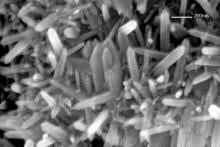
Researchers at The University of Tokyo develop a simple but effective method of bonding polymers with galvanized steel, a material ubiquitous in the automobile industry, to cheaply and easily create a lightweight and durable product.

26 Oct 2022
Researchers from Osaka University have demonstrated a proof-of-concept for a novel molecular hydrogen production method that bypasses the need for expensive purification steps. They developed a system where hydrogen is separated and stored in liquid organic hydrogen carriers by catalysis of triaryl boranes in one seamless process. The results of this work will help facilitate the transition to a hydrogen-based economy that is necessary for a more sustainable future.
17 Oct 2022
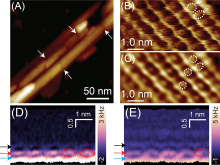
Chemists in Japan, Canada and Europe have uncovered flaws in the surface structure of cellulose nanocrystals—an important step toward deconstructing cellulose to produce renewable nano-materials relevant to biochemical products, energy solutions, and biofuels.

16 Sep 2022
Scientists from The University of Tokyo formulated nonlinear, nonequilibrium energy dissipation relationships using methods from geometry to better understand the kinetics of irreversible chemical processes
10 Aug 2022
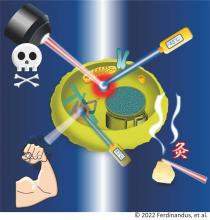
Researchers at Kanazawa University report in ACS Nano the development of a nanoparticle that acts as a heater and a thermometer. Inserting the nanoparticle in living cells results in a heat spot that, by switching it on and off, enables the controlled modulation of local cellular activities.
11 Jul 2022
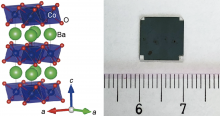
A thermoelectric metal oxide film with a thermoelectric figure of merit of ~0.55 at 600°C has been discovered, opening new avenues towards the widespread use of thermoelectric converters.
14 Mar 2022
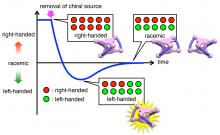
Researchers at Kanazawa University report in Proceedings of the National Academy of Sciences a responsive molecular system that, through chemical reactions, inverses its chirality before becoming racemic.

25 Feb 2022
A Japanese research team created a new way to sort living cells suspended in fluid using an all-in-one operation in a lab-on-chip that required only 30 minutes for the entire separation process.
20 Feb 2022
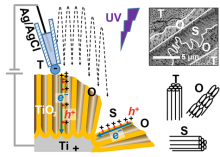
In a recent study published in the journal ACS Catalysis researchers from Kanazawa University describe novel scanning electrochemical cell microscopy measurements to determine sites of photoelectrochemical activity in titanium dioxide nanotubes.
29 Oct 2021
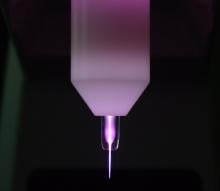
A collaborative project between the Osaka City University Graduate Schools of Medicine and BioMedical Engineering Center (BMEC) revealed new bone formation in critical bone defects of animal model with an exposure to a pencil-type non-thermal atmospheric-pressure plasma at surgery.
19 Oct 2021
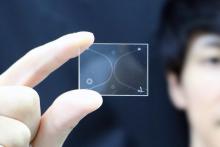
When liquid meets gas, a unique zone forms. Variable by nature, molecules can cross from one state to another, combining in unique ways to either desirable or unwanted ends. From heat escaping a mug of coffee to increasing molecular concentrations in chemical solutions, gas-liquid interfaces are ubiquitous across nature and engineering. But a lack of tools capable of precisely controlling such gas-liquid interfaces limit their applications — until now.
09 Sep 2021
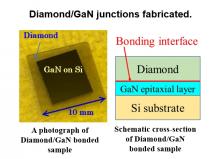
Researchers succeed in the direct bonding of diamond and gallium nitride (GaN) at room temperature and demonstrate that the bond can withstand heat treatments of 1,000℃, making it ideal for the high temperature fabrication process of GaN-based devices. GaN-on-diamond semiconductor material will allow for the next generation of high power, high frequency devices.

02 Aug 2021
The Research Center for Thin Film Solar Cell, DGIST succeeded achieving the world’s highest PCE of 12.2% for flexible CZTS thin film solar cells.
18 Jun 2021
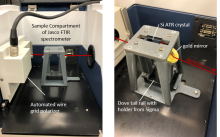
Researchers at Osaka Prefecture University have established an approach to identify the orientation of molecules and chemical bonds in crystalline organic-inorganic hybrid thin films deposited on substrates using Fourier transform infrared spectroscopy (FT-IR) and polarized infrared light with a 3D-printed attenuated total reflectance (ATR) unit. This inexpensive method with laboratory-grade equipment quickly reaches the crystal-structure model of even extremely thin films of less than 10 nm.
01 Jun 2021
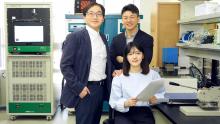
Researchers from Korea utilized LiNO3 pre-planted lithium particles to design a stable, long-lasting lithium metal battery
28 May 2021
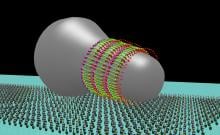
In collaboration with Kanazawa University, researchers from Osaka City University used high-speed atomic force microscopy (HS-AFM) to visualize at the nanometer level the movement of individual particles within the parasitic bacterium Mycoplasma mobile. After confirming the outline on the surface of the cell structure in an immobilized state with previous data gathered from electron microscopy, the team succeeded in visualizing the real-time movements of the internal structure by scanning the outside of the cell with HS-AFM.
20 Apr 2021
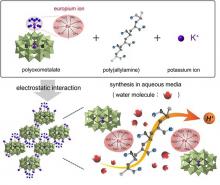
Protons are the next big thing when it comes to fuel cell technology. The subatomic exchange produces power on a scale that challenges contemporary solid-state fuel cell technology, used to help power space shuttles. To realize the proton-based technology sooner, an international team of researchers have developed a hybrid material that effectively transports protons at high temperatures and humidity — two major challenges in past attempts.
Events
Sorry, nothing coming up for this discipline
Researchers
Sorry, nothing coming up for this discipline
Giants in history
Sorry, nothing coming up for this discipline