

Computer Science Quantum computing
News
26 Oct 2026
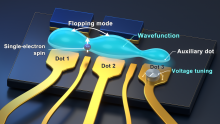
Researchers at the University of Osaka developed an “orbital band engineering” approach that adds an auxiliary quantum dot to semiconductor spin qubits. Electrically tuning the extra dot helped balance fast operation with resistance to electrical noise, two properties that normally compete. Combined with machine-learning-based frequency correction, the method enabled fast, high-fidelity qubit control and could provide a useful strategy for post-fabrication tuning and scaling of semiconductor quantum computers.
01 Sep 2026
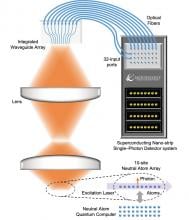
A research group in Japan led by Professor YAMAMOTO Takashi, Deputy Director, Center for Quantum Information and Quantum Biology / Graduate School of Engineering Science, the University of Osaka, in collaboration with the National Institute of Information and Communications Technology (NICT) and Hamamatsu Photonics K.K., has successfully demonstrated a world-record 10-channel multiplexed quantum photonic interface based on an integrated waveguide array, a key technology for optically interconnecting multiple quantum computers.
25 Aug 2026
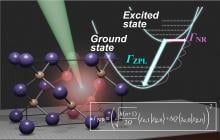
Researchers from the University of Osaka have developed a fast computational framework that predicts the optical performance of quantum color centers without being restricted to a specific host material. By replacing computationally intensive calculations with simple theoretical formulas and procedures, the method enables rapid screening of promising quantum materials spanning ultraviolet to telecommunication wavelengths.
09 Jun 2026
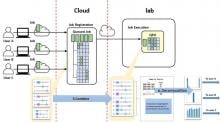
Researchers from The University of Osaka, SEC, and Juntendo University have developed quantum multi-programming auto mode, a function that automatically runs quantum programs from different users in parallel. Implemented in OQTOPUS and launched on QIQB’s quantum computer cloud service, the system reduces idle qubit resources, improves throughput, and may help ease congestion in quantum cloud computing.
01 Apr 2026
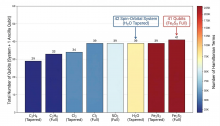
A joint research team between the Center for Quantum Information and Quantum Biology (QIQB) at The University of Osaka and Fixstars Corporation has demonstrated one of the world's largest classical simulations of iterative quantum phase estimation (IQPE) quantum circuits for quantum chemistry on up to 1,024 GPUs, surpassing the previous 40-qubit limit. The result expands the scale of molecular systems available for the development and validation of quantum algorithms for future fault-tolerant quantum computers, supporting progress toward industrial applications in drug discovery and materials development.
30 Mar 2026
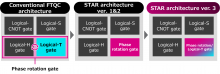
Fujitsu Limited and the Center for Quantum Information and Quantum Biology at The University of Osaka today announced the development of a new technology designed to accelerate the industrial application of quantum computers in the era of early fault-tolerant quantum computing (early-FTQC). By combining ver. 3 of the STAR architecture, a unique highly efficient phase rotation gate quantum computing architecture, with a novel molecular model optimization technique, researchers have significantly reduced computational resource requirements. This breakthrough will enable the energy calculations for chemical material design such as catalyst molecules, within a realistic timeframe using early-FTQC quantum computers. These kinds of calculations are currently not possible using current computers, and would take millennia even using previous versions of the STAR architecture. The technologies are expected to contribute to solving various societal challenges, including accelerating drug discovery, improving the efficiency of ammonia synthesis processes, and advancing carbon recycling technologies.
27 Jan 2026
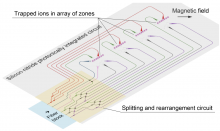
Researchers from The University of Osaka have developed a unique approach to delivering laser light through photonic circuitry for controlling the states of trapped ions, representing a potential novel method for overcoming challenges in quantum computing technology.
24 Dec 2025
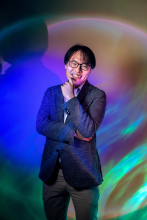
Professor Keisuke Fujii, a leading researcher in quantum science at The University of Osaka, has been named among the Quantum 100, a major global initiative celebrating the centennial of the development of quantum mechanics in 2025, proclaimed by the United Nations and led by UNESCO.

08 Aug 2025
A Japanese superconducting quantum computer, designed and built with homegrown components and software, went live on July 28th at The University of Osaka’s Center for Quantum Information and Quantum Biology (QIQB). This achievement signifies Japan's technological prowess in quantum computing, demonstrating the nation's capacity to design, manufacture, and integrate a complete quantum system. Visitors to Expo 2025, Osaka, Kansai, Japan will have the opportunity to interact with this cutting-edge technology through a dedicated exhibit.

05 Aug 2025
A joint research team from Japan has observed "heavy fermions," electrons with dramatically enhanced mass, exhibiting quantum entanglement governed by the Planckian time – the fundamental unit of time in quantum mechanics. This discovery opens up exciting possibilities for harnessing this phenomenon in solid-state materials to develop a new type of quantum computer.

04 Aug 2025
A research team led by SUTD proposes a quantum-enhanced framework for processing complex topological signals that could one day outperform classical methods in recommendation systems, network science, and more.

20 Jun 2025
Researchers from The University of Osaka have developed a way to efficiently prepare the “magic states” necessary for quantum computers to be resistant to errors. Their technique, called “zero-level distillation,” involves working with qubits at the physical or zeroth level as opposed to higher, more abstract levels. The spatial and temporal overhead of quantum computers prepared from these states using this technique is around several dozen times lower than that of those prepared from conventional methods.

28 Aug 2024
Fujitsu and Osaka University accelerate progress toward practical quantum computing by significantly increasing computing scale through error impact reduction in quantum computing architecture
09 Jan 2024
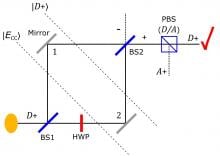
What actually happens is much weirder, and may help us understand more about quantum mechanics
31 Jul 2023
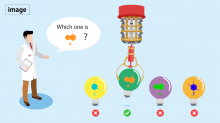
Researchers from Osaka University have demonstrated a proof-of-concept for identifying single nucleotides by using quantum computing. Molecular rotation patterns—and the corresponding variations in conductance—within the nanoscale gap between two electrodes enabled the development of a quantum gate for the nucleotide adenosine monophosphate. Developing quantum gates for the other three nucleotides, and incorporating this technology into DNA sequencing workflows, could revolutionize genome analysis.
26 Nov 2021
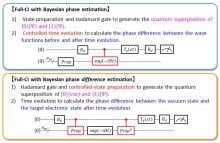
In a continuing effort to improve upon previous work, a research team at the Graduate School of Science, Osaka City University, have applied their recently developed Bayesian phase difference estimation quantum algorithm to perform full configuration interaction (full-CI) calculations of atoms and molecules without simulating the time evolution of the wave function conditional on an ancillary qubit. Superior to conventional methods in terms of parallel execution of quantum gates during quantum computing, this new algorithm is expected to be much easier to implement in actual quantum computers.
02 Sep 2021
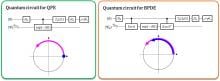
Researchers have developed a general quantum algorithm that can directly calculate the energy difference of an atom and molecule using a quantum computer. By avoiding the need to calculate the total molecular energies, the general algorithm is expected to be applied not only to quantum chemical calculations but also to various physical and mathematical problems, which are intractable with nowadays classical computers.
04 Aug 2021
Combining two magnetic effects can manipulate the magnetic behaviours of a device, offering a novel opportunity for the next generation IT technologies.

17 Mar 2021
Researchers improve their newly established quantum algorithm, bringing it to one-tenth the computational cost of Quantum Phase Estimation, and use it to directly calculate the vertical ionization energies of light atoms and molecules such as CO, O2, CN, F2, H2O, NH3 within 0.1 electron volts of precision.
30 Oct 2020
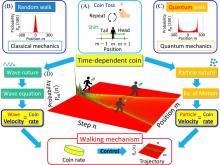
A research team based in Japan may be moving toward a more controlled walk by unveiling the mechanism underlying the directional decision of each quantum step and introducing a way to potentially control the direction of movement.
25 Sep 2020
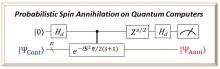
Researchers at Osaka City University create a quantum algorithm that removes spin contaminants while making chemical calculations on quantum computers. This allows for predictions of electronic and molecular behavior with degrees of precision not achievable with classical computers and paves the way for practical quantum computers to become a reality.
09 Jul 2020
Scientists in Korea explain a new process that maximizes photon conversion in 2D materials, which could innovate photonic-based applications
21 Oct 2019
Project to explore new methodologies and use cases in the fields of quantum-inspired computing and artificial intelligence with the world’s 1st on-premises installation of Fujitsu Digital Annealer at SMU in Singapore.

19 Jun 2018
Leading quantum computing experts from around the world have explored what the future holds for the field in a new special collection in the journal Quantum Science and Technology (QST).

31 May 2018
A new theoretical model involving squeezing light to just the right amount to accurately transmit information using subatomic particles is bringing us closer to a new era of computing.
31 May 2018
Although blockchain is traditionally seen as secure, it is vulnerable to attack from quantum computers.

04 Dec 2017
A theoretical model will allow systematic study of a promising class of peculiar quantum states.

08 May 2017
The Tohoku University research group of Professor Keiichi Edamatsu and Postdoctoral fellow Naofumi Abe has demonstrated dynamically and statically unpolarized single-photon generation using diamond.
Events
Sorry, nothing coming up for this discipline
Researchers
Sorry, nothing coming up for this discipline
Giants in history
Sorry, nothing coming up for this discipline