
Space sciences
News
30 Jan 2019
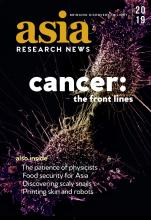
The 2019 issue of Asia Research News magazine features fascinating advances in medicine, technology, social sciences, space and environment from across Asia.
29 Jan 2019
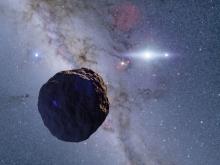
For the first time ever, astronomers have detected a 1.3 km radius body at the edge of the Solar System. Kilometer sized bodies like the one discovered have been predicted to exist for more than 70 years. These objects acted as an important step in the planet formation process between small initial amalgamations of dust and ice and the planets.

17 Dec 2018
A Japan-Spain team has developed a powerful 4-color simultaneous camera named MuSCAT2 for the 1.52-m Telescopio Carlos Sánchez at the Teide Observatory. The instrument aims to find transiting exoplanets, including Earth-like habitable planets orbiting stars near the Sun, in collaboration with NASA’s Transiting Exoplanet Survey Satellite.
10 Dec 2018
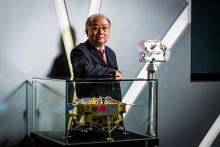
The Hong Kong Polytechnic University (PolyU) proudly supports the nation’s current lunar exploration, Chang’e-4 lunar probe, with advanced technologies.
04 Dec 2018
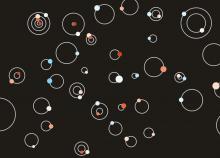
An international team of astronomers using a combination of ground and space based telescopes have reported more than 100 extrasolar planets (here after, exoplanets) in only three months. These planets are quite diverse and expected to play a large role in developing the research field of exoplanets and life in the Universe.
30 Nov 2018
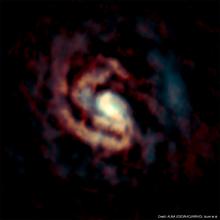
Based on computer simulations and new observations from ALMA, researchers have found that the rings of gas surrounding active supermassive black holes are not simple donut shapes. Instead, gas expelled from the center interacts with infalling gas to create a dynamic circulation pattern, similar to a water fountain in a city park.
22 Nov 2018
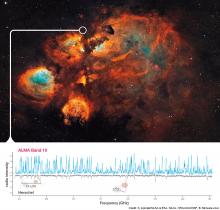
ALMA has tuned in another new channel for signals from space. Using its highest frequency receivers yet, researchers obtained 695 radio signatures for various molecules in the direction of a massive star forming region. These first results from the ALMA Band 10 receivers developed in Japan ensure a promising future for high frequency observations.
12 Oct 2018
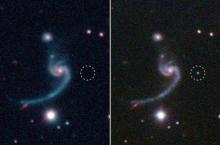
An international research team discovered the first recorded "ultra-stripped supernova," a rare, faint supernova that is believed to play a role in the formation of binary neutron star systems. These will advance our understanding of a variety of topics ranging from gravitational waves to the origin of precious metals like gold and platinum.

12 Oct 2018
Researchers have found a way to predict if it will be an El Niño or La Niña year up to 17 months in advance.
12 Oct 2018
Policy experts gather in Tokyo to discuss science advice in a changing world

01 Oct 2018
With rapidly increasing research output, Daegu Gyeongbuk Institute of Science and Technology applauded by Nature Index as a rising star.

18 Sep 2018
Dr. Sivaprakash Sengodan, 2015 Ph.D. graduate from South Korea's Ulsan National Institute of Science and Technology (UNIST), has been appointed as a professor at Imperial College of London.

18 Sep 2018
South Korea's Ulsan National Institute of Science and Technology (UNIST) has been selected for the 2018 Basic Research Projects in Science and Engineering.
18 Sep 2018
A graduate student from South Korea's Ulsan National Institute of Science and Technology (UNIST) has been selected for GRA-NRF Program in Canada.

27 Aug 2018
PolyU will collaborate with the China Academy of Space Technology to develop and produce a camera on the spacecraft to Mars scheduled for launch in 2020 at the earliest. The two parties signed the Collaborative Research and Development Agreement on Mars Exploration Project at a ceremony on 22 August 2018.

24 Aug 2018
The Milky Way galaxy has died once before and we are now in what is considered its second life. Calculations by Masafumi Noguchi (Tohoku University) have revealed previously unknown details about the Milky Way. These were published in the July 26 edition of Nature.
22 Aug 2018
PolyU will collaborate with the China Academy of Space Technology (CAST) to develop and produce a camera on the spacecraft to Mars scheduled for launch in 2020 at the earliest. The two parties signed the Collaborative Research and Development Agreement on Mars Exploration Project at a ceremony on 22 August 2018.
05 Jul 2018
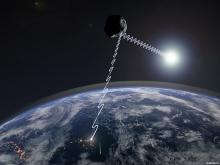
Based on a new study of how near-Earth asteroid Phaethon reflects light at different angles, astronomers think that its surface may reflect less light than previously thought. This is an exciting mystery for the recently approved DESTINY+ mission to investigate when it flies past Phaethon.
19 Jun 2018
Asia Research News magazine showcases your most fascinating research all year long, all around the world. Submit your research news for the 2019 magazine by 30 June.

14 Jun 2018
A team of Japanese scientists led by Masahiro Kayama of Tohoku University’s Frontier Research Institute for Interdisciplinary Sciences, has discovered a mineral known as moganite in a lunar meteorite found in a hot desert in northwest Africa.
08 Jun 2018
We want to give people a glimpse of researchers at work, this is why we are encouraging scientists to share photos of them at work. Send us photos of you at work by email to [email protected] or find us on Twitter @ResearchSEA.

10 May 2018
Supersonic gas streams left over from the Big Bang likely gave rise to early massive black holes.

19 Apr 2018
Dwarf galaxies and star-containing halos found 25 million light years away from Earth hint at how these halos are formed.

03 Apr 2018
An international team of researchers including the Kavli IPMU have observed the most distant individual star, 9 billion light years from Earth.

21 Mar 2018
The availability of high-resolution data collected by miniaturized satellites heralds a turning point in Earth and environmental sensing from space.

23 Feb 2018
An amateur astronomer testing his new camera captures the moment a supernova became visible in the night sky, which has helped an international team of researchers to test their theory about the beginning stages of a stellar explosion.
05 Feb 2018
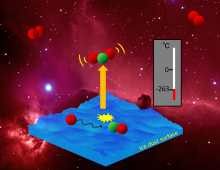
Researchers demonstrate how a gas escapes ice at an extremely cold temperature, providing insight about how stars form in interstellar clouds.

29 Jan 2018
The new Japanese facility, to be ready by the year’s end, will be Asia’s first detector and the world’s first below ground
Events
Sorry, nothing coming up for this discipline
Researchers
Sorry, nothing coming up for this discipline
Giants in history
Sorry, nothing coming up for this discipline