

Chem & Bio Engineering
News
19 Nov 2026
The University of Osaka
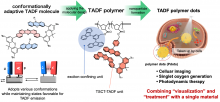
A team led by researchers at the University of Osaka, in collaboration with the University of British Columbia (UBC), has developed a novel polymer material allowing fluorescent cell imaging and potential light-activated disease treatment by generating cell-damaging singlet oxygen. In tests, tiny particles of this material, called polymer dots, retained their fluorescence in water, were taken up by cells, and enabled both imaging and light-triggered cell damage. Supported by JST's ASPIRE program, this international collaborative research lays the groundwork for multifunctional nanotheranostic technologies that integrate imaging and therapy within a single nanoscale platform.