

Environmental Science & Technology
About Environmental Science & Technology
Environmental Science & Technology reports impactful, groundbreaking, world-class research across a diverse range of environmentally relevant topics.
- Website: https://pubs.acs.org/journal/esthag?ref=breadcrumb
- Current Issue: https://pubs.acs.org/toc/esthag/current
News
28 Sep 2026
Ehime University
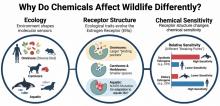
New Horizons in Sensitivity Assessment: Integrating Genetic Sequence Comparison, Machine Learning, In Silico, and In Vitro Analyses of Mammalian Estrogen Receptors

30 Mar 2026
Ehime University
Assessing the Impact of Chemical Contaminants on Finless Porpoises Using In Vitro Data and Mass Distribution Modeling
18 Mar 2026
City University of Hong Kong (CityUHK)
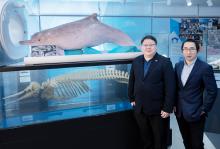
A research team from CityUHK, in collaboration with researchers from the Chinese Mainland, has found that LCMs from household electronics and e-waste can bioaccumulate in marine life, including the endangered Indo-Pacific humpback dolphins and finless porpoises. These compounds can penetrate the blood–brain barrier and accumulate in brain tissue, raising concerns about potential risks to the nervous system and other organs.
24 Feb 2026
Osaka Metropolitan University
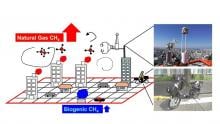
More thorough testing of methane and ethane emissions in Osaka, Japan, identified numerous natural gas-related large methane sources that were mostly overlooked in current predictions. These sources may be useful future targets for mitigating emissions.
20 Oct 2025
National Taiwan University
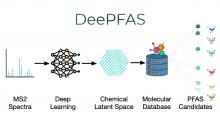
DeePFAS, a novel deep-learning model, streamlines large-scale non-targeted screening of "forever chemicals" (PFAS) by projecting raw MS2 spectra into a latent space of chemical features, offering a rapid, AI-driven solution to replace complex traditional analysis.
23 Sep 2025
Daegu Gyeongbuk Institute of Science and Technology (DGIST)
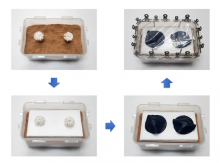
- A research team led by Professor Seongkyun Kim of the Department of Physics and Chemistry, DGIST, developed an artificial plant device that simulates plant transpiration
- Purified more than 95% of soil contaminated by radioactive cesium within 20 days using solar energy alone

14 Aug 2025
Daegu Gyeongbuk Institute of Science and Technology (DGIST)
- Confirmed protein-bound microplastics disrupt brain cells and potentially cause neurotoxicity
- Published findings in Environmental Science & Technology and registered in Hanbitsa (People Making Korea Shine)

03 Mar 2025
Ehime University
Comprehensive screening analysis of organohalogen compounds in blubber samples of 11 toothed whale species stranded on Japanese coasts revealed species-specific accumulation profiles, with a total of over 300 organohalogen compounds detected. For the first time, the composition profiles of marine natural products were found to be useful indicators of the feeding habitats and migration history of individual whale species.
16 Jan 2024
Ehime University
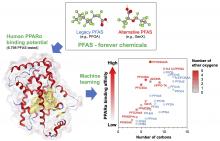
7000 forever chemicals (PFAS) and human PPARa binding properties predicted using AI technology
19 Dec 2022
Ehime University
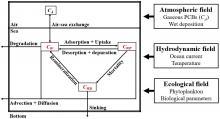
The Kuroshio regulates the air-sea exchange of PCBs
21 Nov 2022
Hiroshima University
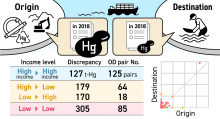
Study can help to assess effectiveness of Minamata Convention on Mercury
03 Sep 2021
Ehime University
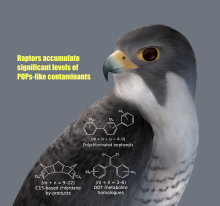
Knowledge of the detailed accumulation profiles of persistent organic pollutants (POPs) and POPs-like contaminants in wild animals is critical for ecological risk assessment. Comprehensive screening of organohalogen compounds in the livers of wild birds from Osaka, Japan using two-dimensional gas chromatography in combination with high resolution time-of-flight mass spectrometry (GC×GC–HRToFMS) revealed specific accumulation of typically unmonitored POPs-like compounds in raptors.
27 Jul 2021
Ehime University
Using neurons directly reprogrammed from tissues of stranded whales to assess brain health
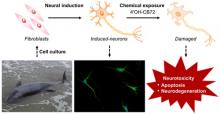
A research team of the Center for Marine Environmental Studies (CMES) of Ehime University, Japan succeeded for the first time in direct reprogramming of whale somatic cells to neuronal cells, and conducted a neurotoxicity test using these cells. Exposure to a metabolite (4′OH-CB72) of polychlorinated biphenyls, ubiquitous environmental pollutants, caused apoptosis in the reprogrammed neurons. Transcriptome analysis of 4′OH-CB72-treated whale neurons showed altered expressions of genes associated with oxidative phosphorylation, chromatin degradation, axonal transport, and neurodegenerative diseases.
16 Dec 2020
Ehime University
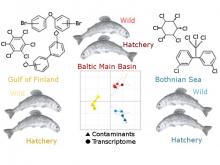
Researchers of Ehime University and the University of Helsinki measured hepatic organohalogen (OHC) concentrations and gene expression profiles in Atlantic salmon collected from three areas in the Baltic Sea. The results showed that OHCs and gene expression profiles were individually grouped in three areas and the covariation of the two datasets provided by a multivariate method was significantly similar. This suggests that the gene expression profiles in salmon are affected by OHC contamination.
14 Sep 2020
Ehime University
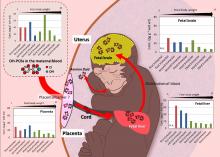
This study selected the Japanese macaque (Macaca fuscata) as a model animal for the fetal transfer of OH-PCBs in humans, and revealed OH-PCB concentrations and their relationships in the maternal and fetal brains. The key finding from this study is that OH-PCBs can reach the developing brain of the fetus as early as the first trimester of pregnancy. These OH-PCBs may exceed the levels that induce adverse effects on neurodevelopment.
20 Jul 2020
Ehime University
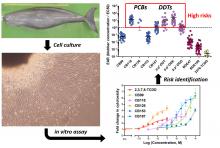
Environmental pollutants threaten the health of marine mammals. This study established a novel cell-based assay using the fibroblasts of a finless porpoise stranded along the coast of the Seto Inland Sea, Japan, to better understand the cytotoxicity and the impacts of environmental pollutants on the porpoise population. The results revealed that the concentrations of PCBs and DDTs which accumulated in the porpoise are likely to have an adverse effect at the cellular level.
03 Jun 2020
Ehime University
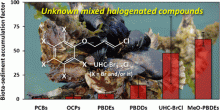
The present study screened known and unknown organohalogen compounds present in mussel and sediment samples from Hiroshima Bay. The results provided scientific evidence that unknown mixed halogenated compounds are ubiquitous in the coastal environment and possess bioaccumulative potential as high as persistent organic pollutants.
15 Apr 2019
Ehime University
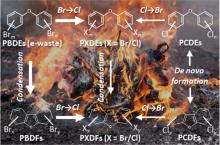
The composition of mixed brominated/chlorinated dibenzofurans (PXDFs) and diphenyl ethers in soils from an e-waste site in Ghana suggests a formation of PXDFs through condensation of the flame retardant PBDEs and subsequent bromine-to-chlorine exchange. PXDFs were substantial contributors of toxic equivalents among dioxins from e-waste burning.

29 Mar 2019
Ehime University
New research found that some man-made chemicals bind more easily to a key protein receptor in Russia's Baikal seals than it does in humans, in part because of the physical structure of the chemical.
27 Nov 2018
King Abdullah University of Science and Technology (KAUST)
An inexpensive hydrogel-based material efficiently captures moisture even from low-humidity air and then releases it on demand.
24 Jan 2018
Tohoku University
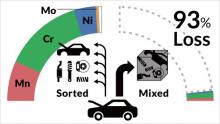
Detailed sorting of scrap car parts could boost recycling rates to over 97%, saving billions spent on new materials and slashing associated greenhouse gas emissions.

08 May 2014
Organization of Frontier Science and Innovation, Kanazawa University
Highlights of Prof. Hayakawa's research who is currently developing methods to identify metabolites of PAHs and NPAHs in urine and blood. Other work include developing the most sensitive method for measuring PAHs and NPAHs, showing that motorcycle engines released more particulate matter than automobiles and more

02 Aug 2005
Nature Publishing Group
Rice grown in the United States contains an average of 1.4-5 times more arsenic than rice from Europe, India and Bangladesh.