

International Journal of Disaster Risk Reduction
About International Journal of Disaster Risk Reduction
The International Journal of Disaster Risk Reduction (IJDRR) is the journal for researchers, policymakers and practitioners across diverse disciplines: earth sciences and their implications; environmental sciences; engineering; urban studies; geography; and the social sciences.
News

24 Jul 2025
The University of Osaka
Researchers at The University of Osaka developed a deep learning model for rapid building damage assessment after floods using satellite imagery. This research establishes the first systematic benchmark for this task and introduces a novel semi-supervised learning method achieving 74% of fully supervised performance with just 10% of the labeled data. A new, lightweight deep learning model named Simple Prior Attention Disaster Assessment Net or SPADANet significantly reduces missed damaged buildings, improving recall by over 9% compared to existing models. This work provides crucial design principles for future AI disaster response, enabling faster and more efficient life-saving operations.

29 Jan 2025
The University of Osaka
In a study on public psychology with regard to the COVID-19 pandemic, researchers from Osaka University found no significant differences among regions of Japan regarding either risk perception or infection-prevention behaviors during the “state of emergency,” suggesting spillover effects between targeted and non-targeted regions. However, risk perception diminished after restrictions were lifted, and both risk perception and hygienic behaviors saw further reductions after the downgrading of the legal status of COVID-19 to that of a common seasonal flu.
19 Nov 2023
The University of Osaka
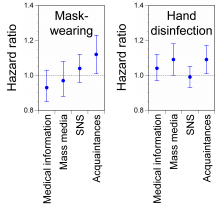
Researchers from Osaka University found that Japanese people who used medical information were more likely to wear masks and disinfect their hands even before the COVID-19 outbreak, while those who exchanged information with acquaintances were more likely to newly start mask-wearing and hand disinfection post outbreak. This will assist in the development of risk communication strategies to promote infection-preventive behavior in a timely manner.

02 Nov 2023
The University of Osaka
A researcher from Osaka University has investigated the associations between mask usage and the reasons people give for wearing a mask. Online surveys were conducted before and after policies that downgraded the status of COVID-19. The study found that 59% of respondents continued wearing masks even after policy changes. Several sociological and psychological reasons other than disease prevention for mask usage were identified.
15 Dec 2022
The University of Osaka
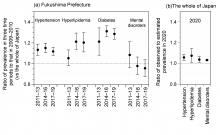
A study by Osaka University has shown that the prevalence of non-communicable diseases, which included hypertension, hyperlipidemia, diabetes, and mental disorders, increased after the Fukushima disaster and the COVID-19 outbreak. These findings emphasize the importance of improving post-disaster health promotion strategies and recommendations.