

The Journal of Physical Chemistry Letters
About The Journal of Physical Chemistry Letters
The Journal of Physical Chemistry Letters rapidly disseminates high-quality communications at the forefront of physical chemistry.
- Website: https://pubs.acs.org/journal/jpclcd?ref=breadcrumb
- Current Issue: https://pubs.acs.org/toc/jpclcd/current
News
01 Jul 2026
Osaka Metropolitan University
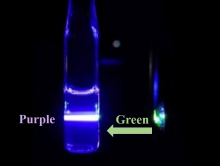
A research group has developed “TP-An,” a molecule that enables even low-energy, long-wavelength light to be used more effectively by solar cells and photocatalysts. The molecule can be used even at high concentrations that are difficult for traditional materials, suggesting their usefulness in technology.
16 Jun 2026
The University of Osaka
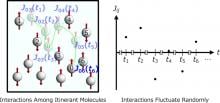
Researchers at the University of Osaka have developed a quantum mechanical model for concentrated organic radical solutions considering stochastic collisions between molecules. The first-order contribution to intermolecular interactions is averaged to zero by collisional fluctuations, but the second-order term survives and enhances the magnetic susceptibility. These results explain experimental observations of an anomalous increase in the magnetic susceptibility at the solid-to-fluid transition that cannot be predicted by conventional theories.
29 Jan 2026
Tohoku University
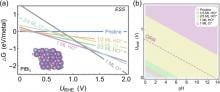
Two-dimensional topological materials are widely studied because they can be efficient and cost-effective catalysts. Their unique electronic properties give rise to robust topological surface states. However, this assumption is often made under the premise that their surfaces remain clean and unchanged during reactions, which is rarely the case. Using quantum computing, a research team has recreated a 2D material’s true working surface under reaction conditions.
18 Nov 2025
Ehime University
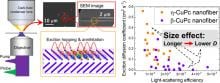
Direct Observation of Energy Transfer in Organic Semiconductor Nanostructures with a Home-Built Femtosecond Microspectroscopy System
10 Sep 2025
Ehime University
【Intriguing behavior of such electrons in particular materials produced by chemical synthesis】
Unpaired electrons located at linear band dispersion (LBD) are exceptional and called Dirac electrons (DE). They are paid attention to because of the unique electronic properties such as temperature (T)-independent resistivity, as if they belong to neither metallic nor non-metallic substances. In this study, we have developed a series of new organic Dirac electron systems and discovered universal features of magnetic behavior originating from LBD.
29 Nov 2022
Osaka Metropolitan University
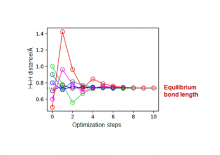
Using a quantum computer, Osaka Metropolitan University researchers utilized quantum logic circuits to directly calculate, in a single calculation, the energy difference between two molecular geometries. The developed method was then applied to execute the molecular geometry optimization of typical molecular systems. On a classical computer, calculations based on the finite difference method require at least two evaluations of the energy for one-dimensional systems, but previous research has shown that a quantum computer can be used to calculate the energy derivatives based on this method in a single calculation. However, quantum circuits relevant to quantum algorithms capable of performing the energy derivative calculations had not been implemented. The research group has successfully created a quantum circuit to calculate the energy derivatives by modifying the quantum circuit used in the previously developed quantum phase difference estimation algorithm.
26 Nov 2021
Osaka City University
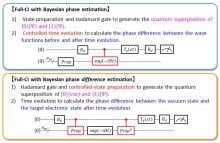
In a continuing effort to improve upon previous work, a research team at the Graduate School of Science, Osaka City University, have applied their recently developed Bayesian phase difference estimation quantum algorithm to perform full configuration interaction (full-CI) calculations of atoms and molecules without simulating the time evolution of the wave function conditional on an ancillary qubit. Superior to conventional methods in terms of parallel execution of quantum gates during quantum computing, this new algorithm is expected to be much easier to implement in actual quantum computers.
20 Aug 2021
Ehime University
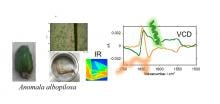
A two-dimensional map of proteins, including secondary structures, was obtained for the hindwings of an insect (Anomala albopilosa) at the spatial resolution of 100 µm. Mapping was achieved with the microscopic vibrational circular dichroism (VCD) system, which has been developed in our laboratory. As a result, the insect hindwing was revealed to be composed of segregated microdomains consisting of proteins with different secondary structures.

17 Mar 2021
Osaka City University
Researchers improve their newly established quantum algorithm, bringing it to one-tenth the computational cost of Quantum Phase Estimation, and use it to directly calculate the vertical ionization energies of light atoms and molecules such as CO, O2, CN, F2, H2O, NH3 within 0.1 electron volts of precision.
03 Feb 2021
Hokkaido University
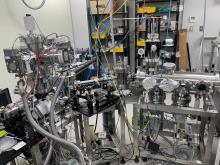
Hokkaido University scientists show that under laboratory conditions, ultraviolet light reacts with nitrophenol to produce smog-generating nitrous acid.
14 Dec 2020
Institute of Industrial Science, The University of Tokyo (UTokyo-IIS)
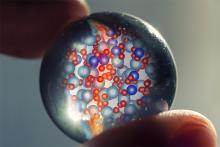
Scientists at The University of Tokyo study aluminosilicate glass to determine its complex local structure with unprecedented detail. This work may lead to tougher and more inexpensive glass for touchscreens and solar arrays