

Materials Horizons
About Materials Horizons
Materials Horizons is a leading journal for the publication of exceptionally high quality, innovative materials science.
News
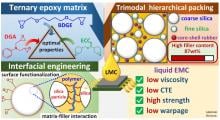
14 Jul 2026
National Taiwan University
Researchers developed a highly filled liquid epoxy for chip packaging that remains easy to process despite its exceptionally high silica content. By optimizing particle packing, surface treatment, and rubber nanoparticle reinforcement, the material minimizes wafer warpage while maintaining excellent toughness and reliability during packaging.
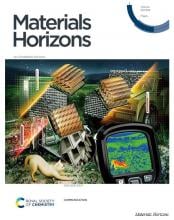
27 May 2026
National Taiwan University
The study from National Taiwan University reveals a single-layer zigzag-type metallic glass film with precisely tunable emissivity for thermal infrared camouflage technology.

20 Mar 2025
National Taiwan University
Integrating an emission gain layer in perovskite LEDs enhances Förster resonance energy transfer and the Purcell effect, achieving high luminance and efficiency.

25 Dec 2024
National Taiwan University
Combining metallic glass with the Berreman mode of epsilon-near-zero (ENZ) thin films achieves a dual-function system for infrared camouflage and thermal management within an identical wavelength region of the atmospheric window. Metallic glasses were selected for their tunable optical properties, providing adjustable emissivity for versatile thermal camouflage while maintaining effective thermal management.
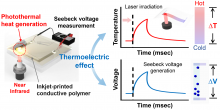
29 Dec 2022
Daegu Gyeongbuk Institute of Science and Technology (DGIST)
- A joint research team led by DGIST Professor Kang Hong-gi and KIST Dr. Chung Seung-jun develops high-speed powerless photothermal effect temperature sensor technology using a transparent polymer thermoelectric material printing process
- Opens up the possibility of direct high-resolution measurement of nano-photothermal phenomenon without interference of light, proposed for brain stimulation, cancer treatment, and ultra-fast PCR, etc.... Published online in ‘Materials Horizons’ in October
30 Jul 2021
Hokkaido University
Testing a large library of compounds reveals an easy-to-make lipid that can carry genetic code into the lung to treat disease.

26 Aug 2019
Ulsan National Institute of Science and Technology (UNIST)
A recent study, affiliated with South Korea's Ulsan National Institute of Science and Technology (UNIST) has introduced a pressure-free approach for creating synthetic graphite with well-oriented crystallites.