
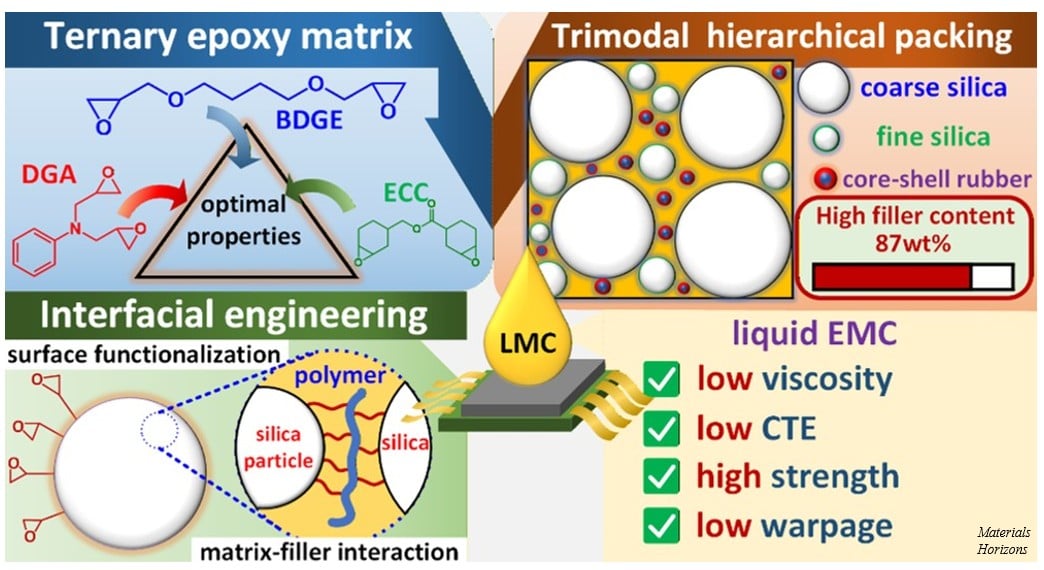
Design of a liquid epoxy that flows easily during processing and becomes strong and stable after curing. The material combines tailored resin, packed silica, rubber nanoparticles, and treated particle surfaces to reduce wafer bending.
As computer chips become more powerful and compact, the materials that protect them must perform better than ever. In advanced chip packaging, liquid epoxy is widely used because it can flow into tiny spaces before curing into a solid protective layer. To be effective, the material must be easy to process in its liquid state while becoming strong, stable, and reliable after curing.
Achieving this balance is not easy. Adding large amounts of silica reduces the thermal expansion of cured epoxy and helps minimize wafer warpage, improving the reliability of packaged chips. However, high silica loading also makes the liquid epoxy much thicker and more difficult to process. As a result, improving the final performance of the material often comes at the cost of manufacturing efficiency.
Researchers led by Prof. Chi-An Dai at the Department of Chemical Engineering, National Taiwan University have developed a liquid epoxy system that overcomes this trade-off through an integrated materials design. The team combined silica particles of different sizes so that smaller particles filled the spaces between larger ones. This optimized particle arrangement enabled the epoxy to incorporate an exceptionally high amount of silica while remaining easy to process. The study is published in Materials Horizons.
Another key innovation was the use of rubber nanoparticles. Dispersed throughout the silica network, these nanoparticles absorbed local stresses, making the cured epoxy tougher and more resistant to cracking. At the same time, they improved thermal stability and further reduced thermal expansion—a combination that is rarely achieved in highly filled epoxy materials.
The researchers also modified the silica surface to improve its compatibility with the epoxy. This prevented the densely packed particles from sticking together, allowing the material to remain highly flowable despite its exceptionally high silica loading. Before curing, the epoxy maintained a relatively low viscosity, making it suitable for manufacturing.
After curing, it exhibited an exceptionally low coefficient of thermal expansion comparable to those of glass and silicon substrates used for chip fabrication, along with excellent mechanical strength, reduced wafer warpage, and outstanding reliability in packaging tests.
“By combining resin design, optimized particle packing, rubber nanoparticle toughening, and surface engineering, we developed a highly filled epoxy that remains easy to process while providing the strength, dimensional stability, and reliability needed for next-generation chip packaging,” says co-corresponding author Prof. Chi-An Dai.
Prof. Chi-An Dai's email address: [email protected]
Advertisement