
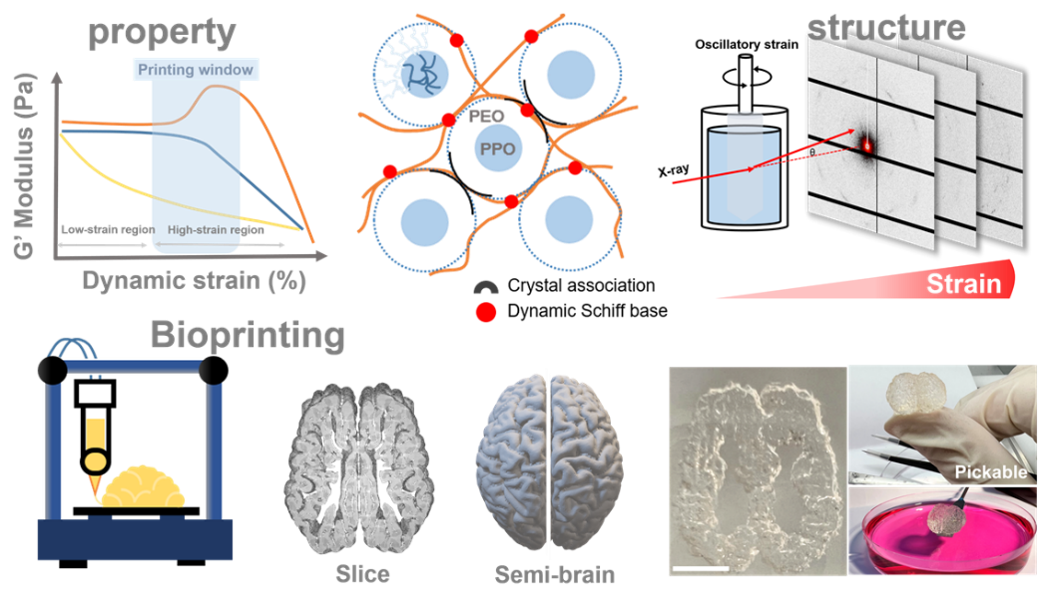

Researchers at National Taiwan University have designed a shear-protective hydrogel bioink that enables high-resolution bioprinting of pickable neural tissue patches with high cell survival.
3D bioprinting of pickable neural tissue constructs using a shear-protective hydrogel bioink to safeguard delicate cells.
National Taiwan University
3D bioprinting allows scientists to build custom tissue structures for medicine, but printing soft tissues like the human brain remains a major challenge. The strong pushing forces required to squeeze biological materials through tiny printer nozzles often crush and damage sensitive cells, leading to low survival rates and weak printed structures.
To solve this problem, a research team at National Taiwan University designed a smart hydrogel bioink. By blending natural polymers with special microscopic structures, they created a dynamic material that easily changes shape under pressure. It flows smoothly like a liquid while being extruded, but quickly transforms back into a firm gel once placed in position. The study was published in Small.
Advanced tests at large-scale research facilities (synchrotron Taiwan Photon Source at National Synchrotron Radiation Research Center, Taiwan and Bilby beamline at Australian Nuclear Science and Technology Organisation) revealed how this material shields living cells. Under stress, the tiny microstructures inside the gel temporarily bend and slide to absorb physical impact, acting like microscopic shear absorbers.
In lab experiments, delicate neural stem cells printed through ultra-fine nozzles maintained high survival rates of over 86%. The bioink also provided a nourishing environment that encouraged these cells to mature into functional brain cells. Using precise computer designs, the team successfully printed detailed brain-slice patches that are strong enough to be easily picked up, moved, and cultured.
“By understanding and tuning how soft materials respond to physical stress, we can protect sensitive cells during high-precision printing. This approach opens exciting new avenues for fabricating biomimetic brain tissue models and advancing future repair strategies for the central nervous system,” says corresponding author Shan-hui Hsu, distinguished professor of polymer science and engineering at National Taiwan University.
Prof. Shan-hui Hsu's email address: [email protected]
Advertisement