
IBS and Sungkyunkwan University researchers uncover a molecular signaling pathway through which astrocytes regulate neuronal activity and vascular responses during prolonged sensory stimulation.
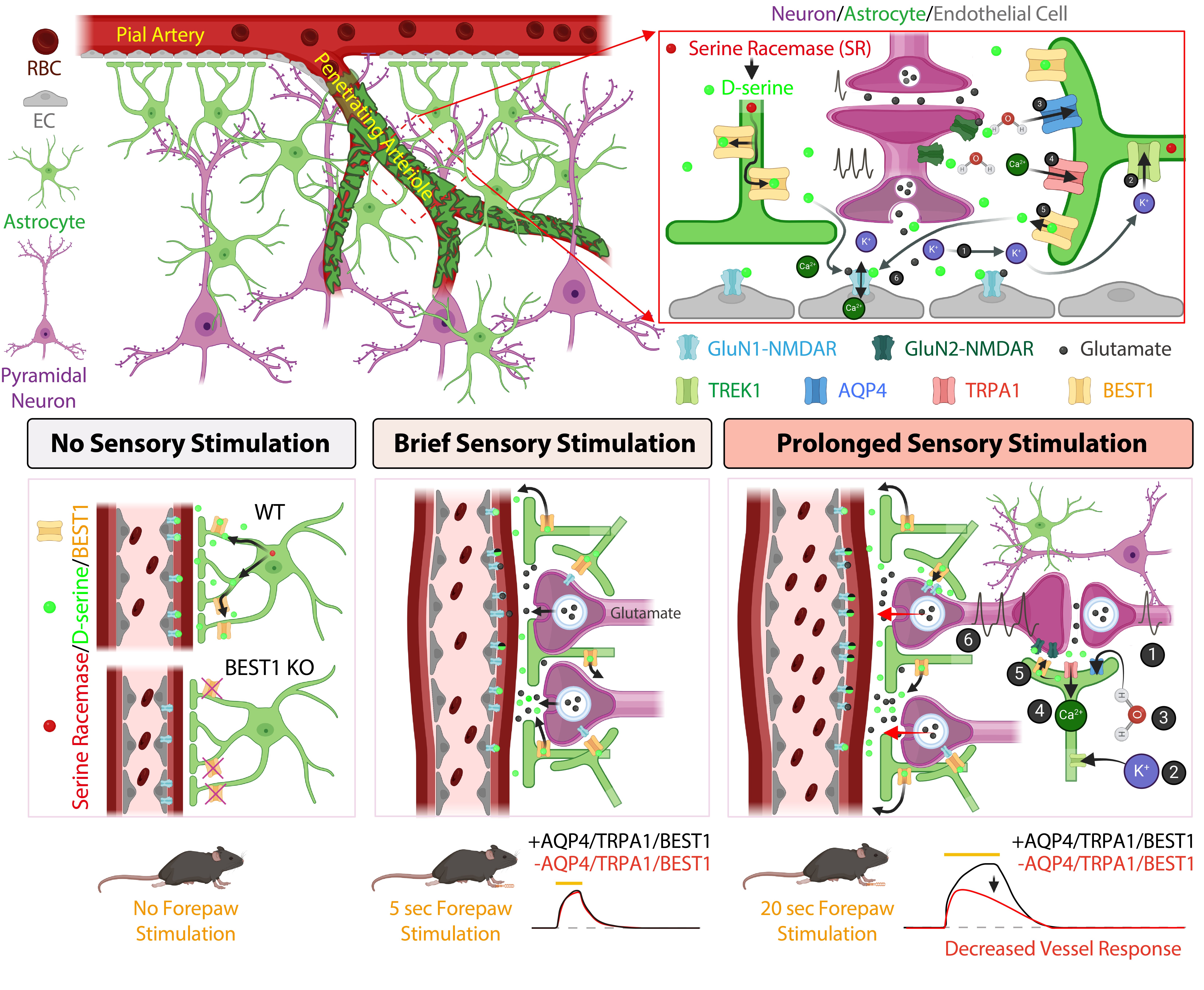
Schematic illustration of astrocyte-mediated regulation of neuronal activity and cerebral vascular responses.
Han, K., Jang, M. W., Park, T., Kim, K. J., Drew, V. J., Kim, S., Kim, T. Y., Park, M. G., Kim, M., Chung, S. W., Suh, M., & Lee, C. J. (2026). Astrocytes coordinate neurovascular coupling during prolonged sensory demand via AQP4/TRPA1/Best1/d‐serine sign
What happens in our brains when we experience sensory stimulation? During everyday activities such as jogging, reading, or listening to music, sensory inputs activate neurons in specific brain regions. Astrocytes, a type of non-neuronal brain cell, respond to neuronal activity and help regulate cerebral blood flow by influencing the dilation of nearby blood vessels, thereby supporting the delivery of oxygen and nutrients. This process is known as neurovascular coupling. However, the precise mechanisms by which astrocytes contribute to this process have remained incompletely understood.
A research team led by Director C. Justin Lee at the Institute for Basic Science (IBS) and Professor Minah Suh at the Department of Biomedical Engineering, Sungkyunkwan University (SKKU), has discovered that astrocytes play a critical role in detecting sustained sensory stimulation and coordinating neuronal activity and cerebral vascular responses. Based on these findings, the researchers propose a new model in which neurons, astrocytes, and blood vessels interact through structural and functional connections to regulate neuronal activity and cerebral blood flow.
Astrocytes are star-shaped cells widely distributed throughout the brain. Traditionally, they were regarded primarily as supportive cells that provide structural and metabolic support to neurons. However, growing evidence suggests that astrocytes actively participate in brain function by communicating with neurons and blood vessels and regulating their activities.
Using mouse models, the researchers investigated how neurons, blood vessels, and astrocytes respond to sensory stimulation of different durations. They found that brief sensory stimulation lasting five seconds induced transient neuronal activation and vascular responses. In contrast, when sensory stimulation was prolonged to approximately 20 seconds, astrocytes became strongly activated and contributed to sustaining both neuronal activity and cerebral vascular responses.
The researchers identified a four-step molecular signaling pathway underlying this process. First, sustained neuronal activity promotes water influx into astrocytes through aquaporin-4 (AQP4), a water channel protein, leading to an increase in astrocytic volume. Second, this volume change is associated with the activation of transient receptor potential ankyrin 1 (TRPA1) channels, allowing calcium ions to enter astrocytes. Third, the resulting increase in intracellular calcium activates bestrophin-1 (BEST1), a calcium-activated anion channel. Finally, BEST1 facilitates the release of D-serine, an amino acid that modulates neurotransmission. D-serine enhances neuronal activity and promotes cerebral vasodilation, thereby increasing blood flow.
Notably, when the researchers suppressed AQP4 or TRPA1 function in astrocytes, both neuronal and vascular responses to sustained sensory stimulation were reduced. Conversely, administering D-serine to mice with astrocytic TRPA1 suppression restored the diminished vascular responses. Furthermore, electrophysiological analyses provided evidence that D-serine is released through astrocytic BEST1 channels.
Together, these findings demonstrate that the AQP4–TRPA1–BEST1–D-serine signaling pathway in astrocytes plays an important role in sustaining neuronal activity and cerebral vascular responses during prolonged sensory stimulation. The researchers also provide novel evidence that astrocytes can continuously release D-serine even in the absence of sensory-evoked neuronal activity, thereby contributing to the regulation of basal vascular tone, which determines the resting degree of blood vessel constriction.
Professor Minah Suh, co-corresponding author of the study, stated, “Our findings establish a clear mechanistic model of how astrocytes communicate with neurons and regulate brain function during sustained sensory stimulation. The newly identified pathway may provide an important foundation for developing therapeutic strategies for neurological disorders associated with impaired sensory processing or cognitive decline.”
Director C. Justin Lee, co-corresponding author of the study, commented, “This study identifies an integrated molecular signaling pathway that regulates both sustained brain activity and vascular stability, revealing a previously underappreciated function of astrocytes and its underlying mechanism. We hope these findings will provide new insights into the treatment of vascular dysfunction associated with challenging neurological diseases, including Alzheimer's disease and stroke, and ultimately contribute to the development of new therapeutic approaches.”
The findings were published online on September 29, 2026, in the international scientific journal Advanced Science.
Advertisement