

National Academy of Sciences of the United States of America (PNAS)
News
24 Mar 2026
The University of Osaka
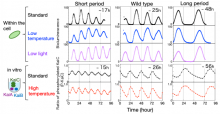
Researchers from The University of Osaka studying simple cyanobacteria found that one protein keeps their internal clock ticking reliably, even outside a living cell. By testing over 20 variants with clock periods ranging from 15 to 60 hours, they discovered that timekeeping precision appears to be built directly into the protein itself, independent of cell activity or environmental changes.
04 Feb 2026
Kanazawa University
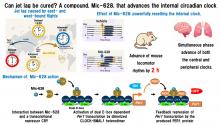
A potential breakthrough for jet lag and shift work-related sleep disorders. A Japanese research team has discovered a new compound that can advance the body’s internal clock—offering hope for faster recovery from jet lag and better adaptation to night-shift work. The compound, called Mic-628, specifically activates the transcription of a clock gene named Period1 (Per1). When given orally to mice, it advanced their body clocks and activity rhythms, regardless of dosing time. The findings suggest a new approach to controlling circadian rhythms through drug action rather than light exposure.

15 Nov 2022
City University of Hong Kong (CityUHK)
The metal-carbon dioxide battery is a promising and environmentally friendly technology, but its energy efficiency is limited. Recently, a research team co-led by chemists from City University of Hong Kong (CityU) discovered an innovative way to overcome this problem by introducing an unconventional phase nanomaterial as a catalyst, boosting battery energy efficiency up to 83.8%. The study reveals a novel design of catalysts for the new generation of meta-gas batteries that can contribute to carbon neutral goals.
11 Oct 2022
City University of Hong Kong (CityUHK)
A research team co-led by materials scientists from City University of Hong Kong (CityU) has recently discovered a new mechanism to increase the strength and ductility of a high-entropy alloy, two properties which normally vary inversely with each other. The findings provide important insights for the future design of strong yet ductile high-entropy alloys and high-entropy ceramics.
23 Dec 2021
Osaka City University
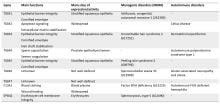
By searching for the protein transglutaminase 1 (TGM1) among patients with various autoimmune skin diseases, researchers have successfully identified a separate disease that
can be linked to autoimmunity against TGM1. This backward method
demonstrates a new way of identifying autoantigens as markers for various
diseases. By letting autoantigens point to the disease, diagnosis and
treatment can be facilitated, according to the study now published in PNAS.
24 Jun 2021
City University of Hong Kong (CityUHK)
It is generally agreed that sperms “swim” by beating or rotating their soft tails. However, a research team led by scientists from City University of Hong Kong (CityU) has discovered that ray sperms move by rotating both the tail and the head. The team further investigated the motion pattern and demonstrated it with a robot. Their study has expanded the knowledge on the microorganisms’ motion and provided inspiration for robot engineering design.