

Royal Society Open Science
About Royal Society Open Science
Royal Society Open Science is an open journal publishing high-quality original research on the basis of objective peer-review.
News
08 Jun 2026
The University of Osaka
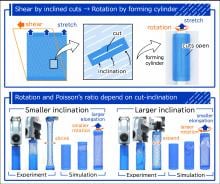
Researchers at The University of Osaka have developed novel kirigami structures with periodic parallel inclined cuts. Stretching these materials longitudinally causes them to twist and rotate. Thus, these structures provide a mechanism for coupling tension and rotation. The mechanical deformation of these structures can be characterized in terms of a geometrical property, the chirality. Some of the developed chiral structures were auxetic, longitudinal stretching resulting in lateral expansion, instead of contraction. The findings have applications in soft robotics and soft actuators.
20 May 2026
Osaka Metropolitan University
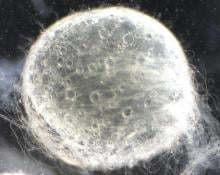
In the latest in a series of studies showing how lab-raised fish differ from those raised in more natural environments, researchers found that medaka maintained in more natural settings ovulated earlier than those in the laboratory. These findings highlight the challenges of inferring natural behavior from that observed in the laboratory.

16 Jul 2025
The University of Osaka
Researchers from The University of Osaka have developed a mathematical model for Volterra defects using differential geometry to analyze the relationships between different types of defects. Their work provides insight into the connections between edge dislocations and wedge disclinations and extends traditional theories in material science. Their results may help to explain the unusual mechanical properties of crystals so they can be used to design new materials.

05 Mar 2025
The University of Osaka
Researchers at Osaka University show that Cartan's First Structure Equation, which relates to edge and screw dislocations in crystal lattices, can be recast in the same form as a basic mathematical formula that governs the behavior of electric currents and magnetic fields. This work can help make new concepts more understandable by employing more familiar frameworks.

08 Jan 2025
Osaka Metropolitan University
Intimate insights into relationship between cost of gamete production and sexual selection
13 Nov 2024
National Taiwan University
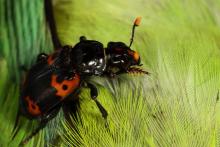
National Taiwan University study finds that burying beetles thrive on both lab and wild carcasses, validating lab studies on their behaviour, ecology, and evolution.

18 Aug 2021
Osaka City University
A collaboration between Osaka City University and Setsunan University sheds light on the effect urbanization has on the flesh fly species Sarcophaga similis. Through a series of laboratory and in-field experiments, scientists show that an increase in nighttime illumination and temperature, two of the major characteristics of urbanization, can postpone S. similis hibernation anywhere from 3 weeks to a month.