
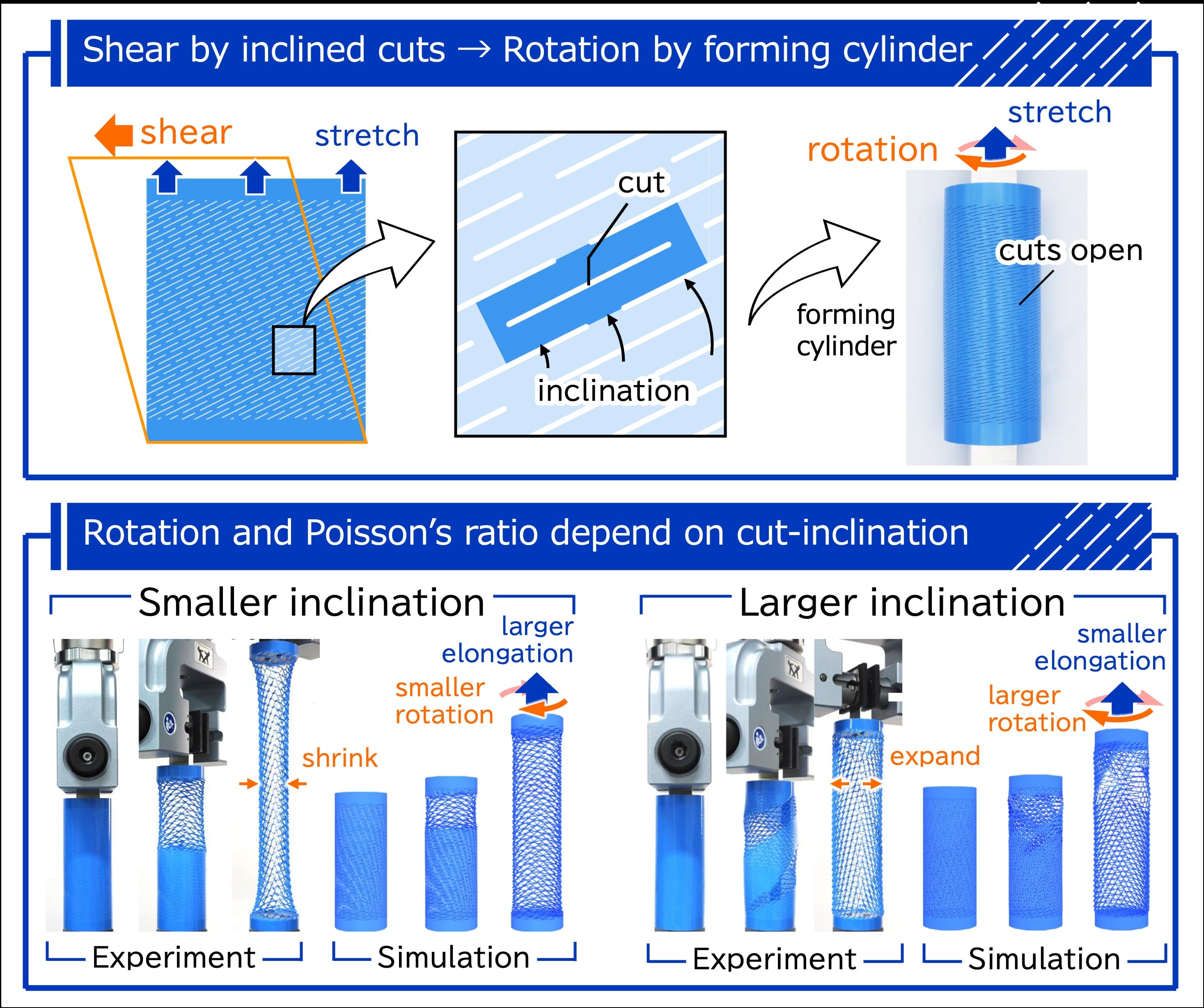

Researchers at The University of Osaka have developed novel kirigami structures with periodic parallel inclined cuts. Stretching these materials longitudinally causes them to twist and rotate. Thus, these structures provide a mechanism for coupling tension and rotation. The mechanical deformation of these structures can be characterized in terms of a geometrical property, the chirality. Some of the developed chiral structures were auxetic, longitudinal stretching resulting in lateral expansion, instead of contraction. The findings have applications in soft robotics and soft actuators.
Fig. 1
Developed Kirigami structures and their response to stretching.
Original content, Credit must be given to the creator., Isamu Hashiguchi, Tomoka Nakahara, Kota Fukui, Shunsuke Kobayashi and Ryuichi Tarumi
Researchers at The University of Osaka exploit geometrical design to make structures rotate, with new potential for robots and actuators made from flexible materials
Osaka, Japan – Kirigami is a variation on the Japanese art of origami, or paper folding, whereby cuts are used to create three-dimensional structures. For example, pop-up cards created from a sheet of paper. Kirigami has additional applications in engineering design to make materials with unique mechanical behavior. Although most studies on kirigami materials have focused on structures with parallel and perpendicular cuts, limiting the applications of the final creations.
Now, researchers at The University of Osaka have developed a novel kirigami structure with inclined cuts that can twist when stretched. This design can be harnessed to make soft robots. This exciting discovery is set to be published in Royal Society Open Science.
In engineering, precise cuts can be made in flat sheets to create complex flexible three-dimensional structures that could not be produced using traditional manufacturing techniques. These kirigami materials have unique mechanical properties, such as high strength-to-weight ratios, which arise from their internal structure; as opposed to properties originating from the chemical composition of the base material.
In typical kirigami patterns, cuts are made parallel or perpendicular to the loading direction. However, The University of Osaka team innovated kirigami patterns by making periodic parallel inclined laser cuts in polyester sheets. The sheets were then rolled into cylinders and subjected to mechanical tests.
“We were able to characterize the mechanical properties of these kirigami structures in terms of their chirality,” explains lead author, Isamu Hashiguchi. “Chirality is a geometric property – a chiral structure cannot be superimposed on its mirror image.”
One common example of chirality includes human hands, which while similar, are not identical and cannot exactly overlay one another. This ‘handedness’ for materials is important, as it allows for the development of materials with tunable properties – expanding their potential applications.
As part of the mechanical tests completed, the scientists found that stretching the cylindrical sheets caused them to twist and rotate. Thus, the developed structures provide an efficient way to couple tension and rotation, meaning forces exerted along the structure could be converted into a rotational force.
“We found that some chiral kirigami structures are auxetic,” reports Ryuichi Tarumi, senior author. “This means that when these structures are stretched longitudinally, they expand laterally instead of becoming thinner.”
Auxetic materials find application in medical stents to support expansion of bronchial tubes, the esophagus, or blood vessels. The rotation of kirigami structures under elongation also makes them promising soft twist actuators, flexible robotic components with twisting ability, used for dexterous manipulation.
###
The article, “Chirality-induced tension–rotation coupling in cylindrical kirigami structures,” was published in Royal Society Open Science at DOI: https://doi.org/10.1098/rsos.250983
About The University of Osaka
The University of Osaka was founded in 1931 as one of the seven imperial universities of Japan and is now one of Japan's leading comprehensive universities with a broad disciplinary spectrum. This strength is coupled with a singular drive for innovation that extends throughout the scientific process, from fundamental research to the creation of applied technology with positive economic impacts. Its commitment to innovation has been recognized in Japan and around the world. Now, The University of Osaka is leveraging its role as a Designated National University Corporation selected by the Ministry of Education, Culture, Sports, Science and Technology to contribute to innovation for human welfare, sustainable development of society, and social transformation.
Website: https://resou.osaka-u.ac.jp/en
Advertisement
Advertisement