

Physical Review Letters
About Physical Review Letters
Physical Review Letters (PRL) is the premier APS journal for current research, providing rapid publication of short reports of important fundamental research in all fields of physics.
- Website: https://journals.aps.org/prl/
- Current Issue: https://journals.aps.org/prl/issues/current
News
29 Jul 2026
Institute of Industrial Science, The University of Tokyo (UTokyo-IIS)
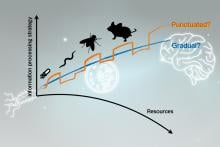
Researchers from the Institute of Industrial Science, The University of Tokyo reveal how limited resources can cause sudden changes in the way organisms process information
14 Apr 2026
Kavli Institute for the Physics and Mathematics of the Universe (Kavli IPMU)
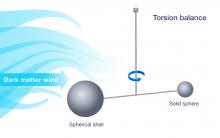
A team of researchers have shown torsion-balance experiments — precision instruments originally built to test the equivalence principle — could double as detectors for very light dark matter.
07 Apr 2026
The University of Osaka
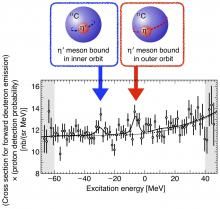
Researchers investigated how the η′ meson behaves inside atomic nuclei and found evidence that it may form bound states known as η′-mesic nuclei. Using high-energy particle experiments and sophisticated data analysis, the team observed signals consistent with theoretical predictions and measured a possible change in the particle’s mass in nuclear matter. These findings provide new insight into the structure of the vacuum and the origin of mass.

12 Mar 2026
Institute of Industrial Science, The University of Tokyo (UTokyo-IIS)
Researchers from Institute of Industrial Science, The University of Tokyo develop a mutual information estimator capable of accurately measuring information flow to biological outputs without needing input quantities
02 Feb 2026
Kavli Institute for the Physics and Mathematics of the Universe (Kavli IPMU)
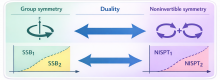
Researchers have found duality can reveal hidden non-invertible symmetry protected topological phases, unlocking new quantum phases.
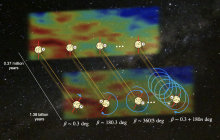
28 Jan 2026
Kavli Institute for the Physics and Mathematics of the Universe (Kavli IPMU)
Researchers have developed a method to reduce uncertainties in observational measurements of cosmic birefringence, which might help explain the Universe’s symmetry.
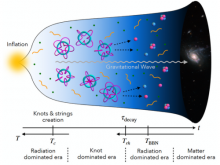
22 Oct 2025
Hiroshima University
In 1867, Lord Kelvin imagined atoms as knots in the aether. It was soon disproven. But a new study suggests his discarded idea may yet hold the key to why the universe exists.

11 Sep 2025
Hiroshima University
Solves a long-standing challenge in fundamental physics

06 Aug 2025
Kavli Institute for the Physics and Mathematics of the Universe (Kavli IPMU)
A team of theoretical researchers including Kavli IPMU's Hirosi Ooguri, and led by Kyushu University's Yuya Kusuki, have used thermal effective theory to demonstrate for the first time that quantum entanglement follows universal rules across all dimensions.

16 Jul 2025
Tohoku University
Rabi-like splitting is one of the key concepts in modern quantum technology. Fully understanding it can help us advance our knowledge in quantum information processing.

10 Jul 2025
Tohoku University
Nonlinear quantum dynamics are complicated, but they don’t have to be. A new, real-time simulation may help demystify these unusual dynamics, serving as a guide to develop next-gen quantum devices.

19 Jun 2025
Kavli Institute for the Physics and Mathematics of the Universe (Kavli IPMU)
An international team of researchers including Kavli IPMU has for the first time observed a new class of exotic atomic systems—highly charged muonic ions.

08 May 2025
Kavli Institute for the Physics and Mathematics of the Universe (Kavli IPMU)
A research team including Kavli IPMU has found neutrinos from galaxy NGC 1068 might come from helium nuclei smashing into UV light and releasing neutrons that decay into neutrinos without gamma rays.

25 Mar 2025
Osaka Metropolitan University
The Super-Kamiokande and Tokai-to-Kamioka (T2K) Collaborations have produced a first joint analysis of their data

06 Feb 2025
Tohoku University
Researchers created platinum-mixed metallic magnetic nanofilms that are 5x more efficient – the ultimate energy-saving solution.

29 Jan 2025
Tohoku University
This novel finding regarding the nonreciprocal diffraction of acoustic waves could open doors for next-generation communication devices.

20 Jan 2025
Singapore University of Technology and Design
SUTD researchers designed a novel nonlinear chiral metasurface that could generate circularly polarized light more easily, expanding optics-based applications.

28 Nov 2024
Kavli Institute for the Physics and Mathematics of the Universe (Kavli IPMU)
The University of Tokyo Kavli Institute for the Physics and Mathematics of the Universe (Kavli IPMU, WPI) Professor Yuji Tachikawa and The University of Tokyo School of Science graduate student Masaki Okada have found that any operation of non-invertible symmetries is a quantum operation, uncovering a link between quantum information theory and particle and condensed matter physics that had previously been unknown.

11 Oct 2024
Osaka Metropolitan University
Scientists visualize and control magnetic domains in quantum antiferromagnets

18 Sep 2024
National Taiwan University
Altermagnetism (AM) is an emerging type of magnetism, combining advantages of both antiferromagnetism (AFM) and ferromagnetism (FM), with no net magnetization and spin-splitting Fermi surfaces. It is ideal material for spintronic applications. In our work, we studied the inverse altermagnetic spin-splitting effect (IASSE) in epitaxial RuO2 film capped by ferromagnetic insulator YIG layer. By injecting a spin current from YIG into RuO2, we observed a significant anisotropic spin to charge conversion with spin index parallel or perpendicular to the Néel vector directions, revealing the inverse altermagnetic spin-splitting effect (IASSE) in RuO2. Furthermore, we verify the ordering of the Néel vector along the [001] direction from magnetization measurements. Our study provides critical insights in the understanding of altermagnetism.

14 Jun 2024
Osaka Metropolitan University
Theoretical simulations and synchrotron experiments reveal the hidden fingerprint of new magnets

09 May 2024
Institute of Industrial Science, The University of Tokyo (UTokyo-IIS)
Researchers at The University of Tokyo demonstrate enhanced radiative heat transfer across a gap between two micro-sized silicon plates by coating them with a layer of silicon dioxide, which may significantly improve heat management of computers.
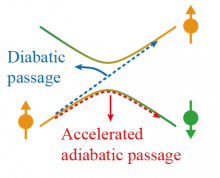
05 Mar 2024
The University of Osaka
SANKEN researchers achieved the acceleration of adiabatic evolution of a single spin qubit in gate-defined quantum dots for the first time. After the pulse optimization to suppress quasistatic noises, the spin flip fidelity can be as high as 97.5% in GaAs quantum dots. This work may be useful to achieve fast and high-fidelity quantum computing.
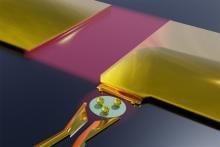
13 Feb 2024
Institute of Industrial Science, The University of Tokyo (UTokyo-IIS)
Researchers from the Institute of Industrial Science, The University of Tokyo have solved a foundational problem in transmitting quantum information, which could dramatically enhance the utility of integrated circuits and quantum computing.
18 Jan 2024
Osaka Metropolitan University
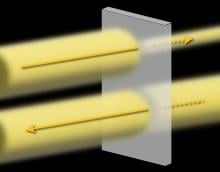
A research group led by Osaka Metropolitan University has discovered significant nonreciprocal optical absorption of LiNiPO4, referred to as the optical diode effect, in which divalent nickel (Ni2+) ions are responsible for magnetism, by passing light at shortwave infrared wavelengths used in optical communications. Furthermore, they have uncovered that it is possible to switch the optical diode effect by applying a magnetic field. This is a step forward in the development of an innovative optical isolator that is more compact and can control light propagation, replacing the conventional optical isolators with complex structures

10 Aug 2023
The University of Osaka
A team led by researchers at Osaka University and University of California, San Diego has conducted simulations of creating matter solely from collisions of light particles. Their method circumvents what would otherwise be the intensity limitations of modern lasers and can be readily implemented by using presently available technology. This work might help experimentally test long-standing theories such as the Standard Model of particle physics, and possibly the need to revise them.

14 Jun 2023
A physicist from the University of the Philippines – Diliman College of Science National Institute of Physics (UPD-CS NIP) led a team of researchers in pioneering a way to make a special kind of “dark” matter that can’t be observed using standard laboratory methods.

11 May 2023
Kavli Institute for the Physics and Mathematics of the Universe (Kavli IPMU)
Kavli IPMU researchers have discovered a new generic production mechanism of gravitational waves generated by a phenomenon known as oscillons.

10 May 2023
Kavli Institute for the Physics and Mathematics of the Universe (Kavli IPMU)
Adapting a detector developed for space X-ray observation, a team including Kavli IPMU researchers have successfully verify strong-field quantum electrodynamics with exotic atoms.