

Communications Physics
About Communications Physics
Communications Physics is an open access journal from Nature Portfolio publishing high-quality research, reviews and commentary in all areas of physics.
- Website: https://www.nature.com/commsphys/
News
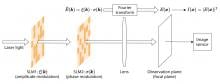
29 Jul 2026
The University of Osaka
Researchers at the University of Osaka have developed a new mathematical framework that helps identify optimization problems that can be solved efficiently using optical computing hardware. The approach allows complex, high-dimensional problems to be transformed into forms compatible with spatial photonic Ising machines and can also accelerate computation using fast Fourier transforms. These findings could broaden the applications of optical computing to areas such as logistics, data analysis, and infrastructure optimization.
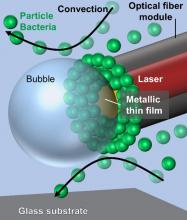
18 May 2026
Osaka Metropolitan University
Researchers have developed an optical fiber that uses laser-induced heating and bubble-driven convection to rapidly concentrate bacteria and nanoparticles in liquid samples. The method collects thousands of targets in 60 seconds with over tenfold higher efficiency than conventional approaches. This approach allows for faster and more sensitive detection in biomedical and environmental applications.

15 May 2025
The University of Osaka
Researchers from The University of Osaka have discovered the mechanism for supercurrent rectification, in which current flows primarily in one direction in a superconductor. By using a specific iron-based superconductor, they were able to observe this phenomenon over a broad range of magnetic and temperature fields. This understanding paves the way for the design and construction of superconducting diodes and other ultra-low energy electronics.

22 Apr 2025
Tohoku University
Researchers at Tohoku University explored a colloidal crystal model to produce specific polymorphs, required for use in materials science and pharmaceuticals.
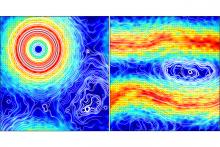
05 Jan 2023
Institute of Industrial Science, The University of Tokyo (UTokyo-IIS)
Researchers at The University of Tokyo simulate the phase separation of self-spinning particles, and show that the process differs from other unmixing processes, which may shed light on the organization of bacteria and other organisms
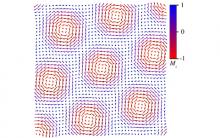
23 Aug 2019
Tohoku University
Researchers at Tohoku University show deformation of skyrmion lattice under steady electric-current flow, and is related to possible friction at edges.