
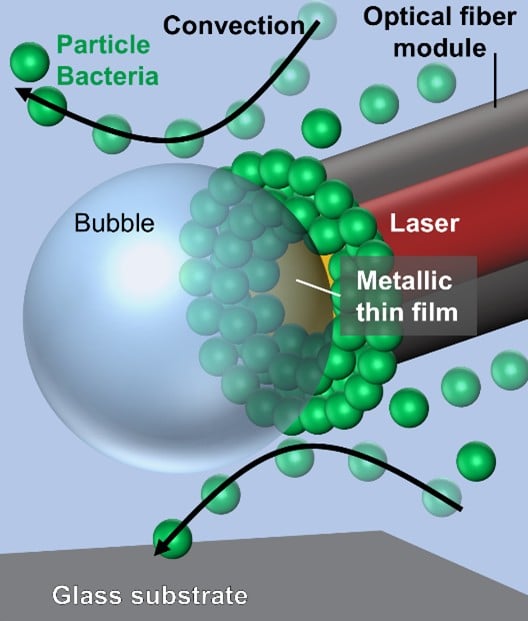
Optical condensation using a fiber-based photothermal module: The system achieves about tenfold higher collection efficiency than conventional approaches, enabling the assembly of approximately 10,000 microparticles or bacteria in just 60 seconds.
How to collect what you can barely find? Concentrate it.
Osaka Metropolitan University researchers have developed a light-driven technique that quickly amasses thousands of bacteria into a single spot, boosting detection speed and sensitivity. Their approach paves the way for earlier diagnosis of disease.
Many harmful bacteria, such as E. coli O157, can trigger severe ailments even at very low concentrations. Rapid detection of trace quantities of bacteria is essential to facilitate early diagnosis and prevent disease. The technique could also identify nanoparticles and other micro- and nanoscale entities that are also affecting the immune system and making the disease worse.
“Many conventional techniques are time consuming, require complex instrumentation, or are limited to collecting targets only near a surface or within a narrow focal region,” said Takuya Iida, professor at the Graduate School of Science and Research Institute for Light-induced Acceleration System (RILACS) at Osaka Metropolitan University and lead author of the study.
Cultivating bacteria in the lab can take days, and even faster antibody-based immunoassays still require several hours.
Looking for a fast yet sensitive alternative, the team turned to something else that has these properties: light.
The researchers created a metallic thin-film-coated optical fiber that acts as a localized photothermal source. When a laser is beamed into the fiber, the gold-coated fiber tip absorbs light and converts it into heat. This localized heating induces fluid motion and microscopic bubble formation in the surrounding liquid. Together, these effects create three-dimensional convection currents that transport bacteria and particles and concentrate them between the bubble and the fiber tip.
“Unlike conventional photothermal techniques that primarily operate in two dimensions along a surface, this system captures targets from all directions within the liquid,” Iida said.
As a result, it can assemble between thousands and hundreds of thousands of bacteria or microparticles from a 20-microliter sample in just 60 seconds. This is a more than tenfold improvement in efficiency compared to traditional approaches.
“Our results demonstrated that complex optical setups are not required to achieve high-efficiency concentration, and that a compact fiber-based approach can substantially enhance collection performance in liquid environments,” Iida explained.
The researchers plan to integrate this optical condensation technique with downstream analytical tools, such as optical sensing and spectroscopy, and to test it across a broader range of target materials and conditions.
“Ultimately, we aim to develop a versatile and reliable approach for rapid, sensitive analysis in small-volume liquid samples, contributing to future advances in bioanalytical research, environmental monitoring, and related analytical technologies,” Iida said.
The study was published in Communications Physics.
Competing interests
The authors declare no competing interests.
###
About OMU
Established in Osaka as one of the largest public universities in Japan, Osaka Metropolitan University is committed to shaping the future of society through the “Convergence of Knowledge” and the promotion of world-class research. For more research news, visit https://www.omu.ac.jp/en/ and follow us on social media: X, Instagram, LinkedIn.