
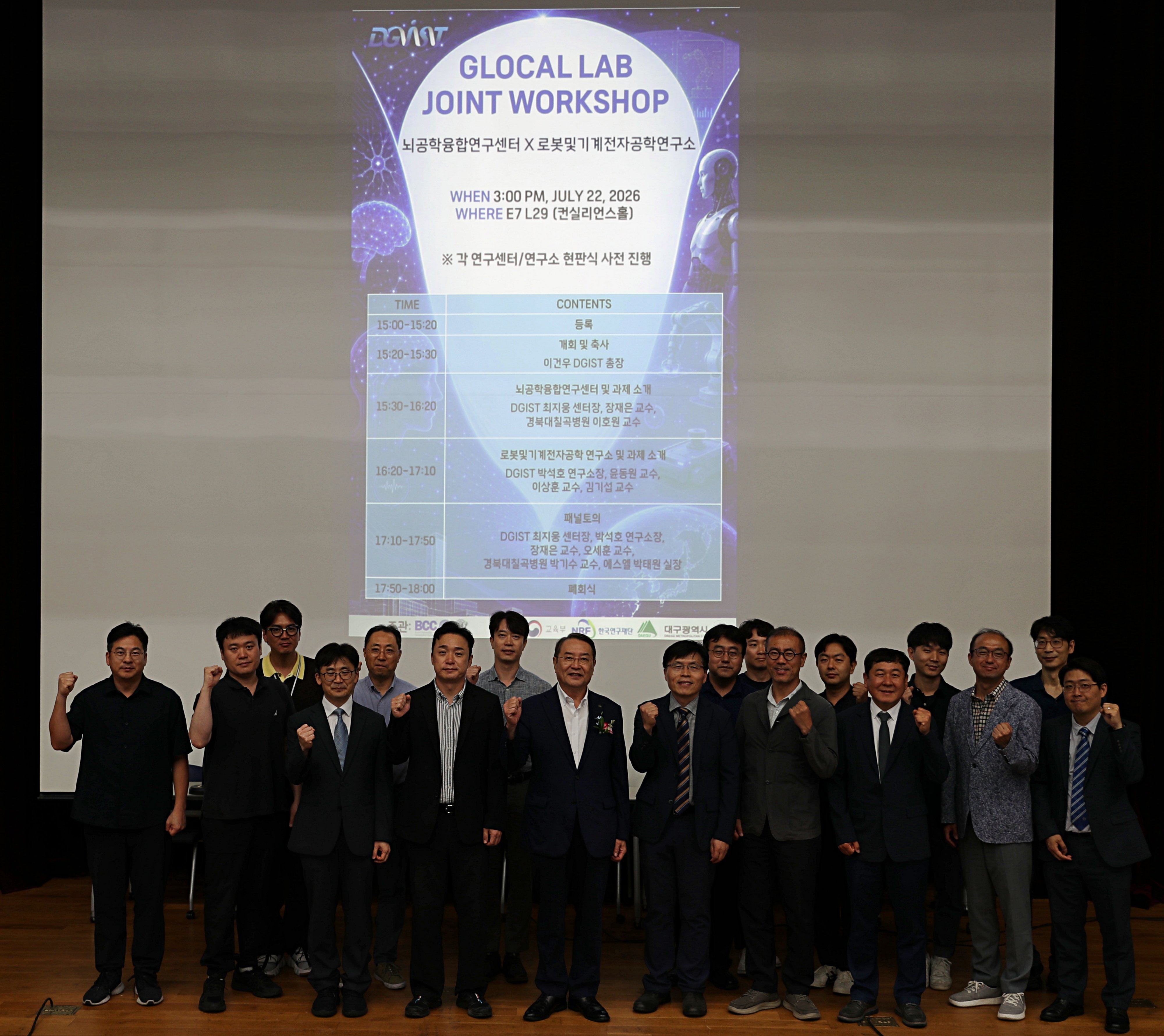
□ DGIST (President Kunwoo Lee) announced that on Wednesday, July 22, the Brain Engineering Convergence Research Center and the Robotics & Mechatronics Research Institute successfully hosted a joint plaque-unveiling ceremony and workshop at the DGIST Consilience Hall and other venues, attended by over 120 researchers, students, and key stakeholders, to celebrate their selection for the 2025 Science and Engineering Academic Research Support Program (Glocal Lab).
□ The event began with the unveiling ceremony of the two research entities, followed by a joint workshop and panel discussion presenting major research initiatives and visions. Participants exchanged the latest insights in brain engineering and robotics and discussed new fusion research opportunities and ways to broaden impact.
□ The Brain Engineering Convergence Research Center will undertake the development of digital twin technology for neural circuits based on “Neuro-Replica.” By replicating the structure and operating principles of real neural circuits in a digital environment, the center aims to precisely analyze brain functions and disorders, extending applications to AI-based disease prediction, personalized neurostimulation, and next-generation artificial sensory technologies to drive innovation in medicine and healthcare.
□ The Robotics & Mechatronics Research Institute will focus on “TransHuman Robotics,” developing next-generation robotic technologies and integrated human–robot platforms that augment human motor, sensory, and cognitive functions. Together, the two institutes will link brain engineering technologies that decode brain mechanisms with robotics technologies that realize them in physical reality, expanding applications across rehabilitation, healthcare, smart manufacturing, as well as space and ocean exploration.
□ Ji-Woong Choi, Director of the Brain Engineering Convergence Research Center, stated, “This joint ceremony and workshop mark the official commencement of the Glocal Lab project and serve as a meaningful occasion to solidify the foundation for collaboration among researchers. Based on Neuro-Replica technology, we will produce world-class research outcomes that contribute to overcoming brain diseases and advancing future medicine.”
□ Sukho Park, Director of the Robotics & Mechatronics Research Institute, remarked, “TransHuman Robotics is a field that requires the convergence of various disciplines, including robotics, neuroscience, artificial intelligence, and medicine. We will expand collaboration with leading institutions at home and abroad to become a global robotics research hub that brings tangible changes to human life.”
□ DGIST President Kunwoo Lee added, “The selection of both research entities for the Glocal Lab project is a significant milestone that recognizes DGIST’s regionally grounded research capabilities alongside its global competitiveness. We will actively support DGIST’s leap toward becoming a world-class innovation university, focusing on strategic research fields such as Physical AI, Human Digital Twin, and Quantum Sensing.”
□ Through the Glocal Lab project, the two research entities have secured KRW 27 billion in government funding over the next nine years. With an additional KRW 900 million in municipal support from Daegu Metropolitan City allocated to the Brain Engineering Convergence Research Center, the total project budget reaches KRW 27.9 billion.