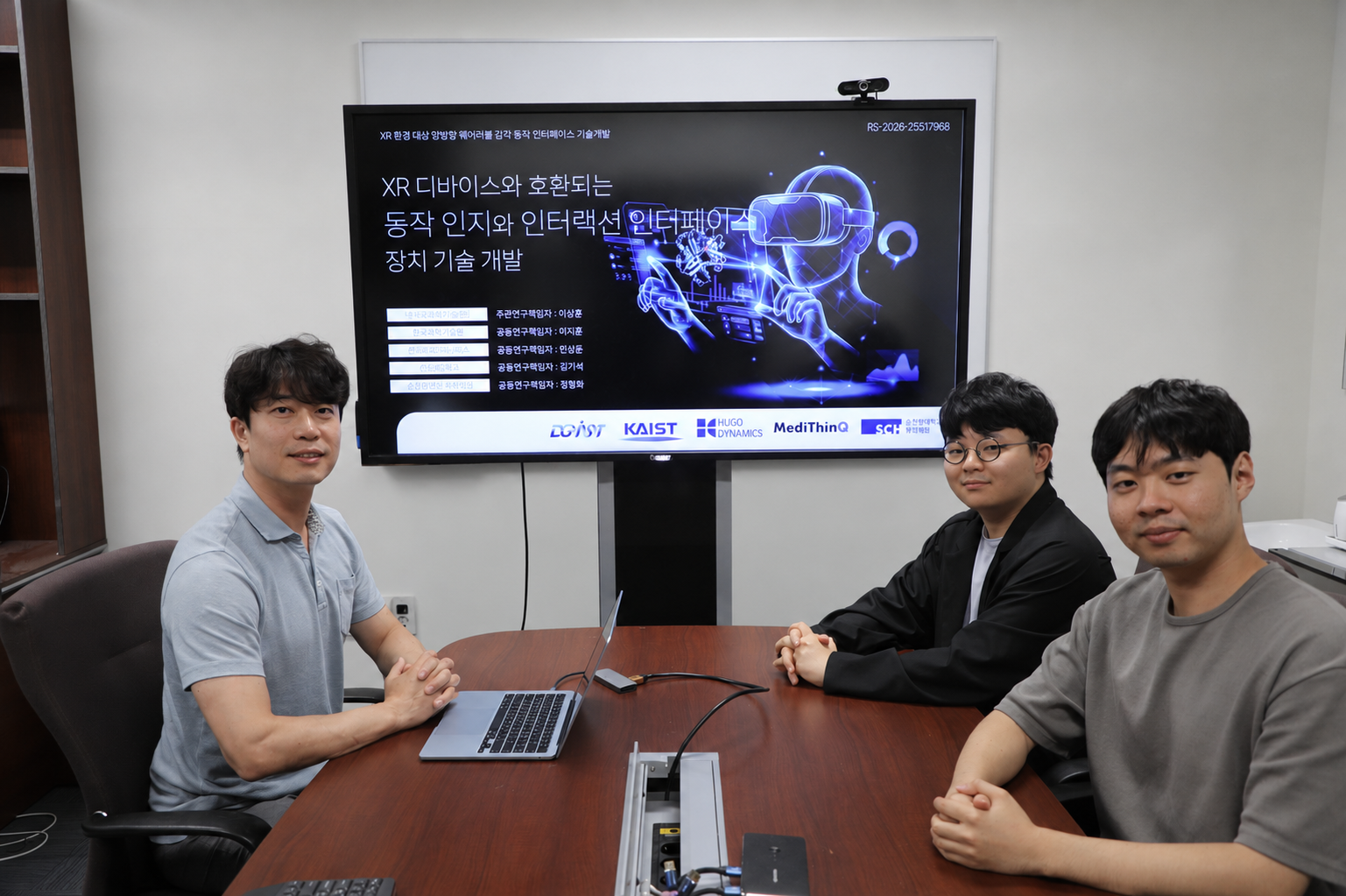
□ DGIST (President Kunwoo Lee) announced that a research team led by Professor Sanghoon Lee of the Department of Robotics and Mechatronics Engineering has been selected for a new national R&D project under the “Core Technology Development for Immersive Content” program, funded by the Ministry of Science and ICT and the Institute for Information & Communications Technology Planning and Evaluation. The team will begin developing core technologies for next-generation bidirectional wearable interfaces in extended reality (XR) environments.
□ The overarching project, titled “Development of Bidirectional Wearable Sensory and Motion Interface Technologies for XR Environments,” will run for four years starting in April 2026, with a total budget of 9 billion KRW. It focuses on two main areas: high-performance AI algorithms capable of recognizing users’ subtle motion intentions and wearable interface devices that connect these inputs to XR environments.
□ Professor Lee’s team will lead Subproject 2, Development of Motion Recognition and Interaction Interface Devices Compatible with XR Systems. To carry out this work, DGIST has formed a consortium with KAIST, Hugo Dynamics, MedithinQ, and Soonchunhyang University’s Industry-Academic Cooperation Foundation. The group will receive 4.5 billion KRW in research funding over the four-year period to drive development of the wearable interface technology.
□ Currently available XR devices rely heavily on camera-based hand tracking, which makes them vulnerable to environmental factors such as occlusion, backlighting, and low-light conditions. They also offer only limited feedback to users during interaction. To overcome these limitations, the DGIST team is developing a wrist-worn bidirectional wearable interface that combines high-resolution electromyography-based micro-gesture input technology with haptic feedback based on electrical stimulation and vibration.
□ This innovation is expected to extend beyond XR and metaverse content into broader applications, including rehabilitation monitoring, precision assembly in smart factories, and non-contact equipment control in hazardous industrial processes.
□ Professor Sanghoon Lee stated, “Through this project, we aim to overcome the limitations of existing XR input methods and realize a bidirectional interface capable of both recognizing user intent and delivering sensory feedback. By securing this core source technology, we will contribute to Korea’s independence in XR input systems and open new opportunities for expansion into medical and industrial fields.”