
- Prof. Sukho Song declares a paradigm shift in the value of robotics from “performance” to “environmental and social contributions”
- Presents, for the first time in the world, three new principles that future robots should uphold (Minimally Invasive, Universally Accessible, and Symbiotic)
- Published in Nature Machine Intelligence (top 0.3% in JCR), a world-leading journal in AI and robotics, and featured on the cover of its July 2026 issue
□ Prof. Sukho Song of the Department of Robotics and Mechatronics Engineering at DGIST (President Kunwoo Lee) has proposed “Sustainability Robotics,” a new academic field that evaluates robots not only in terms of their technical performance but also their contributions to environmental, social, and economic sustainability. The manifesto was published in Nature Machine Intelligence (top 0.3% in the 2025 JCR), a world-leading journal in AI and robotics, and was selected as the cover article for its July 2026 issue.
□ While robotics and physical AI are advancing rapidly, environmental and social issues—including climate change, biodiversity loss, and resource depletion—are also intensifying. The researchers emphasized that, rather than continuing the conventional focus on improving robot performance, the central question going forward should be ”What role should robots play in creating a sustainable future?”
□ Conventional “Green Robotics” has focused on reducing the environmental impact of robots themselves through the use of biodegradable materials, reduced energy consumption, and improved recyclability and repairability of components. In contrast, Sustainability Robotics goes a step further by enabling robots to directly contribute to addressing sustainability challenges in areas such as environmental monitoring, ecosystem restoration, disaster response, healthcare, and critical infrastructure maintenance.
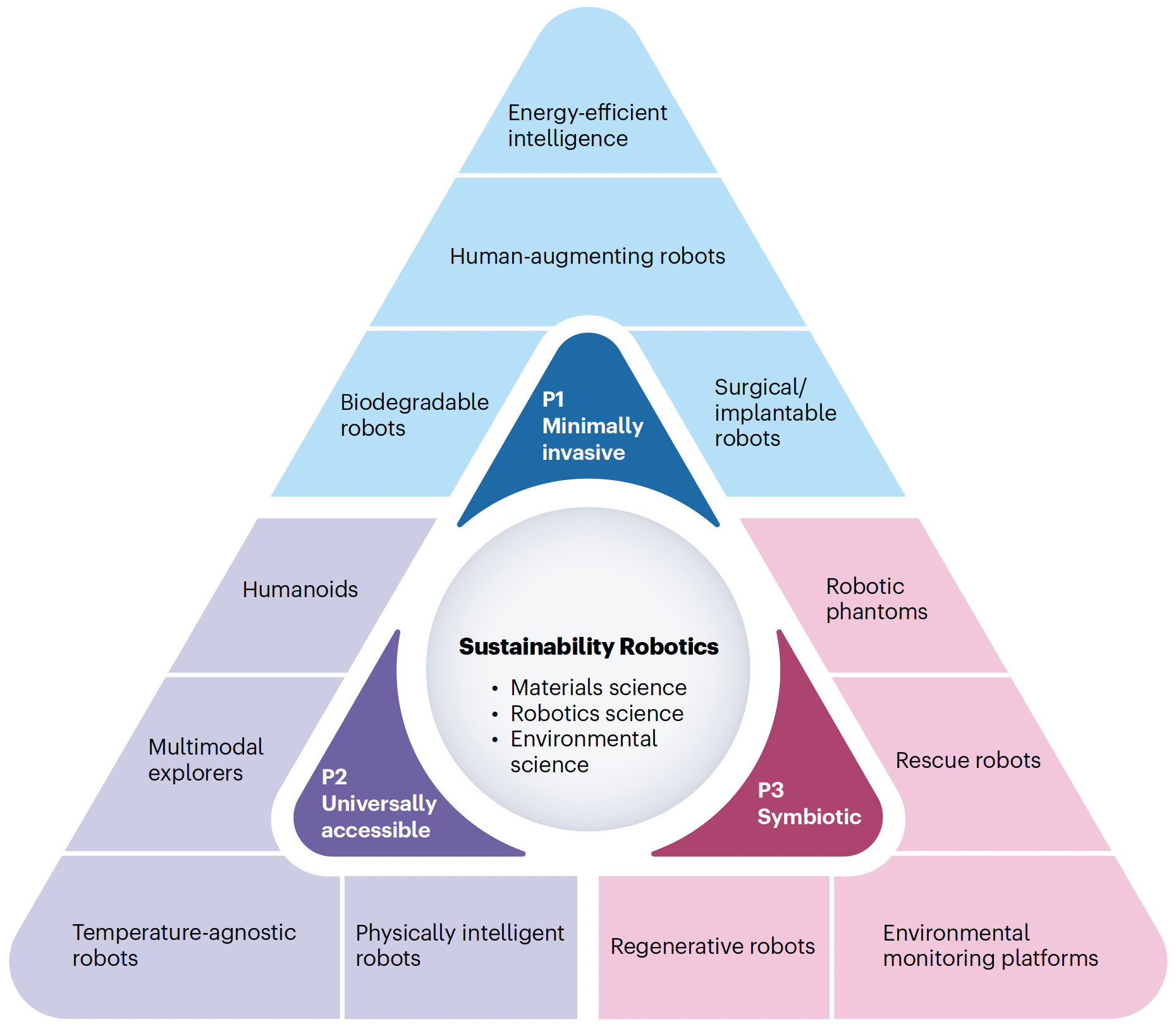
□ The researchers proposed three principles that future robots should uphold: (1) “Minimally Invasive,” minimizing their impact on ecosystems and society; (2) “Universally Accessible,” enabling robots to be readily deployed wherever they are needed regardless of income or location; and (3) “Symbiotic,” fostering positive relationships among humans, the environment, and the economy.
□ Among these principles, the researchers placed particular emphasis on “Symbiotic.” They argued that robots should be evaluated not only in terms of performance and task efficiency but also their environmental and social impacts, including whether they contribute to ecosystems, like coral reef restoration robots, or impose environmental costs, like deep-sea mining robots. They stated that this requires looking beyond “what robots can do” to consider “who benefits and what costs they leave behind.”
□ “The key is not to build faster and more powerful robots, but to build robots that reach the places where they are needed most and benefit both people and nature,” said Prof. Sukho Song. “Sustainability Robotics is a proposal to place at the center of robot design not the performance of robots, but the relationships they establish with the world.”
□ The manifesto was the result of an international collaborative study involving Prof. Sukho Song (DGIST; first author), Prof. Barbara Mazzolai (Italian Institute of Technology), and Prof. Mirko Kovač (Empa and EPFL, Switzerland; corresponding author). The study was supported by the National Research Foundation of Korea and the Ministry of Trade, Industry and Resources.
Advertisement