
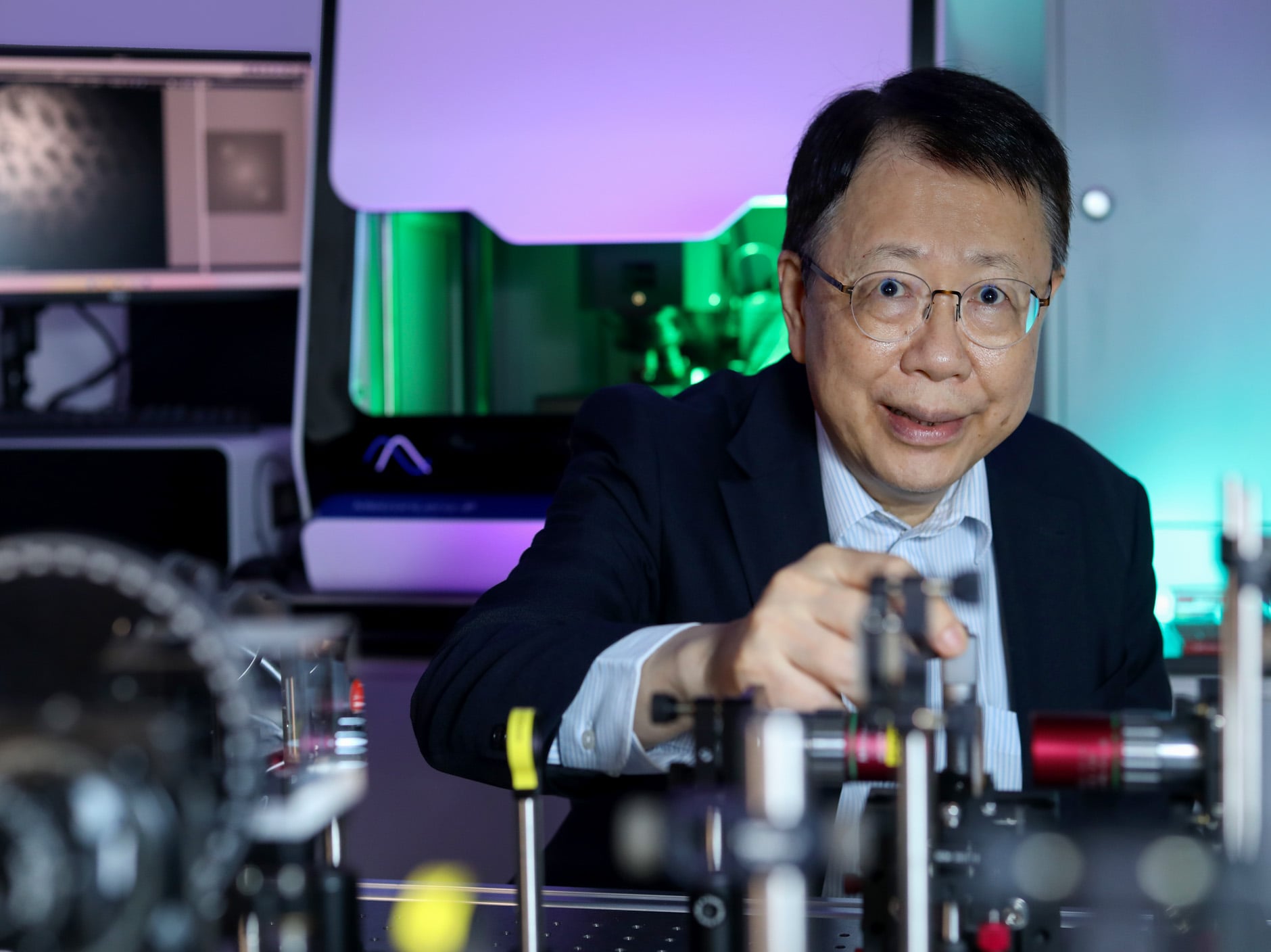
A CityUHK research team, led by Professor Tsai, develops a new optical corner detection imaging method, which demonstrates potential for motion tracking applications.
A research team at City University of Hong Kong (CityUHK) has developed a new optical corner detection imaging method, which uses azimuthal Hilbert transform metasurfaces and is designed to work as a universal framework. The study marks an important advance in high-speed, low-power optical information processing and has demonstrated potential for motion tracking applications.
The study was led by ProfessorTsai Din-ping, Chair Professor in the Department of Electrical Engineering at CityUHK. The project was conducted in collaboration with Professor Tao Li, from the College of Engineering and Applied Sciences at Nanjing University. Titled “Optical corner detection with azimuthal Hilbert transform metasurfaces”, the study was published in the prestigious journal Science Advances and selected as a highlighted work on the journal’s homepage.
The inspiration for this research stems from biological vision. Many animals are especially good at noticing geometric features, especially corners. For example, bees are drawn to angular shapes and use their compound eyes to identify sharp structures on flowers, and woodpeckers often peck at the intersections of bark cracks or the edges of holes, where insects are more likely to be hidden.
These examples reflect a common strategy—extracting key information from complex scenes by focusing on local features, such as corners, that stand out clearly. In today’s world, where information overload is common, this strategy can help reduce visual complexity and improve both sensing and computational efficiency.
Corner detection is widely used in computer vision, including image registration, motion tracking, and 3D reconstruction. Today, most corner detection relies on digital signal processing. However, electronics-based digital processing faces limits in response speed and energy consumption. Photonic or optical processing may offer faster and more energy-efficient performance, but existing optical processing approaches have focused mainly on 2D feature extraction. Practical optical corner detection methods have been limited.
In this study, the research team built a 4f imaging system and introduced a metasurface at the Fourier plane to modulate the optical field in the angular direction. They used silicon nitride as the metasurface material and optimised the structural parameters based on geometric-phase modulation, enabling efficient broadband operation in the visible spectrum.
They first tested metasurfaces with different designs, demonstrating that corners in different polygon shapes were clearly highlighted in the images. They confirmed stable performance across a range of visible wavelengths, supporting the system’s broadband capabilities.
The researchers then used imaging experiments on polygon arrays to show that the scheme could cover the entire detection plane, demonstrating a large-field-of-view corner detection capability.
They further demonstrated that a single metasurface can detect objects with different amplitude, phase, and angular characteristics. They analysed the imaging results, deriving parity rules that explain how bright and dark points form in the resulting images.
Leveraging corner detection capabilities to extract key information, the research team applied the imaging method to track objects undergoing random rotation and translation. The experiments verified its effectiveness in supporting motion tracking and demonstrated efficient data-compression capability.
“Through this study, we highlight the unique advantages of optical metasurfaces for real-time and efficient information processing,” said Professor Tsai. “By providing a new technical pathway for all-optical corner detection, our goal is to reduce energy consumption and improve processing speed in future computational vision systems and next-generation intelligent sensing technologies.”
Dr Chen Chen, a postdoctoral fellow in the Department of Electrical Engineering at CityUHK, served as one of the co-first authors.
This collaborative research was supported by the National Key Research and Development Program of China, the National Natural Science Foundation of China, the Research Grants Council of Hong Kong, and the Areas of Excellence Scheme.