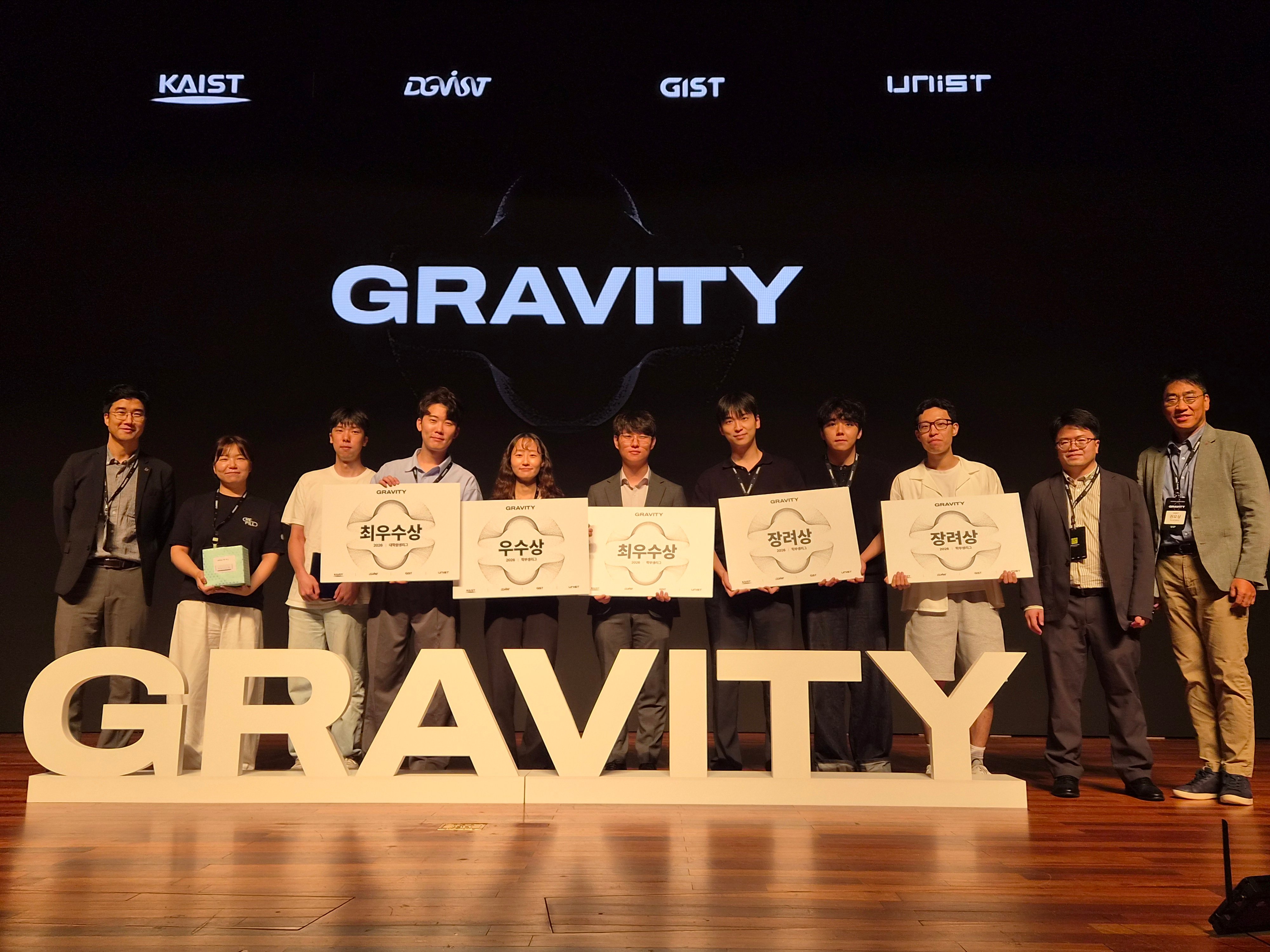
□ DGIST (President Kunwoo Lee) announced that its student startup teams achieved outstanding results in the final round of “GRAVITY 2026,” a joint student startup competition among Korea’s four institutes of science and technology (DGIST, KAIST, GIST, and UNIST), held on the 3rd. Five DGIST teams (including 2 that received Grand Prizes) accounted for half of the 10 award-winning teams and secured a total of KRW 420 million in prize money.
□ Sponsored by the Ministry of Science and ICT and co-hosted by the aforementioned four institutes of science and technology, “GRAVITY 2026” is a competition aimed at building a startup platform that identifies outstanding research achievements and innovative technology startup ideas and connects them with commercialization and follow-on investment. This year, a total of 310 teams applied, resulting in a highly competitive applicant-to-place ratio of 15.5 to 1. A total of 20 teams advanced to the final round, comprising 10 teams in the undergraduate league and 10 in the graduate league.
□ DGIST demonstrated its outstanding entrepreneurial capabilities by sending seven teams to the final round, accounting for 35% of the 20 finalists. Five teams—REPILL, Markworks, Upperbound, QUESTER, and Clebrain—advanced to the undergraduate league, presenting service models based on AI and ICT. Two teams, NEST and QD, competed in the graduate league, presenting advanced commercialization models based on proprietary technologies in the semiconductor and bio-healthcare fields.
□ In particular, five of the seven DGIST teams that advanced to the final round received awards, dominating the competition. In the undergraduate league, Markworks won the Grand Prize (President’s Award) for its “AI patent attorney platform that automates the entire process of securing intellectual property rights,” while in the graduate league, QD won the Grand Prize (President’s Award) for its “next-generation quantum dot-based infrared sensor manufacturing technology designed to replace imported materials.” The teams received KRW 120 million and KRW 150 million in prize money, respectively.
□ In the undergraduate league, QUESTER won the Excellence Award for its “robot learning data infrastructure for the era of Physical AI (AI that interacts with the real world),” securing KRW 50 million in prize money. Upperbound and Clebrain each received an Encouragement Award and KRW 50 million in prize money for their respective projects: “An AI marketing agent for 800,000 food service businesses” and “AI piano lessons that listen to performances and provide immediate corrections.”
□ In addition to prize money, the winning teams will receive extensive follow-up support, including a global acceleration (startup planning and development) program, overseas proof-of-concept testing (technology validation in the market), and connections to investment opportunities. This support is intended to help students turn their creative ideas from concepts into actual market entry and global commercialization.
□ Building on these achievements, DGIST is further stepping up its support for student entrepreneurship on campus. With the Innovation Startup Center, a dedicated organization established in July, serving as the focal point, DGIST is operating a full-cycle support system encompassing the identification of aspiring entrepreneurs, technology advancement, and overseas expansion. By utilizing shared infrastructure on campus, DGIST is improving the efficiency of prototype development and building a leading startup ecosystem that enables outstanding deep-tech (advanced technology-based) companies to expand onto the global stage.
□ “The remarkable achievements of DGIST’s student startup teams at GRAVITY 2026 demonstrate that the students’ strong entrepreneurial spirit and outstanding research capabilities are translating into actual commercialization,” said DGIST President Kunwoo Lee. “We will continue to strengthen our startup infrastructure and support system to the fullest extent so that our students can grow into deep-tech entrepreneurs who lead the global market based on their distinctive technological capabilities.”