

Nationwide Japanese survey reveals how cultural worldviews relate to environmental policy support
How cultural worldviews relate to support for climate change and biodiversity policies in Japan
YOKOHAMA National University
If you want to drum up support for environmental action, putting climate change front and center may not always be the best strategy.
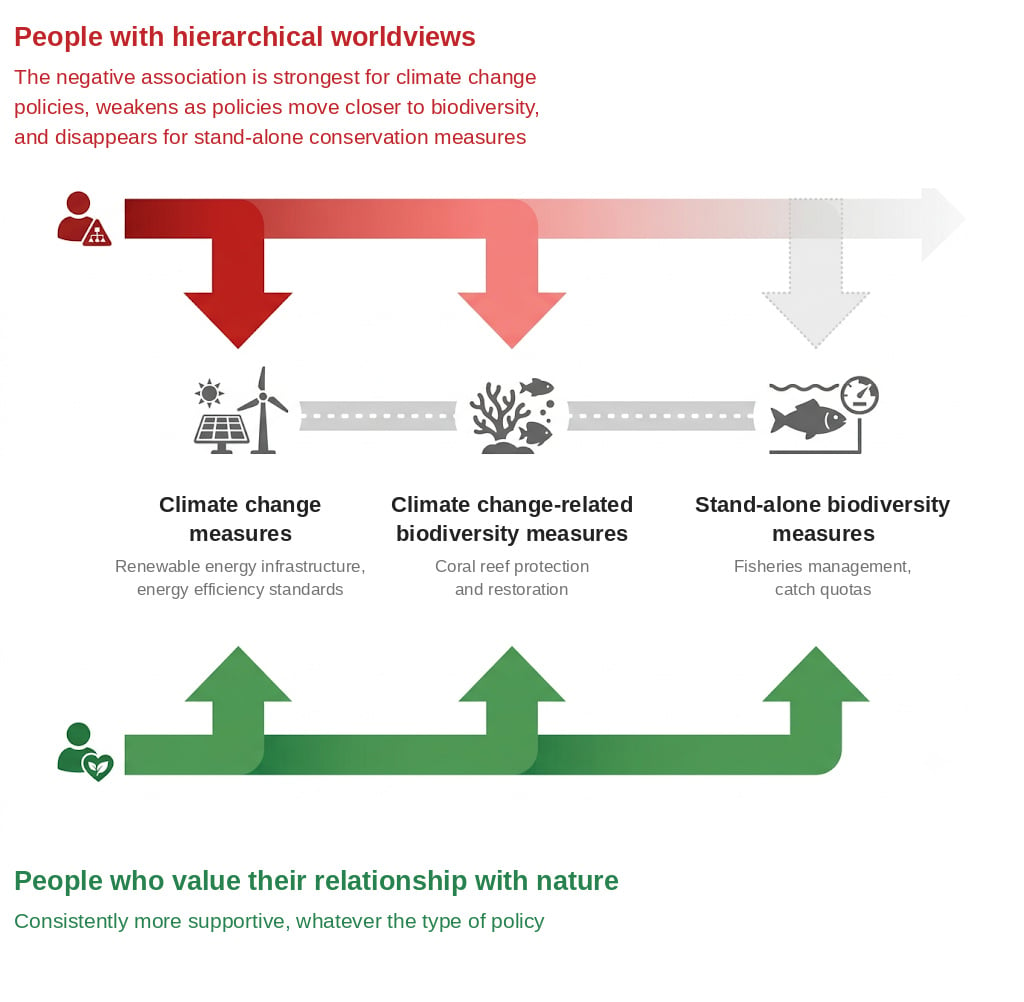
A new study by Aya Takagi and Ryosuke Nakadai of YOKOHAMA National University suggests that support for policies that emphasize biodiversity conservation, including conservation measures that also contribute to climate goals, may be less divided along cultural lines than measures explicitly associated with climate change. The findings were published in Communications Sustainabilityin July 2026.
Public support for climate action is often assumed to depend on whether people accept the science. In Japan, outright denial of human-caused climate change is uncommon, yet support for climate policies still varies — suggesting that scientific understanding may be only part of the picture.
“Support for environmental policy may depend not only on what people know, but also on the cultural worldviews they hold and how they value nature,” said Aya Takagi, associate professor at YOKOHAMA National University’s Faculty of Environment and Information Sciences, and lead author of the study.“We wanted to find out whether cultural worldviews are as strongly linked to support for biodiversity conservation as they are to support for climate policy, and how people’s own values of nature fit into the picture.”
In June 2025, the team surveyed 1,133 people across Japan about their cultural worldviews, values of nature, perceptions of environmental risks and support for different environmental policies, including climate change measures, biodiversity conservation measures related to climate change, and stand-alone biodiversity conservation measures.“We found that cultural worldviews were not linked to environmental policy in the same way across every issue domain,” said Ryosuke Nakadai, lecturer at YOKOHAMA National University’s Faculty of Environment and Information Sciences, and co-author of the study.
The results showed that cultural worldviews mattered most for climate change. People with more hierarchical worldviews — those who are more comfortable with stratified rather than equal social relations — tended to perceive climate change as less risky, and were less supportive of climate change measures, compared to people with more egalitarian worldviews.The association was considerably weaker for biodiversity conservation measures related to climate change. For stand-alone biodiversity conservation measures, the researchers found no clear direct association between hierarchical worldview and policy support.
The findings suggest a potential advantage for biodiversity conservation as a prominent component of climate policy. However, the researchers caution that their results do not mean a climate policy could simply be made more popular by presenting it as biodiversity conservation. The policies examined in the survey were substantively different measures, and the study identified associations rather than causal relationships.
The study also points to another potential source of common ground: relational values of nature, meaning the personal and cultural connections people have with the natural world. Participants with stronger relational values were more supportive of all three types of environmental policy examined.General scientific knowledge was also positively associated with support for biodiversity conservation measures, including those related to climate change.
The team plans to test these relationships experimentally. By presenting the same policy in different ways while keeping its substance constant, researchers might determine whether the framing of environmental action itself affects the influence of cultural worldviews on policy support. They also hope to replicate the findings in countries where environmental issues are more politically polarized than they are in Japan, as well as extend the approach to other policy areas such as health and food security.
“Our ultimate goal is to help design climate and biodiversity policies — and ways of communicating them — that can earn broad public support without deepening social division,” Nakadai said.
###
YOKOHAMA National University (YNU) is a leading research university dedicated to academic excellence and global collaboration. Its faculties and research institutes lead efforts in pioneering new academic fields, advancing research in artificial intelligence, robotics, quantum information, semiconductor innovation, energy, biotechnology, ecosystems, and smart city development. Through interdisciplinary research and international partnerships, YNU drives innovation and contributes to global societal advancement.
Advertisement