
Visualizing the ultrastructure of cellular organelles at the nanometer scale has traditionally required specialized electron microscopy systems or advanced superresolution imaging platforms. Although expansion microscopy (ExM) has emerged as a powerful alternative by physically enlarging biological specimens, achieving both high expansion factors and structural uniformity in a simple workflow has remained a major challenge.
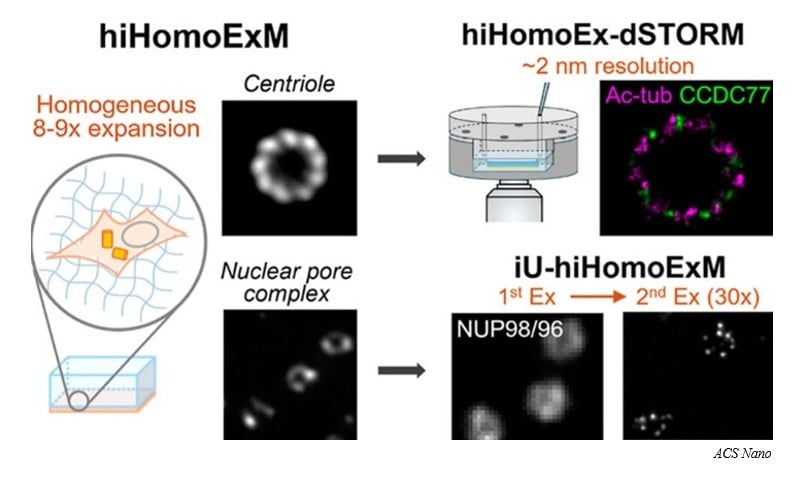
In a study published in ACS Nano, researchers from National Taiwan University report a new expansion microscopy strategy termed high-fold homogeneous expansion microscopy (hiHomoExM), capable of achieving approximately 8–9× isotropic expansion in a single expansion step while preserving delicate ultrastructural organization.
Expansion microscopy works by embedding biological samples within a swellable polymer hydrogel. Following chemical processing, the hydrogel expands uniformly in water, physically separating biomolecules and effectively increasing the spatial resolution achievable by conventional light microscopes.
“To achieve nanoscale imaging faithfully, both high expansion and homogeneous specimen preservation are essential,” explains the research team. “Nonuniform expansion can distort ultrastructural information and limit biological interpretation.”
The newly developed hiHomoExM method addresses these limitations through optimized hydrogel chemistry and specimen anchoring strategies that minimize spatial distortion during expansion. Using this approach, the researchers successfully visualized centrioles — cylindrical organelles critical for cell division and cilia formation — with remarkable structural clarity.
Centrioles possess highly ordered nanoscale architectures composed of microtubule triplets and associated proteins arranged with precise symmetry. Because these structures are only a few hundred nanometers in diameter, detailed imaging has historically relied on electron microscopy. By combining hiHomoExM with fluorescence labeling, the team demonstrated that ultrastructural centriole features could instead be resolved using standard optical microscopy platforms.
The researchers further extended the technology by integrating hiHomoExM with direct stochastic optical reconstruction microscopy (dSTORM), establishing a hybrid imaging platform termed hiHomoEx-dSTORM. This combined approach leverages both physical specimen expansion and single-molecule localization microscopy to achieve substantially enhanced spatial resolution beyond either technique alone.
Using hiHomoEx-dSTORM, the team was able to visualize nanoscale protein arrangements within centrioles with exceptional precision, revealing ultrastructural organization patterns that are difficult to resolve using conventional superresolution microscopy. The method also improves molecular separation after expansion, reducing signal overlap and enhancing localization accuracy for densely packed protein complexes.
“Our approach simplifies high-resolution imaging while preserving ultrastructural fidelity,” the authors note. “By combining homogeneous expansion with single-molecule localization microscopy, hiHomoEx-dSTORM provides a versatile platform for studying nanoscale cellular architecture using fluorescence imaging.”
The findings highlight the growing role of advanced expansion microscopy technologies in bridging the gap between conventional fluorescence imaging and electron microscopy for nanoscale biological research.
The article, “High-fold Homogeneous Expansion Microscopy Reveals Ultrastructural Centrioles,” was published in ACS Nano.
Corresponding author Prof. T. Tony Yang's email address: [email protected]