
The UNU Hub at Lingnan University has developed an AI smart trolley capable of reducing pushing force by up to 90 per cent, significantly easing the physical burden on logistics and delivery workers.
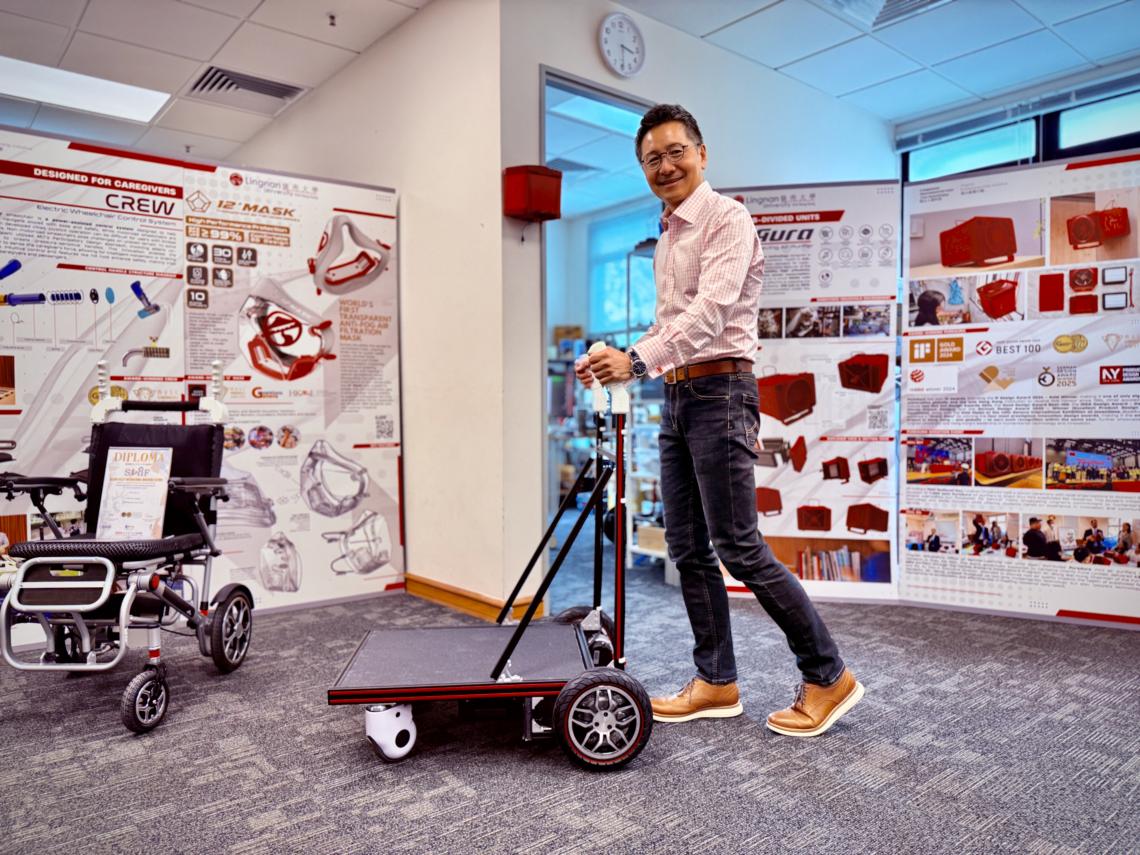
Prof Albert Ko, Founding Director of the UNU Hub at Lingnan University.
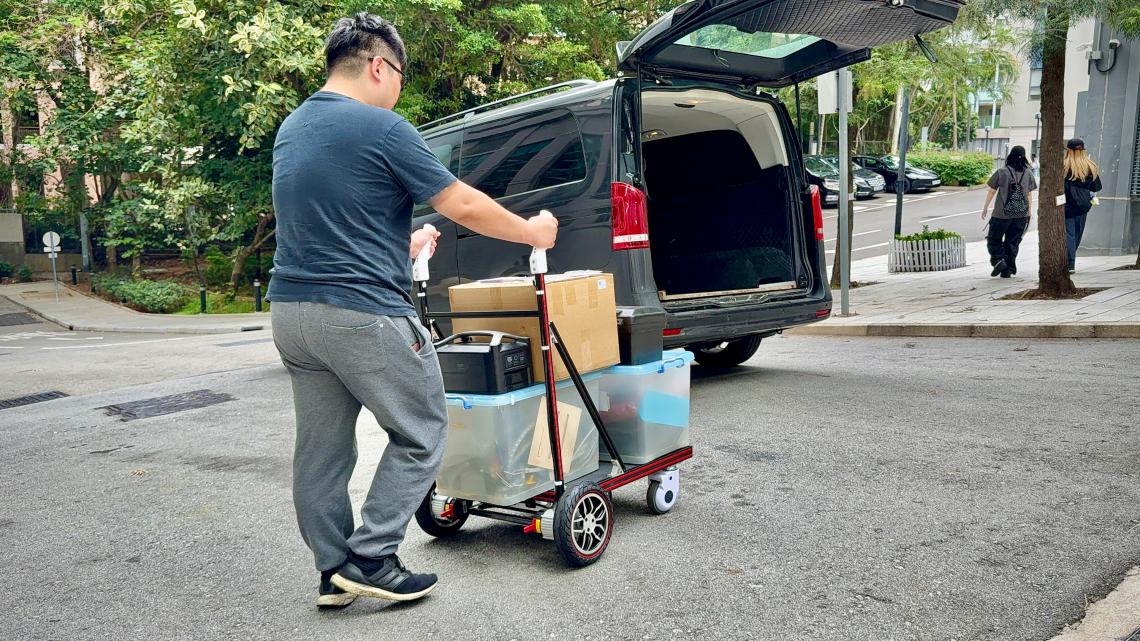
Mr Yim, a self-employed logistics worker participating in the trial, says that using the AI smart trolley to transport heavy goods greatly relieves the strain on his waist and arms.
The AI smart trolley integrates advanced Edge AI and haptic sensing technology, enabling the trolley to collect data and process calculations instantly without requiring an internet connection. By detecting the user’s pushing force and direction, the built-in electric drive acts as a mechanical power assist, automatically providing corresponding support. Users need only push, and the system immediately increases the force to move heavy loads forward.
Experimental testing has shown that the AI smart trolley can lessen pushing effort by up to 90 per cent, even on slopes, around corners, and in narrow passageways, while maintaining smooth and stable movement, largely overcoming the difficulties of transporting heavy goods. Built on the design concept of “the greater the pushing force, the greater the reduction in effort”, the system can further reduce the required pushing force by approximately 96.4 per cent when users push the trolley uphill on a 15-degree slope. In addition, the system is equipped with a safety braking mechanism that activates immediately when the handle is released, reducing the risk of the trolley surging forward or sliding backward.
Prof Albert Ko, Founding Director of the UNU Hub at Lingnan University, said that the concept behind the AI smart trolley derives from another Lingnan University innovation originally designed for conventional wheelchairs, the “CREW Intelligent Wheelchair Control System”. Through AI algorithm enhancement and increased load-bearing capability, the technology has evolved into the “IntuCREW – Intelligent Power Assist System” for industrial and logistics applications, representing a cross-sector breakthrough, and extending technology initially designed to assist elderly mobility and relieve caregivers’ physical burden to commercial and industrial use.
Prof Ko said, “Hong Kong has a massive logistics and retail delivery market, where labour costs and physically intensive work have always been major industry challenges. The breakthrough of this technology lies in combining artificial intelligence with haptic sensing technology to create an AI-powered assistive system capable of understanding human pushing behaviour and providing instant power assistance. This addresses pain points in logistics and delivery work by considerably reducing the physical exertion necessary, while improving efficiency and safety. The system has strong potential for application in warehouse management, delivery logistics, hotel services, and retail restocking, and not only demonstrates the wider possibilities of AI technology across different sectors and user groups, but also the considerable opportunities for commercialisation.”
The AI smart trolley has now entered its field-testing stage in Hong Kong, where self-employed delivery workers, warehouse operators, and logistics practitioners, have been recruited, and the project team is collecting usage data and feedback from different working environments to optimise the design and AI algorithms, while also seeking collaboration with logistics and technology companies for commercialisation and large-scale application.
Mr Yim, a self-employed logistics worker participating in the trial, said that using the AI smart trolley when transporting heavy goods during long working hours greatly relieves the strain on his waist and arms reducing fatigue, and improving work sustainability.
Prof Ko added that the AI smart trolley reflects the Hub’s human-centred technology approach, integrating artificial intelligence, engineering design, and social needs to develop practical innovation solutions. The Hub has already developed a number of award-winning humanitarian technology projects, including the mini air purifier designed to improve the living conditions of low-income families, and infant incubators for remote regions. The UNU Hub at Lingnan University will continue to promote research and development in humanitarian innovation and technology, and to explore the practical potential of AI in society, with the aim of improving the working and living conditions of different communities through technology.