

Lingnan University achieves outstanding results at the 51st International Exhibition of Inventions Geneva, winning 13 awards, more than twice as many as last year.
This year’s award-winning inventions integrate artificial intelligence (AI) with diverse applications (AI+X), notably AI + Creativity, AI + Humanity, AI + Pedagogy, AI + Sustainability, and AI + Trustability. These span professional domains such as data science, advanced materials, sustainable energy, art technology, and transformative education, fully demonstrating Lingnan’s achievements in interdisciplinary collaboration and human-centric innovation, which ultimately drive positive social impact and enhanced community wellbeing.
Prof S. Joe Qin, President and Wai Kee Kau Chair Professor of Data Science at Lingnan University, expressed his delight at the University’s latest important milestone and congratulated all the award-winning teams. He said, “This year, multiple innovative inventions jointly developed by faculty and students’ teams were entered by Lingnan University. By actively breaking traditional disciplinary boundaries under the AI + concept, we have integrated AI into various academic fields, resulting in a series of human-centred research and innovative solutions that respond to societal needs, affirming the University’s mission of ‘Education for Service’. In the face of global technological innovation challenges, Lingnan continues to promote interdisciplinary research, strengthen industry–academia–research collaboration, and transform research into practical applications. At the same time, we seek to equip students with humanistic values to guide technological applications, and make a positive impact on society.”
The research project that received the Gold Medal with Congratulations of the Jury is “FlexiBot: Make Every Parking Spot a Charging Spot”, developed by a team led by Prof Tang Xiaopeng, Assistant Professor (Presidential Early Career Scholar) of the Division of Science. FlexiBot is an intelligent robot designed to provide wireless charging for electric vehicles in any parking space. The robot automatically locates and moves to the nearest charging point. Its wireless charging module and adapter are compatible with all electric vehicles, offering park-and-charge compatible chargers. The system also features smart scheduling for charging, automatically avoiding peak electricity times to reduce grid load and cost.
A total of five projects have won the Gold Medals, including “SmartCool: Digital Twin AI, Cool Smarter with Human Feedback, Hit Carbon Zero”, developed by a team led by President S. Joe Qin; “BuildGuard: Blockchain Oracle AI for Instant Secure Compliance”, developed by Prof Wu Liupengfei, Assistant Professor of the Division of Industrial Data Science at the School of Data Science; “IDShield: AI Behavioural Fingerprinting for Anonymous Dialogue Decode”, developed by a team led by Prof Shen Jiaxing, Assistant Professor of the Division of Artificial Intelligence of the School of Data Science; “Solid-Safe Lithium Battery: Puncture-Proof, 500Wh/kg, Compatible with All Lines”, developed by a team led by Prof Chen Ze, Assistant Professor of the Wu Jieh Yee School of Interdisciplinary Studies; and “StorySketcher: A Multi-Agent AI System for Child-Led Co-Creative Narratives”, a project developed by Prof Xu Xian, Assistant Professor of the Department of Digital Arts and Creative Industries.
Three projects have won Silver Medals, including “Face Fortress: Adaptive All-In-One AI for Digital ID Safety”, developed by a team led by Prof Sam Kwong Tak-wu, Associate Vice-President (Strategic Research); “Hydrogel Smart Window: Cool Without Power”, developed by a team led by Prof Chen Xi, Dean of the Wu Jieh Yee School of Interdisciplinary Studies; and “Smarter Traffic, Safer Roads: AIoT and Real-Time GeoAI Innovations for Urban Transport”, a project developed by Prof Paulina Wong Pui-yun, Head and Associate Professor (Presidential Early Career Scholar) of the Division of Science.
Four projects have won the Bronze Medals, including “DynaGuard: The Smart Brain for Dynamic System Monitoring and Diagnostics”, developed by a team led by President S. Joe Qin; “Generative AI Assessment System (GAAS): A Game-Changer for Timely Student Feedback”, developed by a team led by Prof Frankie Lam King-sun, Director of the Teaching and Learning Centre; “TransLab: AI-powered Translation Learning and Evaluation Suite”, a project developed by Prof George Chan Chi-yu, Assistant Professor of Practice of the Department of Translation; and “CineSim: Interactive Cinematography Lab”, a project developed by Dr Tobby Kan Shiu-tao, Senior Lecturer of the Department of Digital Arts and Creative Industries.
The International Exhibition of Inventions Geneva, held annually since 1973, is the world’s largest exhibition of innovation and invention. This year’s exhibition features over 1000 inventions from approximately 35 countries and regions.
Details of the projects are listed below:
List of winning projects and introduction
|
Awards |
Gold Medal with Congratulations of the Jury; "Thailand Award for the Best International Invention and Innovation" issued by the National Research Council of Thailand |
|
Project Title |
FlexiBot: Make Every Parking Spot a Charging Spot |
|
Winning Lingnan Faculty and Research Staff |
|
|
Project description |
FlexiBot is an intelligent robot designed to provide wireless charging for electric vehicles in any parking space. A smart solution increasing the efficient use of fixed charging stations, the robot automatically locates and moves to the nearest charging point. Its wireless charging module and adapter are compatible with all electric vehicles, offering park-and-charge compatible chargers. The system also features smart scheduling for charging, automatically avoiding peak electricity times to reduce grid load and cost.
Key Features:
The robot goes to the vehicles to be charged automatically, offering flexibility and reducing the cost of parking modifications.
Uses an adapter suitable for all electric vehicles, eliminating compatibility issues and ensuring safe and convenient operation.
Automatically arranges charging times and plans charging queues to optimise energy usage.
|
|
Awards |
Gold |
|
Project Title |
SmartCool: Digital Twin AI, Cool Smarter with Human Feedback, Hit Carbon Zero |
|
Winning Lingnan Faculty and Research Staff |
|
|
Project description |
The SmartCool project is an AI-driven air conditioning management system that optimises performance through the integration of DEMMFL predictive algorithms and RL-MPC control technology. The system simulates both the supply side (chiller units) and the demand side (office spaces) at the same time. Smart feedback devices on office desks instantly report their thermal sensation, enabling precise optimisation of the office air conditioning. This ensures personalised comfort as well as systematic, efficient energy savings. Through accurate load forecasting and reinforcement learning scheduling, SmartCool achieves a precise match between cooling supply and demand. This not only reduces energy consumption, but also resolves the familiar issue of office overcooling, creating a human-centric intelligent environment.
Key Features:
A personalised tool (M5DIAL) on each desk encourages users to provide real-time feedback on their thermal comfort. This input is used to adjust the air conditioning settings in their immediate vicinity for accurate and individualised comfort.
The system integrates all user feedback through a reinforcement learning (RL) algorithm to dynamically optimise the settings of each air conditioning terminal unit, which enhances overall comfort while resolving the usual office overcooling pain point, optimising energy savings and personal comfort.
The system accurately determines the actual cooling load required, and by integrating the DEMMFL forecasting method, it achieves long-term, hour-by-hour load predictions based on the weather, ensuring that the energy supply exactly matches demand, and reducing waste at source.
|
|
Awards |
Gold Medal |
|
Project Title |
BuildGuard: Blockchain Oracle AI for Instant Secure Compliance |
|
Winning Lingnan Faculty and Research Staff |
|
|
Project description |
BuildGuard acts like a super-smart, tamper-proof inspector for remote manufacturing. It uses AI trained by experts and secure blockchain data feeds to check quality and compliance in real time, replacing slow manual reviews with instant, trustworthy, digital audits. The system transmits different types of production data securely to the blockchain ledger, where AI performs real-time analysis to ensure data cannot be altered. Through human-AI collaboration, BuildGuard transforms manual inspections into instant digital processes, solving the problems of low data trustworthiness and slow inspection speeds to support large-scale remote manufacturing while staying compliant with the latest regulations.
Key Features:
An AI core trained in specific domains analyses multi-modal production data on-site, autonomously conducting expert-level compliance checks.
Integrated with blockchain oracle technology, inspection data is securely transmitted to the blockchain ledger, ensuring audit results are authentic and immutable.
Converts time-consuming manual compliance reviews into instant digital workflows, significantly improving remote manufacturing efficiency and allowing high-volume production.
|
|
Awards |
Gold Medal |
|
Project Title |
IDShield: AI Behavioural Fingerprinting for Anonymous Dialogue Decode |
|
Winning Lingnan Faculty and Research Staff |
|
|
Project description |
In the digital era, anonymous mode does not mean true anonymity. Even when users are not logged in, use guest mode, or hide their IP addresses through a VPN, AI conversations may still retain traceable behavioural fingerprints, such as content preference, writing style, interaction patterns, and personality traits. These signals may create a risk of cross-session linkage, identity inference, and privacy non-compliance. IDShield is designed to close this gap. Before content enters the AI platform, it detects and removes behavioural signals that could lead to re-identification. In doing so, it helps companies build safer, more verifiable, and regulation-compliant AI customer service and conversational environments, while preserving the meaning and usability of the interaction.
Key Features:
The system identifies behavioural cues that might reveal a user’s identity from multiple dimensions, including content, writing style, interaction patterns, and personality traits, thereby reducing the risks of cross-session linkage and re-identification.
Unlike solutions that only mask accounts or IP addresses, this system processes identifiable features before content is sent to AI models, which closes the gap where users can still be recognised in anonymous mode, while preserving as much semantic meaning and business value as possible.
The system generates compliance verification reports, allowing companies to assess whether their AI conversational systems fulfil relevant requirements under GDPR Recital 26 and the EU AI Act, reducing regulatory risk and potential exposure to penalties.
Through verifiable anonymisation protection, companies can not only strengthen privacy safeguards, but also improve user trust, platform adoption, and overall service.
|
|
Awards |
Gold Medal |
|
Project Title |
Solid-Safe Lithium Battery: Puncture-Proof, 500Wh/kg, Compatible with All Lines |
|
Winning Lingnan Faculty and Research Staff |
|
|
Project description |
This innovative all-solid-state lithium battery does not contain flammable liquid electrolytes, and offers enhanced safety and stability. It can be deployed to high-performance drones, electric vehicles, and large-scale grid energy storage systems that require extra safety. Currently, the battery has an energy density exceeding 500 Wh/kg, weighs nearly 40 per cent less than traditional power banks under equivalent conditions, and demonstrates significantly improved efficiency, charging from 20 per cent to 80 per cent in just 20 minutes.
Key Features:
The team has validated its stability through extreme tests such as needle penetration, overcharge and over-discharge, axe splitting, and fire exposure.
Benefiting from the integration of “anode-free technology” that further reduces the weight and volume of the battery, its energy density has surged to 500 Wh/kg, placing it at the forefront of the current market. In the future, this advancement could potentially extend the range of electric vehicles to over 800 kilometres.
|
|
Awards |
Gold Medal |
|
Project Title |
StorySketcher: A Multi-Agent AI System for Child-Led Co-Creative Narratives |
|
Winning Lingnan Faculty and Research Staff |
|
|
Project description |
This platform uses AI-guided questions to turn children's drawings into complete and unique stories, stimulating their narrative creativity, logical thinking, and language skills, and making the creative process fun.
Key Features:
Through AI questioning and drawings, children are shown how to extend storylines they have created, and gradually construct a complete narrative.
The interface is suitable for independent operation by children, and also supports parental guidance and companionship.
|
|
Awards |
Silver Medal |
|
Project Title |
Face Fortress: Adaptive All-In-One AI for Digital ID Safety |
|
Winning Lingnan Faculty and Research Staff |
|
|
Project description |
This innovative system integrates deepfake detection and image quality filtering into a single verification pipeline. It first automatically assesses key quality indicators of facial images, such as clarity and lighting conditions, and then applies advanced algorithms to detect whether the image contains synthetically generated or manipulated facial content before proceeding to face recognition. The system is suitable for identity verification and public safety applications where accuracy and reliability are paramount.
Key Features:
Deepfake detection and quality filtering are combined within a unified workflow, eliminating the need to connect multiple systems, and considerably augmenting operational efficiency and reliability.
The system automatically evaluates uploaded facial images based on clarity, lighting, angle, and other quality indicators, filtering out blurred or non-compliant images to ensure high verification accuracy.
Delivers trusted verification results in accuracy-critical environments, such as opening a bank account, border control clearance, and other security-sensitive applications.
|
|
Awards |
Silver Medal |
|
Project Title |
Hydrogel Smart Window: Cool Without Power |
|
Winning Lingnan Faculty and Research Staff |
|
|
Project description |
This is a mass-producible hydrogel smart window that autonomously regulates indoor temperatures without electricity. The technology uses a water-retentive thermochromic hydrogel combined with low-emissivity film to filter solar heat radiation, cooling indoor spaces and reducing energy consumption by up to 34 per cent.
Key Features:
Relying solely on the physical properties of the materials, it senses temperature changes autonomously, and adjusts dynamically in real time, for heat insulation in summer and thermal retention in winter.
Compared to traditional building glass, this can reduce indoor cooling energy consumption by up to 34 per cent, improving environmental sustainability.
|
|
Awards |
Silver Medal |
|
Project Title |
Smarter Traffic, Safer Roads: AIoT and Real-Time GeoAI Innovations for Urban Transport |
|
Winning Lingnan Faculty and Research Staff |
|
|
Project description |
This system is designed to tackle road congestion and improve road safety in Hong Kong. It combines AIoT hardware, cloud-based software platforms, and a GeoAI model to process and analyse dynamic traffic data as well as to forecast traffic conditions for the next hour. At the core of the solution are two actionable outputs: the Traffic Congestion Index (TCI) and the Traffic Accident Risk Index (TARI). These indices provide near-real-time information to drivers and fleet managers on future road conditions and give higher-risk driving contexts, improving safety, fleet management, and traffic congestion.
The project is funded by the Smart Traffic Fund (Project Ref: PSRI/56/2212/PR), and is currently being trialled on about 150 minibuses in Hong Kong.
|
|
Awards |
Bronze Medal |
|
Project Title |
DynaGuard: The Smart Brain for Dynamic System Monitoring and Diagnostics |
|
Winning Lingnan Faculty and Research Staff |
|
|
Project description |
This system works by learning from the normal operational data of machinery and equipment. When any subtle anomaly deviating from the norm occurs in a complex engineering system, it can instantly identify and issue an early warning, while conducting an in-depth diagnosis of the root cause. This allows engineers to intervene and address issues before a failure occurs, and also to pinpoint the source of the problem, improving operational safety and efficiency.
Key Features:
Through AI-driven autonomous learning of normal system dynamics, the technology improves the accuracy of anomaly detection, identifying hidden issues that traditional monitoring methods often overlook. It also diagnoses the type of anomaly, enabling an intelligent process of detection coupled with immediate diagnosis.
Suitable for a variety of complex dynamic systems such as industrial manufacturing and healthcare. In future, it should be able to expand to smart city applications such as transportation networks and big data in financial systems, increasing diagnostic efficiency and precision.
|
|
Awards |
Bronze Medal |
|
Project Title |
Generative AI Assessment System (GAAS): A Game-Changer for Timely Student Feedback |
|
Winning Lingnan Faculty and Research Staff |
|
|
Project description |
The Generative AI Assessment System (GAAS) is an innovative student-centred teaching tool that combines cutting-edge AI technologies such as Retrieval-Augmented Generation and Chain of Thought. It provides students with immediate and targeted feedback on their assignments, which saves teachers time marking work, allowing them to focus more on teaching, while also enabling students to track their own progress, strengthening learning effectiveness and experience.
Key Features:
Uses AI technology to provide students with immediate and targeted learning feedback so as to improve the effectiveness and experience of assignments, including graduation and service-learning projects. It also assists teachers to optimise assessment methods, thereby improving overall learning outcomes.
All cases submitted for AI evaluation are automatically de-identified, meaning student names and ID numbers are not displayed. All data collected by the system will be permanently deleted after use.
GAAS accurately identifies the strengths and weaknesses in student assignments, and provides specific, actionable suggestions for improvement. Students can instantly see their personal learning progress, and teachers get a comprehensive view of students' learning trajectories, thus achieving the goal of using teaching assessment to promote student growth.
|
|
Awards |
Bronze Medal |
|
Project Title |
TransLab: AI-powered Translation Learning and Evaluation Suite |
|
Winning Lingnan Faculty and Research Staff |
|
|
Project description |
TransLab is an AI-powered educational platform specifically designed for translation and language learning. By integrating pedagogical principles into the learning process, providing context-specific feedback, and offering visual explanations for its evaluations, it significantly improves translation, learning and assessment, establishing a new teaching benchmark for efficient translation and language training.
The platform includes two main modules that both assist students in learning and support teachers in assessment, filling a gap in the existing market. The Learner Module (Transmuse) is designed for students and anyone learning to translate, offering a two-stage learning process from comprehension to improvement. It first helps users understand the source text properly, and then to consciously improve the quality of the translation. The Instructor Module (TransEval AI) is designed for teachers and evaluators, analysing translations using multiple criteria, highlighting error types and their causes, and providing specific revision suggestions based on context.
Key Features:
By automating marking, it makes teachers more efficient, identifies error types and their causes, and offers specific revision suggestions based on the text's context, allowing teachers to focus on teaching.
The system improves students' self-learning translation and language skills without teacher guidance.
|
|
Awards |
Bronze Medal |
|
Project Title |
CineSim: Interactive Cinematography Lab |
|
Winning Lingnan Faculty and Research Staff |
|
|
Project description |
This is 3D film production simulation educational software designed for beginners, students, and professionals in the film industry. By integrating immersive VR technology, it creates a virtual film set where users can experience realistic production scenarios and practise principal filmmaking skills, such as cinematography, lighting, camera movement, and storyboard design.
The system overcomes the limitations of physical equipment and venues, fostering creativity, conceptual understanding, and technical skills while providing a cost-effective alternative to expensive physical studios and filming equipment.
The full desktop version of CineSim has been released on the STEAM platform, while the VR version is scheduled for release in the second quarter of this year.
Key Features:
Users can select realistic 3D scene templates from multiple presets such as a nostalgic Hong Kong-style bing sutt or a public housing estate, and adjust lighting, switch between day and night, modify camera angles, and direct character movements to learn and practise filmmaking techniques. They can also develop their own scenes quickly in CineSim to improve pre-production efficiency.
Students can experiment with different setups and generate multiple versions to compare within minutes, significantly reducing the time required for pre-production planning and communication.
|
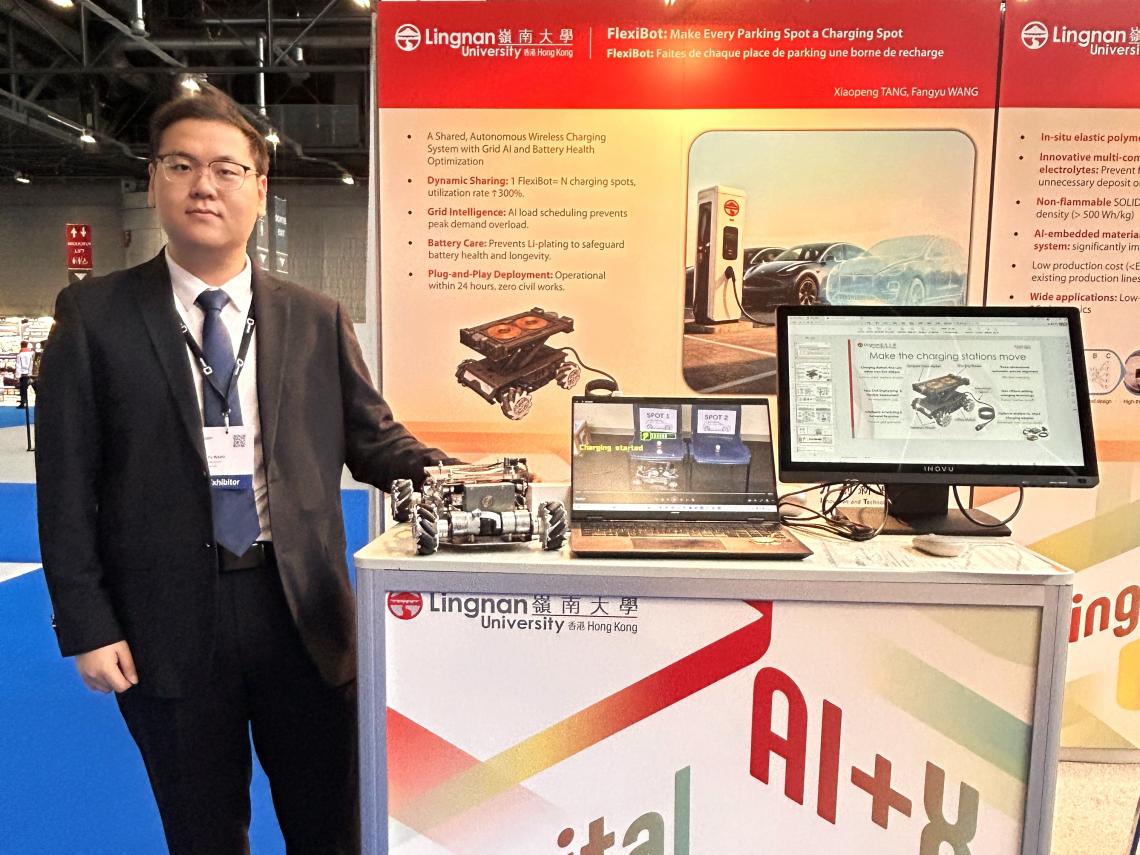
“FlexiBot: Make Every Parking Spot a Charging Spot” wins a Gold Medal with Congratulations of the Jury. The project was developed with the participation of Mr Wang Fangyu, Senior Research Assistant of the Division of Science at Lingnan University.
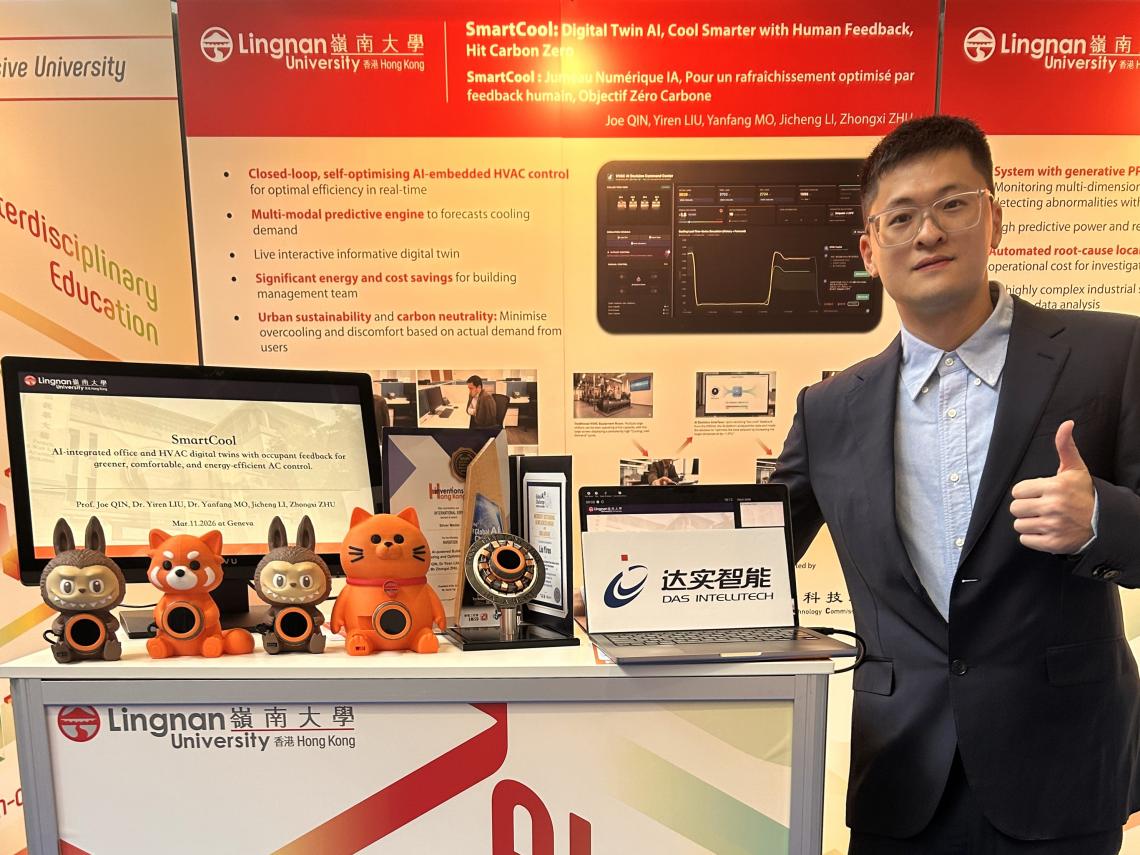
“SmartCool: Digital Twin AI, Cool Smarter with Human Feedback, Hit Carbon Zero” wins a Gold Medal. Shown in the photo is Dr Liu Yiren, Postdoctoral Fellow of the Division of Industrial Data Science at the School of Data Science, who contributed to the project led by President S. Joe Qin.

“Face Fortress: Adaptive All-In-One AI for Digital ID Safety”, developed by a team led by Prof Sam Kwong Tak-wu, Associate Vice-President (Strategic Research) (right), wins a Silver Medal.