

Social sciences Archaeology
News

10 Sep 2026
Two new papers published in Nature offer new insights into how this group of ancient humans looked, evolved, and behaved.
28 Apr 2026
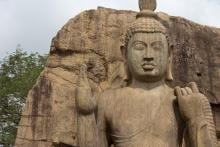
Sculpted from a granite rock face in Sri Lanka’s North Central Province, the Avukana Buddha is an early example of colossal Buddha imagery in Sri Lanka. Its form and detailing suggest connections with sculptural traditions from Amaravati and the Gupta period, while its execution reflects regional adaptation. Discover how the sculpture and its associated finds have been linked to the doctrine of Lokottara or transcendence, later adopted by Mahayana Buddhism.
01 Apr 2026
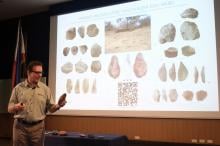
New technology coming out of Ateneo de Manila University is helping reveal the technology of the Philippines' deep past.
22 Jan 2026
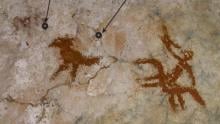
Hand-stencil motifs found in caves in Sulawesi, Indonesia, dating to at least 67,800 years ago, may be the oldest rock art discovered, according to a study published in Nature.

05 Jun 2025
The Mindoro Archaeology Project has found compelling evidence of the pivotal role of the Philippine archipelago in ancient maritime Southeast Asia.

17 Mar 2025
Surviving Antarctica, Probiotics ease anxiety, Ancient mariners, Addressing large urban fires, Smart patch & Dying galaxies. Plus Women experts for International Women’s Day 2025. Read all in the latest Editor's Choice.

21 Feb 2025
New evidence suggests that ancient seafarers in Island Southeast Asia had a technological sophistication comparable to much later civilizations.

24 Jan 2025
Tsuyoshi Watanabe uses corals to understand the environment of the past and what it can tell us about people living then.

17 Jun 2024
A research paper titled ‘Disaster, survival and recovery: the resettlement of Tanegashima Island following the Kikai-Akahoya ‘super-eruption’, 7.3ka cal BP’ co-written by Hokkaido University GSI’s Professor Peter Jordan has been awarded the prestigious Ben Cullen Prize 2024 for making an “outstanding contribution” to World Archaeology.
28 Jun 2023
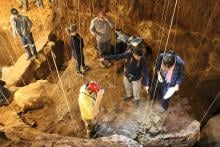
New findings from a cave in northern Laos add to a growing body of evidence that modern humans arrived in Southeast Asia over 80,000 years ago, tens of thousands of years earlier than previously thought.

08 Apr 2022
A team of international researchers, led by Associate Professor Masaki Eda of the Hokkaido University Museum, have discovered that the oldest type of poultry ever domesticated may have been geese. The study involved interdisciplinary research of bones excavated from Tianluoshan site in the lower Yangtze River valley, Zhejiang Province, China.
13 Oct 2021
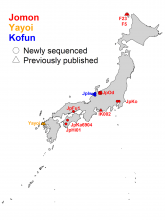
A long-standing hypothesis, the dual-structure model, posits that Japanese populations derive dual ancestry from indigenous Jomon hunter-gatherer-fishers and succeeding Yayoi farmers. We conduct paleogenomic analyses of people of the Jomon, Yayoi, and Kofun periods from Japanese archaeological sites. We identify a later influx of East Asian ancestry in the Kofun period and clarify that the genome of the modern Japanese population is composed of three ancestral components, proposing a tripartite model of Japanese origins.
17 May 2017
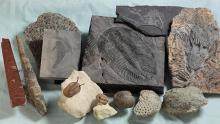
Researchers in the USA and Japan say they may have found the cause of the first mass extinction of life.
Events
Sorry, nothing coming up for this discipline
Researchers
Sorry, nothing coming up for this discipline
Giants in history
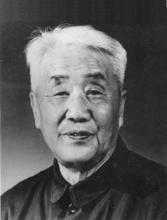
Chinese palaeontologist, archaeologist and anthropologist Pei Wenzhong (January 19, 1904 – September 18, 1982) is regarded as a founder of Chinese anthropology.