

Biology Chronobiology
News
04 Feb 2026
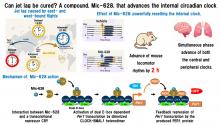
A potential breakthrough for jet lag and shift work-related sleep disorders. A Japanese research team has discovered a new compound that can advance the body’s internal clock—offering hope for faster recovery from jet lag and better adaptation to night-shift work. The compound, called Mic-628, specifically activates the transcription of a clock gene named Period1 (Per1). When given orally to mice, it advanced their body clocks and activity rhythms, regardless of dosing time. The findings suggest a new approach to controlling circadian rhythms through drug action rather than light exposure.

18 Dec 2024
Researchers have found that adding sugar or artificial sweetener to drinks with caffeine gives a significant boost to the sleep-wake period in mice
21 Dec 2023
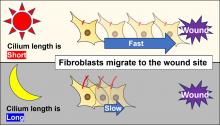
We’re all familiar with our body’s internal clock: it gives us cues on when to wake and when to rest, but it also can determine the rate and time of day at which your body most effectively heals wounds.
14 Dec 2022
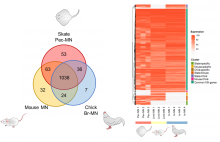
- Identifying the entire genome of the primitive fish, little skate, and proposing the molecular mechanism for the evolution of movement
- Joint Research of DGIST · Seoul National University · New York University Medical School... Published in SCI-level journals
07 Dec 2018
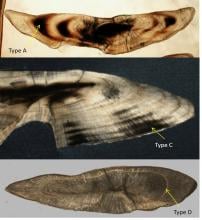
Biologists in Japan have identified four distinct zones in the otolith, a calcium carbonate structure in the inner ear, which can be used to determine age in fish.
Events
Sorry, nothing coming up for this discipline
Researchers
Sorry, nothing coming up for this discipline
Giants in history
Sorry, nothing coming up for this discipline