

Physics Computational physics
News
16 Jul 2026
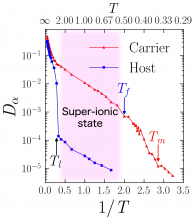
Using a simple physical model, researchers at the University of Osaka, The National Institute of Advanced Industrial Science and Technology (AIST), RIKEN, and the Institute of Science Tokyo revealed how superionic conduction emerges when mobile ions undergo sublattice melting while the surrounding crystal framework remains intact. Near this transition, ions move cooperatively in spatially heterogeneous, string-like patterns, aided by anharmonic lattice motion. The findings identify general physical principles connecting lattice softness and collective transport, potentially guiding more efficient development of solid electrolytes for batteries and energy-conversion technologies.
10 Jun 2026
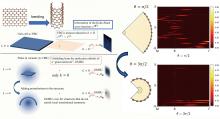
New “GMBU” procedure reveals band structures in finite, curved nanomaterials, linking nano‑ARPES and theory for next‑generation device design.
25 Sep 2025
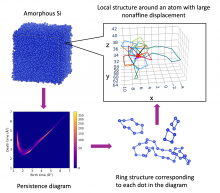
Researchers from The University of Osaka, AIST, Okayama University, and the University of Tokyo applied an innovative computational-analysis technique to clarify the atomic structure of soft, easily deformable regions in amorphous silicon. They discovered that these regions combine medium-range order with local disorder, a finding that will guide the design of more durable amorphous materials.

05 Aug 2025
A joint research team from Japan has observed "heavy fermions," electrons with dramatically enhanced mass, exhibiting quantum entanglement governed by the Planckian time – the fundamental unit of time in quantum mechanics. This discovery opens up exciting possibilities for harnessing this phenomenon in solid-state materials to develop a new type of quantum computer.

16 Jul 2025
A groundbreaking new method developed at The University of Osaka calculates the entropy of liquids using a non-empirical approach, requiring only the atomic species as input. This revolutionary technique eliminates the need for extensive experimental data, paving the way for enhanced predictions of chemical reactions and optimization of industrial applications involving liquids.

02 Jun 2025
A team led by Professor Masakatsu Murakami has developed a novel concept called micronozzle acceleration (MNA). By designing a microtarget with tiny nozzle-like features and irradiating it with ultraintense, ultrashort laser pulses, the team successfully demonstrated—through advanced numerical simulations—the generation of high-quality, GeV-class proton beams: a world-first achievement.

27 Jan 2025
The team’s findings have potential applications in photonics and memory devices.
03 Apr 2024
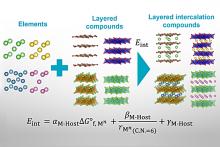
Researchers from the Institute of Industrial Science, The University of Tokyo and collaborating partners have created guidelines for the design of intercalated materials, which will accelerate research on energy storage, electronics, and more

21 Jul 2023
Researchers from the Institute of Industrial Science, The University of Tokyo, provide physical insights into porous soft materials, which will facilitate the design of many energy, medical, and other technologies.
06 Jan 2023
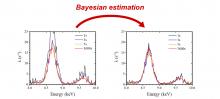
A research group at Osaka Metropolitan University has succeeded in significantly reducing the measurement time of a glass standard sample by applying Bayesian estimation to X-ray fluorescence analysis. The ability to perform rapid non-contact elemental analysis in a nondestructive manner could lead to the widespread use of this technique in many fields, including the analysis of moving industrial products and waste materials while being carried on conveyor belts.
25 Jul 2022
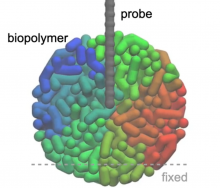
Researchers at Kanazawa University report in The Journal of Physical Chemistry Letters how to simulate 3D atomic force microscopy images of out-of-equilibrium systems involving biomolecules. The approach makes use of a celebrated equation from thermodynamics applicable to non-equilibrium situations.
16 Feb 2022
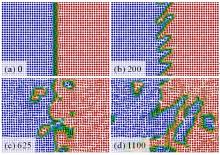
Through numerical simulations, a researcher details the discovery of a new isolated skyrmion with a half-integer topological quantum number in the ferromagnetic phase of the magnetic quantum fluid Bose-Einstein condensate (BEC). The new skyrmion is generated by applying a spin current to a magnetic domain wall and it has an eccentric (off-center) spin singularity inside it.

02 Sep 2021
Researchers have developed a general quantum algorithm that can directly calculate the energy difference of an atom and molecule using a quantum computer. By avoiding the need to calculate the total molecular energies, the general algorithm is expected to be applied not only to quantum chemical calculations but also to various physical and mathematical problems, which are intractable with nowadays classical computers.

17 Mar 2021
Researchers improve their newly established quantum algorithm, bringing it to one-tenth the computational cost of Quantum Phase Estimation, and use it to directly calculate the vertical ionization energies of light atoms and molecules such as CO, O2, CN, F2, H2O, NH3 within 0.1 electron volts of precision.
02 Dec 2020
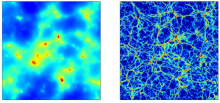
A research team including Kavli IPMU Principal Investigator Naoki Yoshida has, in a world first, succeeded in performing a 6-dimensional simulation of neutrinos moving through the universe.
Events
Sorry, nothing coming up for this discipline
Researchers

Dr. Umedjon Khalilov is a computational materials scientist with over 20 years of experience in atomistic modeling of nanostructures. His research integrates molecular dynamics (MD), Monte Carlo (MC), and density functional theory (DFT) simulations to investigate the synthesis, stability, and functionality of carbon-based and silicon-based nanomaterials. He has led or contributed to numerous international projects focused on hydrogen storage, carbon nanotube growth, and surface reactions in plasma environments. Dr. Khalilov is also actively involved in AI-driven materials discovery and collaborative platforms bridging simulation with experiment.
He has authored 40+ peer-reviewed publications in leading journals.
Giants in history
Sorry, nothing coming up for this discipline