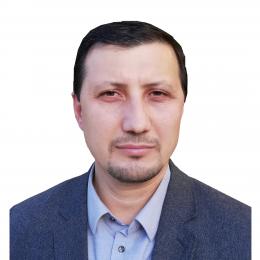
Dr. Umedjon Khalilov
Curriculum Vitae
1. Personal Information
Name: Dr. Umedjon Khalilov
Nationality: Uzbekistan
Current Affiliation: Institute of Ion-Plasma and Laser Technologies, Academy of Sciences of Uzbekistan / University of Antwerp, Belgium
E-mail: [email protected], [email protected]
Website: https://nsgroup.uz/
ORCID: http://orcid.org/0000-0003-3841-1895
2. Education and Qualifications
- DSc in Physics/Mathematics – Academy of Sciences of the Republic of Uzbekistan (2021)
- PhD in Chemistry – University of Antwerp, Belgium (2013)
- MSc in Physics – Termez State University, Uzbekistan (1998)
3. Current Position
Chief Researcher (IPLT, Uzbekistan) (Nov. 2020 – Present)
4. Previous Positions
- Senior Postdoctoral Researcher, UA and FWO, Belgium (2017–2020)
- Postdoctoral Researcher, UA and FWO, Belgium (2014–2017)
- Postdoctoral Researcher, UA, Belgium (2013–2014)
- PhD Student, UA & IMEC, Belgium (2009–2012)
- Lecturer and Assistant Researcher, Uzbekistan (1998–2008)
5. Research Interests and Scientific Profile
Dr. Khalilov specializes in computational materials science, with a focus on atomistic modeling of nanostructure synthesis mechanisms, including carbon nanotubes, graphene, and silicon-based materials. His work combines reactive molecular dynamics (MD), Monte Carlo (MC) simulations, and density functional theory (DFT) to uncover mechanisms at the atomic scale. He is internationally recognized for his contributions to plasma-assisted nanostructure synthesis and nucleation theories.
6. Key Achievements and Contributions
- First-author article in Nature Communications (2015)
- “Hot Paper” in Nanoscale (2014)
- Front cover, Chemistry of Materials (2012)
- “IOP select” publication, New Journal of Physics (2012)
- Over 40 peer-reviewed publications, h-index 14 (Scopus)
- International research stays: University of Tehran, University of Orleans, University of Antwerp
7. Research Funding and Projects
- PI, Selective synthesis of carbon nanostructures (2021–2026, Uzbekistan Ministry of Innovation)
- PI, Molecular mechanisms of nanostructure processes (2022–2024, ASRUz)
- FWO Projects (2014–2020, Belgium)
- IMEC-UA collaboration on CNT growth / Si oxidation (2009–2012)
8. International Experience
- University of Tehran, Iran (2024)
- PLASMANT group, University of Antwerp (2023)
- GREMI group, University of Orleans, France (2016)
9. Teaching and Supervision
- Supervises MSc and PhD students in computational modeling
- Teaches General Physics, Physical Chemistry, and Computational Physics/Chemistry
10. Skills
- Programming: Fortran (advanced), C/C++ (basic)
- Software: LAMMPS, VASP, COMSOL (basic), LaTeX
- Platforms: Windows, Linux
11. Languages
- English, Russian (professional); French, Dutch (basic); Uzbek (native)
Selected publications
1. U. Khalilov et al., Nat. Commun., 2015, 6, 10306. (IF: 11.3)
2. U. Khalilov et al., Nanoscale Horiz., 2019, 4, 674. (IF: 9.1)
3. U. Khalilov et al., Nanoscale, 2017, 9, 1653. (IF: 7.2)
4. U. Khalilov et al., FlatChem, 2023, 39, 100506. (IF: 5.8)
5. U. Khalilov et al., Acc. Chem. Res., 2017, 50, 796. (IF: 20.9)
6. U. Khalilov et al., Chem. Mater., 2012, 24, 2141. (IF: 8.2)
7. U. Khalilov et al., Carbon, 2021, 171, 72. (IF: 8.8)
8. U. Khalilov et al., Carbon, 2019, 153, 1 (IF: 7.466)
9. U. Khalilov et al., Int. J. Hydrogen Ene., 2024, 55, 604. (IF: 7.2)
10. D. Yu et al., Small, 2024, 20, 2311810. (IF: 13.3)