

Engineering & Technology Materials Science and Engineering
News

27 Jan 2022
To meet the demand for strong and tough transparent thin films for sustainable applications, Dr Sunanda Roy from GLA University India has led a multi-national team to successfully develop a novel transparent thin film made from cellulose nanofiber (CNF) reinforced by glycerol & glutalraldehyde (reinforcing glycerol).
18 Jan 2022
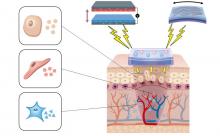
Researchers are working to overcome challenges in order to bring wearable, electric, wound-healing devices to clinical practice.

22 Dec 2021
To meet the demand for alternative low-cost, sustainable, light weight and strong materials for two wheelers, Dr JS Binoj from Sree Vidyanikethan Engineering College India has led a multi-national team to successfully develop a novel riser bar made from jute fibre reinforcing isophthalic polymer composite material.

09 Dec 2021
An engineering project team, has been awarded the Institution of Engineers - Singapore, Prestigious Engineering Achievement Awards 2021 in the Research & Development Category. The award was for their work on Replication & Repair of Hot Air Thermal Defects on Composite Aero-Structures.

02 Dec 2021
Researchers from the The University of Tokyo Institute of Industrial Science use electron energy loss spectroscopy to understand local thermal behavior at grain boundaries in polycrystals

04 Nov 2021
A research led by scientists from City University of Hong Kong (CityU) has successfully developed a super-strong, highly ductile and super-light titanium-based alloy using additive manufacturing, commonly known as 3D printing. Their findings open up a new pathway to design alloys with unprecedented structures and properties for various structural applications.

28 Oct 2021
Researchers succeed in developing a lithium sulfide cathode containing a solid electrolyte with high decomposition resistance, enabling the realization of all-solid-state lithium-sulfur batteries that exceed the energy density of lithium-ion batteries

28 Oct 2021
Spontaneous wide-area spreading of oil on water inspires a facile energy-saving route of crafting electrically conductive nanostructures for future sensor/energy devices

29 Sep 2021
A quick, cost-effective approach improves the accuracy with which machine learning models can predict the properties of new materials.

20 Sep 2021
Twisting light that switches direction at room temperature could be the future of quantum information processing.

14 Sep 2021
Researchers at Jilin University, China, reviewed recent progress in the study of Salvinia leaves and their artificial replicas.
09 Sep 2021
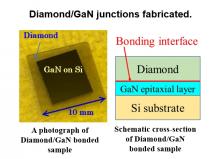
Researchers succeed in the direct bonding of diamond and gallium nitride (GaN) at room temperature and demonstrate that the bond can withstand heat treatments of 1,000℃, making it ideal for the high temperature fabrication process of GaN-based devices. GaN-on-diamond semiconductor material will allow for the next generation of high power, high frequency devices.

01 Sep 2021
Scientists from South Korea add foreign atoms to monolayer graphene in a controlled manner to selectively enhance its desirable properties

18 Aug 2021
Scientists in Korea make hand-drawn and flexible pressure sensors that can control a phone from underwater.
29 Jul 2021
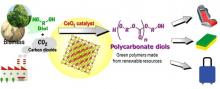
Using a CeO2 catalyst, researchers develop an effective catalytic process for the direct synthesis of polycarbonate diols without the need for dehydrating agents. The high yield, high selective process has CO2 blown at atmospheric pressure to evaporate excess water by-product allowing for a catalytic process that can be used with any substrate with a boiling point higher than water.

13 Jul 2021
As rechargeable batteries get more powerful, the chance of batteries overheating –thermal runaway - increases. Seeking a way to make batteries safer, researchers have investigated one of thermal runaway’s main triggers: oxygen release.

05 Jul 2021
Osaka Prefecture University develops a method to design and control the path of electron flow in a polycrystalline material. Using epitaxial growth approach, researchers address the electrical conductivity problem of thin film materials by realizing a highly conductive in-plane orientation of a metal-organic framework. Furthermore, they show that it is possible to fabricate oriented thin film patterns by integration with UV lithography technology.
18 Jun 2021
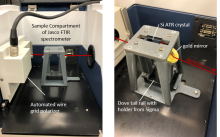
Researchers at Osaka Prefecture University have established an approach to identify the orientation of molecules and chemical bonds in crystalline organic-inorganic hybrid thin films deposited on substrates using Fourier transform infrared spectroscopy (FT-IR) and polarized infrared light with a 3D-printed attenuated total reflectance (ATR) unit. This inexpensive method with laboratory-grade equipment quickly reaches the crystal-structure model of even extremely thin films of less than 10 nm.
25 May 2021
Scientists develop degradation-mitigating additives that vastly extend the lifespan of Nafion-based fuel cells

13 May 2021
The trick to extremely thin supercapacitors with improved performance is spraying graphene ink at an angle.
12 May 2021
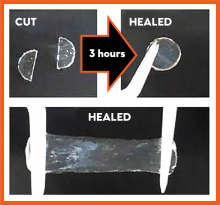
Ion-conducting gels that repair themselves following damage are under development for wearable electronics.

12 May 2021
Heusler alloys are promising contenders for faster and more energy-efficient computing and memory storage devices.

12 May 2021
Printing electronic circuits could soon get easier and cheaper.

12 May 2021
Molecular interactions within gels and rubbers can be controlled to fabricate stronger and more elastic materials.

12 May 2021
An artificial intelligence approach extracts how an aluminium alloy’s contents and manufacturing are related to specific mechanical properties.

12 May 2021
From biomemory to implants, researchers are looking for ways to make more eco-friendly electronic components.

10 May 2021
Complex algorithms can be taught to predict steel corrosion rates in coastal regions, helping engineers choose the best materials for each location.
19 Apr 2021
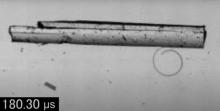
Researchers discovered, while exploring the photomechanical properties of diarylethene, that under irradiation with UV light the crystal of the compound peels off into micrometer sized crystals at a world’s fastest speed of 260 microseconds. As the material returns to its former molecular structure when exposed to visible light, the exfoliation method positions itself as a candidate for photoactuator manufacturing.
14 Apr 2021
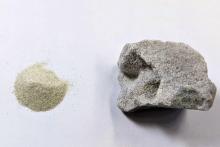
Researchers at the Institute of Industrial Science at The University of Tokyo examined a new method of producing concrete via direct bonding of sand particles, which may help reduce greenhouse emissions and even construct a Moon base.
01 Apr 2021
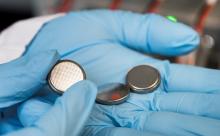
The promotion of electric cars has dramatically increased the demand for lithium-ion batteries. However, cobalt and nickel, the main cathode materials for the batteries, are not abundant. If the consumption continues, it will inevitably elevate the costs in the long run, so scientists have been actively developing alternative materials. A joint research team co-led by a scientist from City University of Hong Kong (CityU) has developed a much more stable, manganese-based cathode material. The new material has higher capacity and is more durable than the existing cobalt and nickel cathode materials - 90% of capacity is retained even when the number of charging-recharging cycles doubled. Their findings shed lights on developing low cost and high efficiency manganese-based cathode materials for lithium-ion batteries.
Events
Sorry, nothing coming up for this discipline
Researchers
Sorry, nothing coming up for this discipline
Giants in history
Sorry, nothing coming up for this discipline