

Chemical Engineering Nanotechnology
News

25 Sep 2026
New laser-powered technology rapidly gathers microscopic targets for faster, more sensitive and selective detection

13 Aug 2026
Black hole "blast", Bacteria-detecting robot, A crab's tale, Sensors that remember, and Silk in cycling. Plus submission deadline for 2027 magazine. Read all in the latest Editor's Choice.
22 Jul 2026
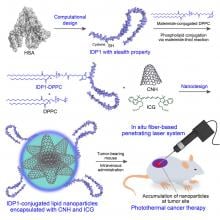
Photothermal therapy is a cancer treatment option lacking the negative side effects associated with chemotherapy. Near-infrared laser light selectively heats and destroys cancer cells. However, two issues have stopped this less invasive treatment from becoming mainstream. Scientists have long sought to find a way to prevent nanoparticle clearance - where the immune system clears the nanoparticles carrying therapeutic agents before they can reach tumors - and better laser efficacy so it can reach deeper tumors. Now, a research team has overcome these challenges.
28 May 2026
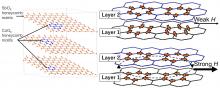
Researchers from The University of Osaka created stable cobalt-based honeycomb structures inside a layered material and observed ferromagnetic-like ordering at low temperatures. By introducing a small amount of cobalt into NaSbO3, the team demonstrated a new platform to study Kitaev materials using abundant 3d transition metals, potentially supporting future cost-effective quantum technologies.
16 Mar 2026
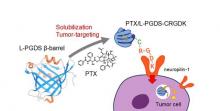
Through protein binding, molecular heavy drugs are effectively transported to cancerous tissues
02 Dec 2025
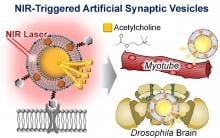
Researchers at the Nano Life Science Institute (WPI-NanoLSI), Kanazawa University, report in ACS Nano the successful creation of artificial synaptic vesicles that can be remotely controlled by near-infrared (NIR) light. By embedding a phthalocyanine dye into lipid bilayers, the team achieved local heating that modulates membrane permeability, enabling precise release of neurotransmitters such as acetylcholine. These findings demonstrate that nanoscale heating can control communication between nerve cells.
The work opens new avenues for non-genetic modulation of neuronal activity, with potential applications in neuroscience, drug delivery, and bioengineering.

06 Nov 2025
Researchers at the Nano Life Science Institute (WPI-NanoLSI), Kanazawa University, report in the Journal of the American Chemical Society the use of three-dimensional atomic force microscopy (AFM) and molecular dynamics simulations to determine the structure of water in the hydration of different types of chitin nanocrystals, and how this affects their mechanical properties, reactivities, and interactions with enzymes and reactants.
18 Sep 2025
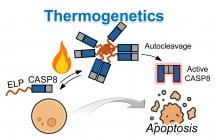
Researchers at the Nano Life Science Institute (WPI-NanoLSI), Kanazawa University, report in ACS Nano, how proteins in cells can be controllably activated through heating, an effect that can be used to initiate programmed cell death.

23 Jun 2025
Cyborg jellyfish, 3D collagen, Light, light go away, AI electronic nose, FLASHing cancer, Hydrogen storage in nanoscales & Can I drink this? Read all in the latest Editor's Choice

18 Jun 2025
Researchers at the Nano Life Science Institute (WPI-NanoLSI), Kanazawa University observe and model how the enzyme ADAR1 interacts with double-stranded RNA, which may be useful for future cancer treatment strategies.
12 Mar 2025
Researchers at Nano Life Science Institute (WPI-NanoLSI), Kanazawa University, observe the configuration of different dipeptides on graphite electrodes and the subsequent arrangement of catalytic hemin on them to get an idea of the factors affecting its catalytic activity.

05 Jul 2024
Researchers at Nano Life Science Institute (WPI-NanoLSI), Kanazawa University report in Small Methods the 3D imaging of a suspended nanostructure. The technique used is an extension of atomic force microscopy and is a promising approach for visualizing various 3D biological systems.

10 May 2024
Researchers at Nano Life Science Institute (WPI-NanoLSI), Kanazawa University report in Nano Letters how the use of high-speed atomic force microscopy helps to understand the crucial role played by certain biomolecules in DNA wrapping dynamics.
04 Mar 2024
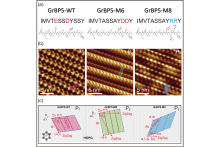
In a study recently published in the journal SMALL, a weekly peer-reviewed scientific journal covering nanotechnology, published by Wiley-WCH, Germany, researchers from Nano Life Science Institute (WPI-NanoLSI), Kanazawa University, Japan, collaborating with Professor Sarikaya, Seattle, USA, used frequency modulated atomic force microscopy to reveal the molecular architecture of genetically designed and point mutated peptides and their self-organizations each forming single-molecule thick, distinct biological crystals on atomically flat graphite and MoS2 surfaces, offering a potential platform for hybrid technologies such as bioelectronics, biosensors, and protein arrays.

19 Aug 2023
In a study recently published in the journal Nanoscale, researchers from Kanazawa University and AGC Inc. use three-dimensional atomic force microscopy to study the hydrated form and structure of commonly occurring oxide crystals.
14 Mar 2023
In a study recently published in the journal ACS Nano, published by American Chemical Society, researchers from Kanazawa University, Kanazawa, Japan, collaborating with University of Washington, Seattle, USA, used frequency modulated atomic force microscopy to reveal the molecular architecture of a genetically designed peptide and its self-organization that forms single-molecule thick crystals on atomically flat graphite surfaces, that offer a potential platform for hybrid technologies such as bioelectronics, biosensors, and protein arrays.
17 Oct 2022
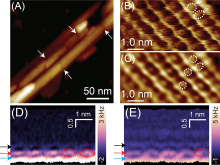
Chemists in Japan, Canada and Europe have uncovered flaws in the surface structure of cellulose nanocrystals—an important step toward deconstructing cellulose to produce renewable nano-materials relevant to biochemical products, energy solutions, and biofuels.
25 Feb 2022
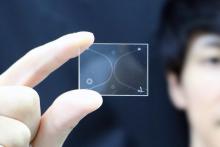
A Japanese research team created a new way to sort living cells suspended in fluid using an all-in-one operation in a lab-on-chip that required only 30 minutes for the entire separation process.
19 Oct 2021
When liquid meets gas, a unique zone forms. Variable by nature, molecules can cross from one state to another, combining in unique ways to either desirable or unwanted ends. From heat escaping a mug of coffee to increasing molecular concentrations in chemical solutions, gas-liquid interfaces are ubiquitous across nature and engineering. But a lack of tools capable of precisely controlling such gas-liquid interfaces limit their applications — until now.
28 May 2021
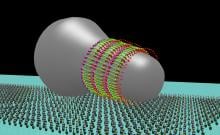
In collaboration with Kanazawa University, researchers from Osaka City University used high-speed atomic force microscopy (HS-AFM) to visualize at the nanometer level the movement of individual particles within the parasitic bacterium Mycoplasma mobile. After confirming the outline on the surface of the cell structure in an immobilized state with previous data gathered from electron microscopy, the team succeeded in visualizing the real-time movements of the internal structure by scanning the outside of the cell with HS-AFM.
19 Nov 2020
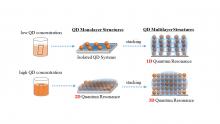
Scientists have found a way to control an interaction between quantum dots that could lead to more efficient solar cells.
17 Nov 2020
Scientists explain how selective electrostatic doping can balance the charge in optoelectronic devices with 2D materials

26 Mar 2020
In a recent study published in Autophagy, researchers at Kanazawa University show how abnormalities in a gene called TPR can lead to pediatric brain cancer
26 Aug 2019
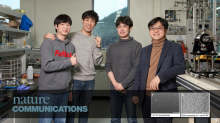
A recent study, affiliated with South Korea's Ulsan National Institute of Science and Technology (UNIST) has introduced a novel technology, capable of fabricating highly ordered arrays of graphene quantum dot (GQD). This research has gained much attention from academia since it was introduced in the February 2019 issue of Nature Nanotechnology.
Events
Sorry, nothing coming up for this discipline
Researchers
Sorry, nothing coming up for this discipline
Giants in history
Sorry, nothing coming up for this discipline