

Angewandte Chemie International Edition
About Angewandte Chemie International Edition
Angewandte Chemie International Edition is a journal of the German Chemical Society (GDCh). It is one of the prime chemistry journals in the world. It is the only journal in the field delivering a stimulating mixture of Review-type articles, Highlights, Communications, and Research Articles. New articles appear online almost every day.
News
11 Sep 2019
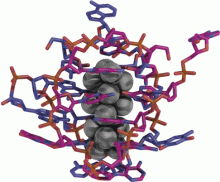
Determination of the crystal structure of a DNA-stabilized silver nanocluster
29 Jul 2019
Daegu Gyeongbuk Institute of Science and Technology (DGIST)
Joint research team of Professors Jaeheung Cho and Daeha Seo in the Department of Emerging Materials Science developed a technology to control the generation of nitric oxide in cells. Proposed the possibility of additional research related to cell signal transfer.
02 May 2019
Duke-NUS Medical School
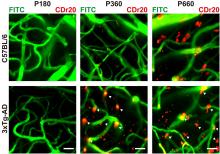
Researchers in South Korea and Singapore have, for the first time, developed a chemical probe that enables live-imaging of a type of immune cells in the brain, known as microglia, in a live animal brain.
22 Jan 2019
Ulsan National Institute of Science and Technology (UNIST)
A new type of organic solar cells with high flexibility can withstand up to 100 continual bending/unbending cycles.
12 Nov 2018
Hokkaido University
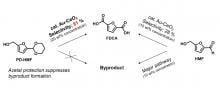
Scientists have discovered a novel method to synthesize furan-2,5-dicarboxylic acid (FDCA) in a high yield from a glucose derivative of non-food plant cellulose, paving the way for replacing petroleum-derived terephthalic acid with biomaterials in plastic bottle applications.
16 Aug 2018
Institute of Transformative Bio-Molecules (WPI-ITbM), Nagoya University
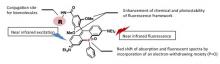
Promising photostable tool for single molecule tracking and multicolor imaging.
11 Jun 2018
Nagoya University
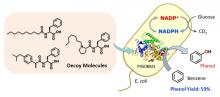
Nagoya University researchers use E.coli to convert benzene into phenol, simplifying a chemical reaction that is difficult by conventional methods
24 May 2018
Ulsan National Institute of Science and Technology (UNIST)
A team of researchers, affiliated with South Korea's Ulsan National Institute of Science and Technology (UNIST) has introduced novel solution for hydrogen storage
20 Apr 2018
Asia Research News
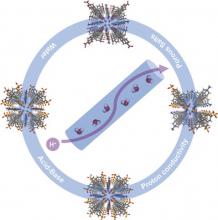
Organic salts with high proton conductivity
18 Apr 2018
King Abdullah University of Science and Technology (KAUST)
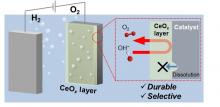
A porous cerium-based coating boosts the durability of oxygen-forming catalysts while maintaining their inherent water-splitting activity.
19 Feb 2018
Institute of Transformative Bio-Molecules (WPI-ITbM), Nagoya University
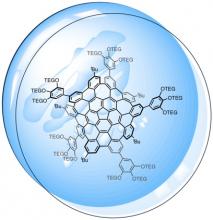
~ A new water-soluble nanocarbon triggers cell death when exposed to light ~

03 Oct 2017
King Abdullah University of Science and Technology (KAUST)
The molten surface of a sodium-based material could assist the direct conversion of methane to useful building blocks.
24 Jul 2017
Institute of Transformative Bio-Molecules (WPI-ITbM), Nagoya University
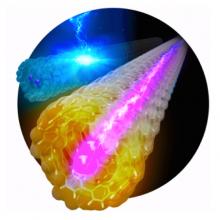
Scientists at Nagoya University have developed a new way to make stimuli-responsive materials in a predictable manner. They used this method to design a new material, a mixture of carbon nanorings and iodine, which conducts electricity and emits white light when exposed to electricity.
02 Jul 2017
King Abdullah University of Science and Technology (KAUST)
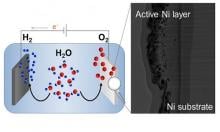
A technique to create a material for cost-effective water electrolysis uses a simple chemical method for preparing nickel-based anodes to improve the oxygen-evolution reaction. Efficiency gains like this one developed by KAUST are important in evolving renewable energy.
09 Jun 2017
Hokkaido University
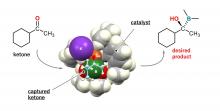
A team of Hokkaido University researchers has developed the world’s first method to achieve the catalytic asymmetric borylation of ketones, a breakthrough expected to facilitate the development of new medicines and functional chemicals.
06 Jun 2017
King Abdullah University of Science and Technology (KAUST)
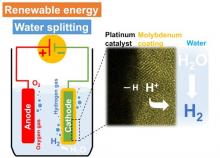
A coating of molybdenum improves the efficiency of catalysts for producing hydrogen.
06 Mar 2017
King Abdullah University of Science and Technology (KAUST)
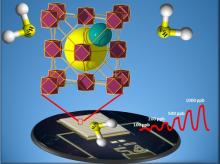
Tunable porous MOF materials interface with electrodes to sound the alarm at the first sniff of hydrogen sulfide.
19 Jan 2017
Institute for Integrated Cell-Material Sciences (iCeMS) at Kyoto University
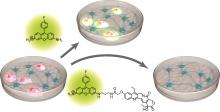
A new compound could help rid stem cell samples of potentially tumorigenic cells, making them safer for regenerative therapies.
20 Oct 2016
Nagoya University
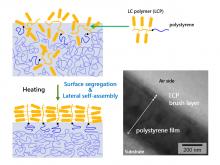
Japanese researchers have developed a new approach for obtaining functional surfaces consisting of organized polymers.

04 Aug 2016
Ulsan National Institute of Science and Technology (UNIST)
Ulsan National Institute of Science and Technology (UNIST), South Korea, is well-represented 2016 List of Most Cited Researchers in Materials Science and Engineering (MSE) by Elsevier Scopus Data, which includes only the top 300 of the world's researchers in the field of MSE ranked by the total citations of their papers.
04 Jul 2016
Hokkaido University
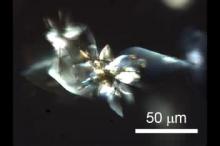
Scientists at Japan’s Hokkaido University have developed light-powered molecular motors that repetitively bend and unbend, bringing us closer to molecular robots.
01 Jul 2016
Hokkaido University
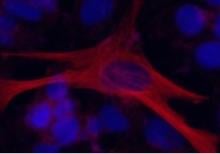
Scientists at Hokkaido University in Japan have developed a new technique to unleash silenced genes and change cell fates using CRISPR/Cas9.
14 Apr 2016
Hokkaido University
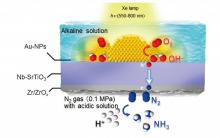
By using a photoelectrode in which gold nanoparticles are loaded on an oxide semiconductor substrate, a research at Hokkaido University, Japan, has worked to develop a method of artificial photosynthesis that has received attention as an ultimate light energy conversion system.
01 Apr 2016
Asia Research News
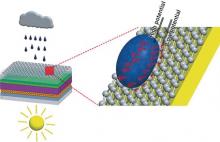
Graphene layer could allow solar cells to generate power when it rains.
17 Mar 2016
Korea Advanced Institute of Science and Technology (KAIST)
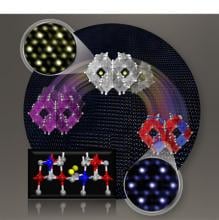
Atomic motion in a crystalline oxide that was used as a cathode in Li-ion batteries was directly demonstrated by state-of-an-art transmission electron microscopy, revealing the transient pathway of a chemical ordering reaction.
16 Mar 2016
Korea Advanced Institute of Science and Technology (KAIST)
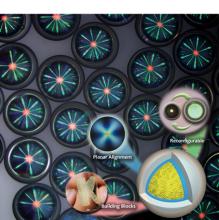
Photonic microcapsules confining cholesteric liquid crystals are microfluidically produced, potentially serving as building blocks to compose any shapes of photonic devices.
22 Feb 2016
Nagoya University
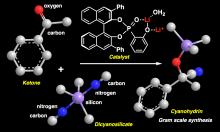
A research group led by Dr. Kazuaki Ishihara, a professor at Nagoya University, has established a new method of chemically modifying ketones in a way that ensures that optically active cyanohydrins are obtained, enabling efficient production of pharmaceutical precursors at a high yield and with good selectivity.
14 Dec 2015
King Abdullah University of Science and Technology (KAUST)
The right blend of polymers enables rapid and molecule-selective filtering of tiny particles from water.
11 Nov 2015
Korea Advanced Institute of Science and Technology (KAIST)
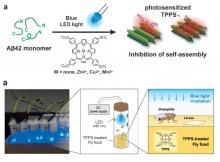
Medical application of photoactive chemicals offers a promising therapeutic strategy for neurodegenerative diseases.
26 Oct 2015
Institute of Transformative Bio-Molecules (WPI-ITbM), Nagoya University
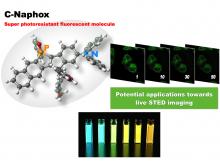
A new photostable fluorescent dye for super resolution microscopy could serve as a powerful tool to visualize biological events and structural details in living cells at real-time for prolonged recording periods.