

IEEE Robotics and Automation Letters
About IEEE Robotics and Automation Letters
The IEEE Robotics and Automation Letters (RA-L) publishes peer-reviewed articles that provide a timely and concise account of innovative research ideas and application results, reporting significant theoretical findings and application case studies in areas of robotics and automation.
News
17 Jul 2026
Kanazawa University
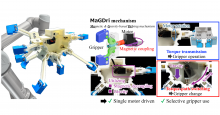
A conventional robotic hand is equipped with multiple motors or peripheral devices for grasping a wide variety of objects. This study presents a robotic hand equipped with multiple grippers that are driven by a single motor with the transmission of motor power switched via a mechanism using gravity (Magnetic and Gravity-based Driving mechanism). Thus, it provides design guidelines for a new robotic hand capable of accommodating diverse grasping actions while maintaining a relatively simple structure.
03 Sep 2025
Tohoku University
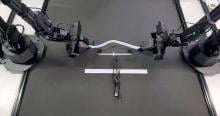
Combining multiple sensory inputs has been a big hurdle for developing physical AI robots. Recent research at Tohoku University solves this problem using a brand new approach.
09 May 2024
Tohoku University
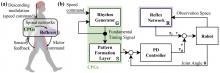
Walking and running is notoriously difficult to recreate in robots. Now, a group of researchers has overcome some of these challenges by creating an innovative method that employs central pattern generators - neural circuits located in the spinal cord that generate rhythmic patterns of muscle activity - with deep reinforcement learning. The method not only imitates walking and running motions but also generates movements for frequencies where motion data is absent, enables smooth transition movements from walking to running, and allows for adapting to environments with unstable surfaces.
23 Mar 2020
Tohoku University
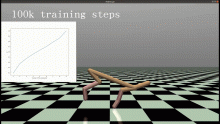
Human motor control has always been efficient at executing complex movements naturally, efficiently, and without much thought involved. This is because of the existence of motor synergy in the central nervous system (CNS). Motor synergy allows the CNS to use a smaller set of variables to control a large group of muscles; thereby simplifying the control over coordinated and complex movements.