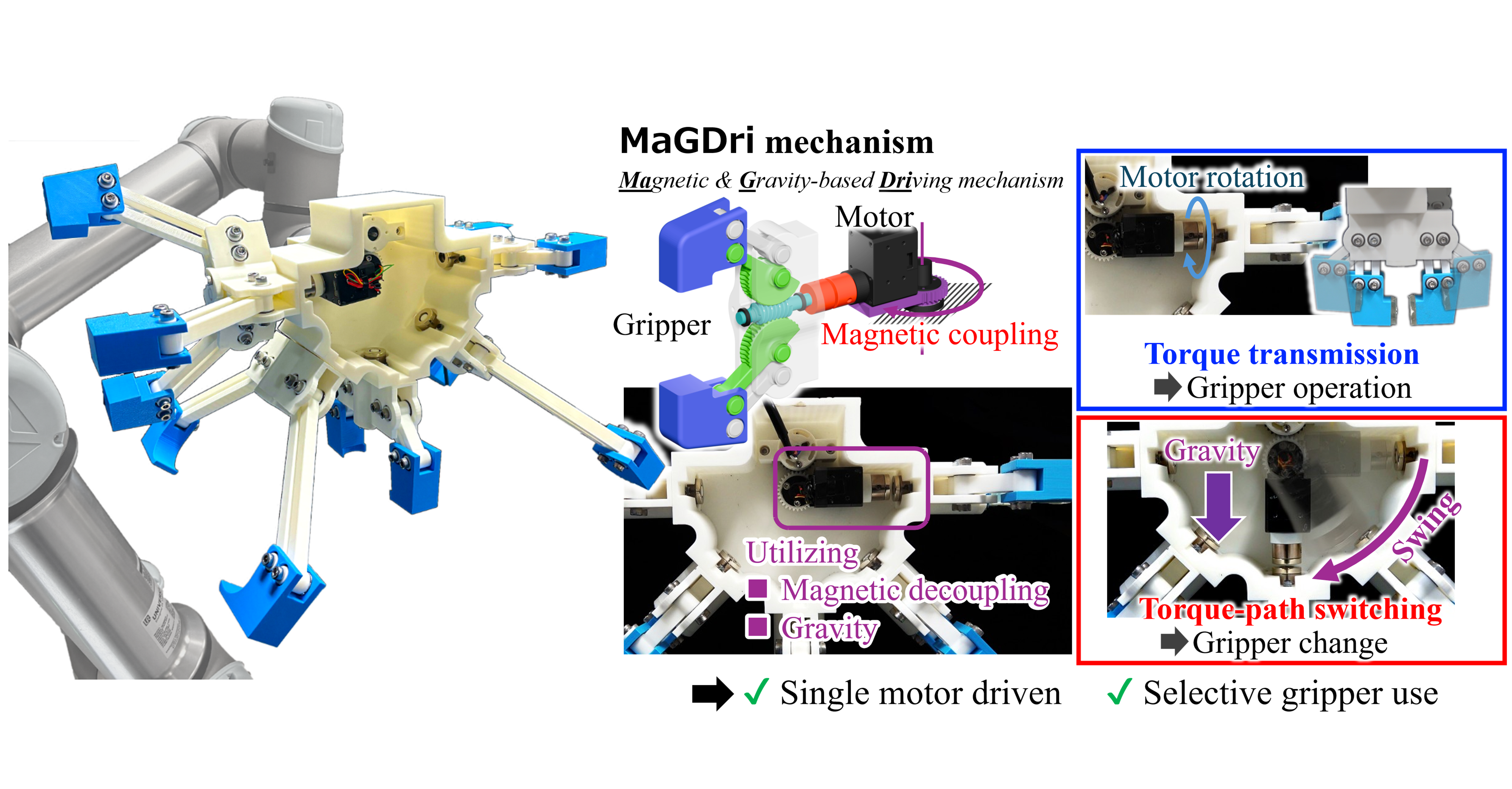
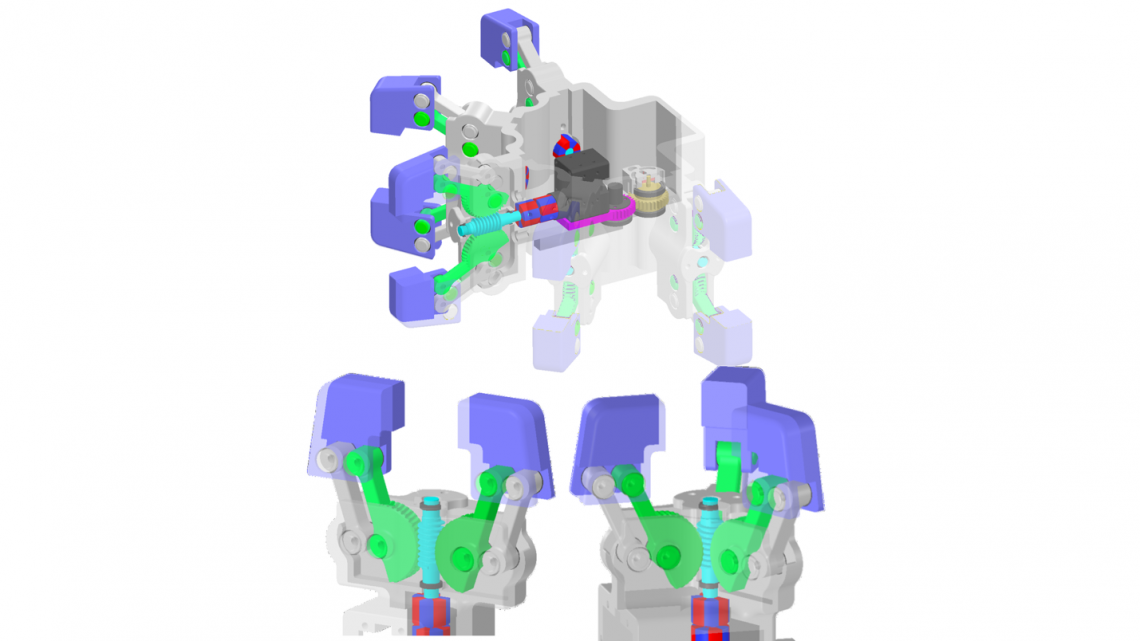

A conventional robotic hand is equipped with multiple motors or peripheral devices for grasping a wide variety of objects. This study presents a robotic hand equipped with multiple grippers that are driven by a single motor with the transmission of motor power switched via a mechanism using gravity (Magnetic and Gravity-based Driving mechanism). Thus, it provides design guidelines for a new robotic hand capable of accommodating diverse grasping actions while maintaining a relatively simple structure.
Fig. 1. Developed robotic hand.
T. Nishimura, Kanazawa University
Background
For robots to be used in various settings such as factories, logistics, service industries, and households, they must be able to stably handle a diverse range of objects differing in shape, size, weight, and rigidity. However, conventional robotic hands often require multiple motors and complex control systems, presenting challenges in terms of weight, cost, the risk of failure, and control difficulties. In this study, the researchers aimed to develop a robotic hand that possesses multiple gripping units (grippers*1)) while using a single motor as the driving source. In addition, they established a new principle for robot design in the form of a unique mechanism principle that uses gravity, which is generally treated as a disturbance in robotics, as a driving source for a robotic hand.
Results
This study was conducted by a team consisting of researchers from the Institute of Science and Engineering, Kanazawa University, with the participation of a graduate student. The team has developed a robotic hand equipped with multiple types of grippers that allows for switching between them depending on the object to be grasped, using only a single motor. The team demonstrated that multiple gripping functions could be achieved without the use of additional actuators or complex control, by introducing the "MaGDri (Magnetic and Gravity-based Driving) mechanism*2)," which uses gravity to switch the torque path. Furthermore, experiments using prototypes confirmed that appropriate grippers can be selected to grasp objects of varying shapes and sizes.
With conventional robotic hands, it is common to use a hand equipped with multiple motors or peripheral devices known as tool changers in order to grasp a wide variety of objects. The uniqueness of the present study lies in the fact that, while the hand is equipped with multiple grippers, they are driven by a single motor, with the transmission of motor power switched via a mechanism that uses gravity. This has provided design guidelines for a new robotic hand capable of accommodating diverse grasping actions while maintaining a relatively simple structure.
The results of this research are expected to contribute to the practical application of robots that handle a wide variety of objects such as those used in factories, logistics facilities, and service industries. Traditionally, it was necessary to use different specialized grippers depending on the shape or application of the object; however, if a single hand can switch between multiple grasping methods as demonstrated in this study, the operational range of robots can be expanded. Since a single motor can drive multiple grippers, this has the potential to reduce the weight, space requirements, and cost of the robotic hand.
A major significance lies in presenting a new design principle that expands the functionality of a robotic hand through innovative mechanical design without increasing the number of motors. A torque-path switching mechanism that uses gravity is a unique approach to realizing a simple yet multi-functional robotic hand, which is expected to advance robotic hand design and mechanism research.
Future prospects
The results of this study may lead to the advancement of robots that support our daily lives in the future. For example, tasks such as tidying up household items, handing over objects in nursing care or social welfare settings, and handling products in stores or logistics facilities require the safe and reliable handling of a wide variety of objects that differ in shape, size, and rigidity. If, as in this study, a single robotic hand becomes capable of switching between multiple grasping methods, it is expected that the range of tasks robots can handle will be broadened, enabling them to support human work with much more flexibility.
Furthermore, since multifunctional gripping can be achieved with a single motor, this should lead to lighter and lower-cost robotic hands. Thus, the results of this study are expected to contribute to the realization of robotic hands that can easily be operated in a wide range of settings, not only in industrial robots but also domestic robots, care-support robots, mobility robots, and disaster-response robots.
Glossary
*1) Gripper
The part of a robot used to grasp objects. There are various types such as those that hold an object in parallel or those that wrap around an object with multiple grippers depending on the shape of the target object and the intended application.
*2) MaGDr (Magnetic and Gravity-based Driving) mechanism
A mechanism proposed in this study that uses magnetic coupling and gravity to switch the transmission of motor power between multiple grippers.
Note
The robotic hand can be seen in action in a video posted on the laboratory's official YouTube channel:
https://www.youtube.com/@hmilabkanazawauniversityja4095
###
About Kanazawa University
— Contributing to Society through “Future Oriented Intelligence”, Built on an “All Kanazawa University” Approach.
Kanazawa University (KU), founded in 1862, is a research university dedicated to education, while opening up its doors to both local and global society. Guided by our vision, “Kokorozashi,” we contribute to society through “Future-oriented Intelligence,” addressing current challenges and anticipating future ones from both local and global perspectives.
KU includes 4 colleges, 20 schools, 7 graduate schools, a hospital, and specialized research centers such as the Cancer Research Institute, a leading hub for research on cancer metastasis and drug development. Over 1,000 researchers drive innovation and international collaboration across diverse fields.
KU is advancing research through WPI (World Premier International Research Center Initiative) and J-PEAKS (Program for Forming Japan’s Peak Research Universities), accelerating interdisciplinary and international collaborations and innovations.
Learn more here: https://www.kanazawa-u.ac.jp/en/
Advertisement