

High-coverage Jomon and Yayoi genomes reveal continuity with modern Japanese, continental ancestry, and prehistoric starch adaptations in Japan.
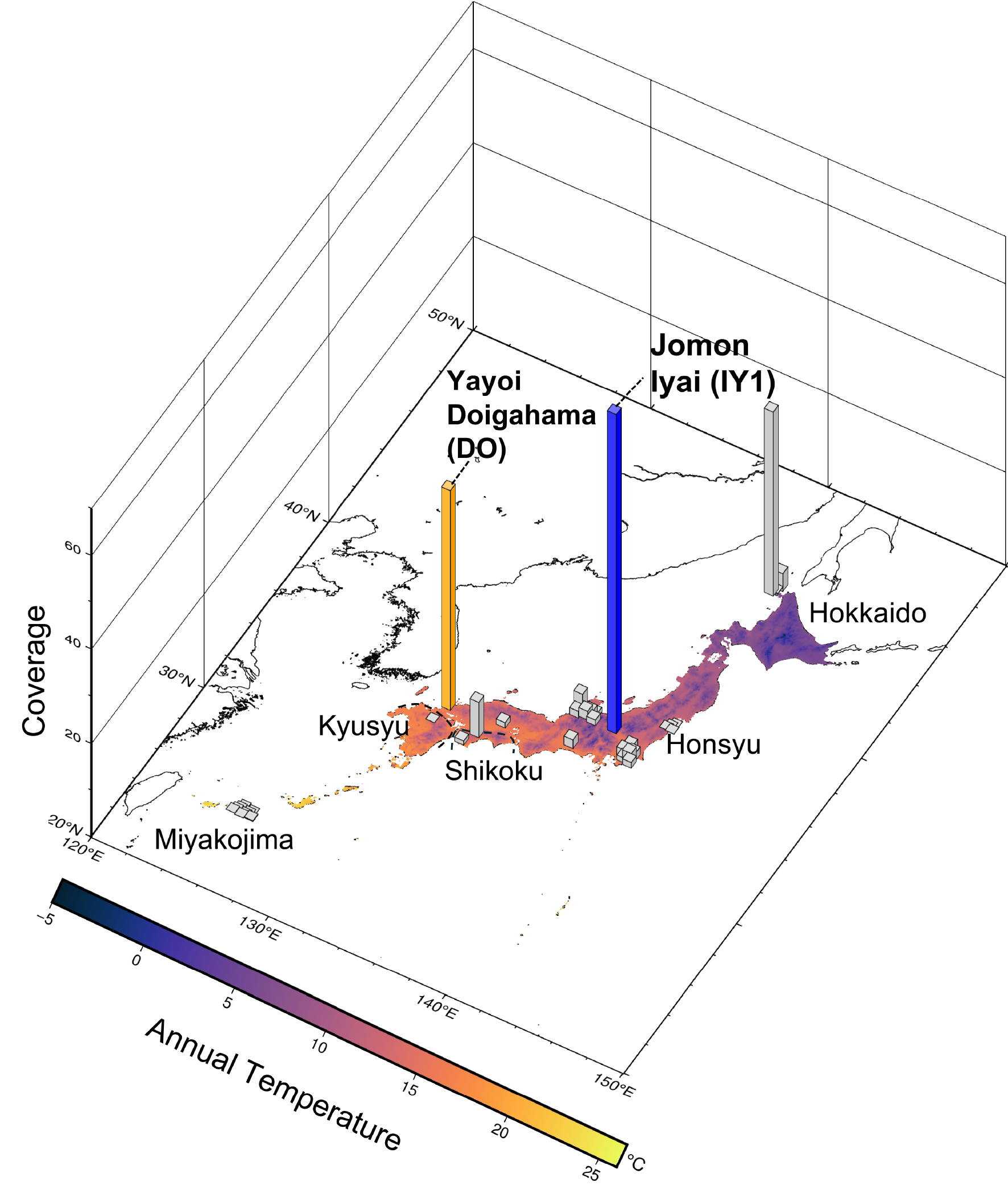
Figure1. Archaeological site locations and autosomal genome coverage of ancient individuals in Japan.
The 3D bars indicate sequencing coverage, and the heatmap shows 1991–2020 mean annual temperatures (yellow, warmer; blue, cooler; Japan Meteorological Agency).
Adapted from Ishiya et al. (2026), Proceedings of the National Academy of Sciences.
The research teams led by Koji Ishiya of Kanazawa University reconstructed exceptionally high-coverage genomes from two ancient individuals in Japan: IY1, a woman from the Initial Jomon period who lived about 8,300 years ago, and DO, a man from the Middle Yayoi period who lived about 2,300 years ago.
Ancient DNA is often poorly preserved in Japan because warm, humid conditions and acidic soils accelerate degradation. Nevertheless, the team obtained genome-wide coverage of approximately 67-fold for IY1 and 46-fold for DO, enabling detailed analyses that are difficult with lower-coverage data.
IY1 clustered with previously studied Jomon individuals, supporting an early-diverging Jomon-related lineage that contributed ancestry to present-day Japanese populations. DO was genetically closer to present-day mainland Japanese and carried ancestry components associated with Northeast Asia. Population-mixture models of Yayoi people further indicated contributions related to several ancient continental groups, including populations from the Amur River region, Inner Mongolia, and Shandong. These groups are best regarded as genetic proxies rather than direct ancestors, suggesting that interactions among multiple continental populations shaped Yayoi ancestry.
Demographic analyses indicated that the ancestral populations of both individuals declined around the Last Glacial Maximum. The Yayoi-related lineage subsequently showed gradual growth, possibly beginning on the Eurasian continent before migration to the Japanese archipelago, whereas the Jomon-related lineage remained comparatively stable.
The high-coverage genomes enabled estimation of amylase gene copy number, which is associated with salivary amylase production and starch digestion. Both individuals carried relatively high copy numbers. The finding indicates that starch-related genetic diversity was present in prehistoric East Eurasia before large-scale agriculture and may have followed regionally distinct trajectories.
“High-coverage ancient genomes allow us to investigate much more than broad population relationships,” said Ishiya. “They provide information about demographic history and complex genetic variation that is often inaccessible in low-coverage data. We were particularly interested to find a relatively high amylase gene copy number in an Initial Jomon individual, because it suggests that the relationship between plant-food use and human genetic variation may have a deeper and more regionally diverse history than previously recognized.”
The research teams now plan to analyze additional high-coverage ancient genomes from different regions and periods of the Japanese archipelago. By integrating genomic evidence with plant and animal remains, stable-isotope analyses, and information on past environments, they hope to clarify how migration, climate change, and changing subsistence practices shaped human genetic diversity.
The study was published in the Proceedings of the National Academy of Sciences.
Advertisement