

IEEE Transactions on Visualization and Computer Graphics
About IEEE Transactions on Visualization and Computer Graphics
IEEE Transactions on Visualization and Computer Graphics (TVCG) publishes papers on subjects related to computer graphics, information and scientific visualization, visual analytics, virtual and augmented reality, focusing on theory, algorithms, methodologies, human-computer interaction techniques, systems, software, hardware, and applications in these areas.
News
19 Mar 2026
The University of Osaka
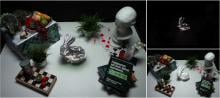
This study proposes a thin, compact system for enabling high-contrast projection mapping in brightly lit environments. By precisely controlling light so that only the target object remains unilluminated, high-contrast images can be projected onto the object without darkening the entire space. In contrast to existing large-scale illumination systems, the proposed system employs an LED display panel with an aperiodic lens array, enabling next-generation immersive spatial experiences in commercial facilities, exhibition spaces, and public environments.
18 Mar 2026
The University of Osaka
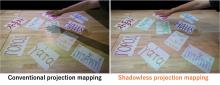
Researchers from The University of Osaka have demonstrated for the first time that images projected using a shadowless projection mapping system can be perceived by observers as changes in color and texture of physical objects themselves, rather than as overlaid imagery
18 Mar 2024
The University of Osaka
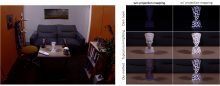
Researchers from Osaka University developed a system that enables projection mapping within an illuminated environment. Several standard projectors and one large-aperture projector reproduce the environmental illumination in all areas except for the target object, whereas texture projectors display the texture on the unilluminated object’s surface. Experiments show that participants perceived the objects using surface-color mode instead of aperture-color mode, verifying that the proposed system has the potential to produce highly realistic interactive environments.
13 Mar 2024
Tohoku University
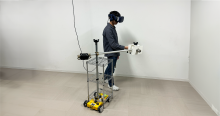
Recreating the action of opening doors in the virtual world requires engineering ways in which to provide the equivalent haptic feedback and steer users away from walls in the real world. A research group has done just this; developing RedirectedDoors+, which employs door robots and rotation to create a more realistic experience.
30 Nov 2020
Tohoku University
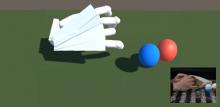
A new sensing method has made tracking movement easier and more efficient. A research group from Tohoku University has captured dexterous 3D motion data from a flexible magnetic flux sensor array, using deep learning and a structure-aware temporal bilateral filter.
03 Sep 2019
Ulsan National Institute of Science and Technology (UNIST)
A recent study, affiliated with South Korea's Ulsan National Institute of Science and Technology (UNIST) has presented an artificial intelligence technology that can predict traffic conditions for the next 5 to 15 minutes at an error rate of less than four kilometers an hour.