

Nano Letters
About Nano Letters
Nano Letters is a forum for reporting original results on fundamental, applied, and emerging research in all areas of nanoscience and nanotechnology that require rapid dissemination.
- Website: https://pubs.acs.org/journal/nalefd
- Current Issue: https://pubs.acs.org/toc/nalefd/current
News

09 Jul 2020
Daegu Gyeongbuk Institute of Science and Technology (DGIST)
Scientists in Korea explain a new process that maximizes photon conversion in 2D materials, which could innovate photonic-based applications

30 Apr 2020
Tohoku University
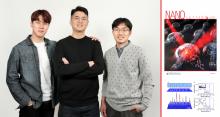
A multinational team of researchers from Tohoku University and institutions in the UK, Germany and Switzerland has revealed the magnetic states of nanoscale gyroids, 3D chiral network-like nanostructures. The findings add a new candidate system for research into unconventional information processing and emergent phenomena relevant to spintronics.
10 Mar 2020
Ulsan National Institute of Science and Technology (UNIST)
A recent study, affiliated with South Korea's Ulsan National Institute of Science and Technology (UNIST) has introduced a novel technology, which allows carbon nanotubes (CNTs) to be easily observed under room temperature.

06 Feb 2020
Hokkaido University
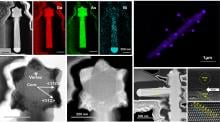
A nanoscale gold butterfly provides a more precise route for growing/synthesizing nanosized semiconductors that can be used in nano-lasers and other applications.
18 Oct 2019
Ehime University
A research team of Ehime University paved a way to achieve unexplored III-V semiconductor nanostructures. They grew branched GaAs nanowires with a nontoxic Bi element employing characteristic structural modifications correlated with metallic droplets, as well as crystalline defects and orientations. The finding provides a rational design concept for the creation of semiconductor nanostructures with the concentration of constituents beyond the fundamental limit, making it potentially applicable to novel efficient near-infrared devices and quantum electronics.
26 Aug 2019
Ulsan National Institute of Science and Technology (UNIST)
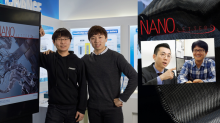
A joint research team, affiliated South Korea's Ulsan National Institute of Science and Technology (UNIST) has developed a high-performance metal electrode (carbon fiber-metal composite) through a process of penetrating liquid metal into fine gaps of carbon fiber.
26 Aug 2019
Ulsan National Institute of Science and Technology (UNIST)
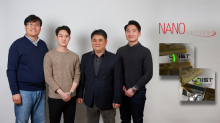
A recent study, affiliated with South Korea's Ulsan National Institute of Science and Technology (UNIST) has presented a new perovskite light-emitting diodes (PeLEDs) with high flexibility.

06 Aug 2019
Daegu Gyeongbuk Institute of Science and Technology (DGIST)
Senior Researcher Changsoon Choi's team at DGIST and Dr. Sungwoo Chun at SKKU developed a new tactile sensor mimicking human skin. Can recognize more sensitive tactile than the existing sensors... Expected to contribute greatly to the development of artificial skin.
31 May 2019
Hokkaido University
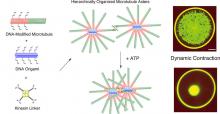
Researchers have successfully used DNA origami to make smooth-muscle-like contractions in large networks of molecular motor systems, a discovery which could be applied in molecular robotics.
24 Nov 2016
Daegu Gyeongbuk Institute of Science and Technology (DGIST)
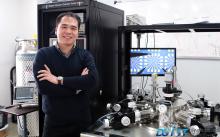
A joint team has developed cryogenic microwave photodetector which is able to detect 100,000 times smaller light energy compared to the existing photedetectors. The significance is DGIST have developed the world's first microwave photodetector using graphene device.