

Lingnan University's CREW Intelligent Wheelchair Control System wins “Top 10 Technological Innovation Award” at the first Shenzhen Health & Elderly Care Robotics Competition. (From left: Mr Bob Yu Ting, Senior Control Engineer of Office of Service-Learning at Lingnan University; Prof Albert Ko, Director of the Office of Service-Learning and Lingnan Entrepreneurship Initiative; and Mr Adrian Lo Chun-kwong, Product Design Lead of Office of Service-Learning)
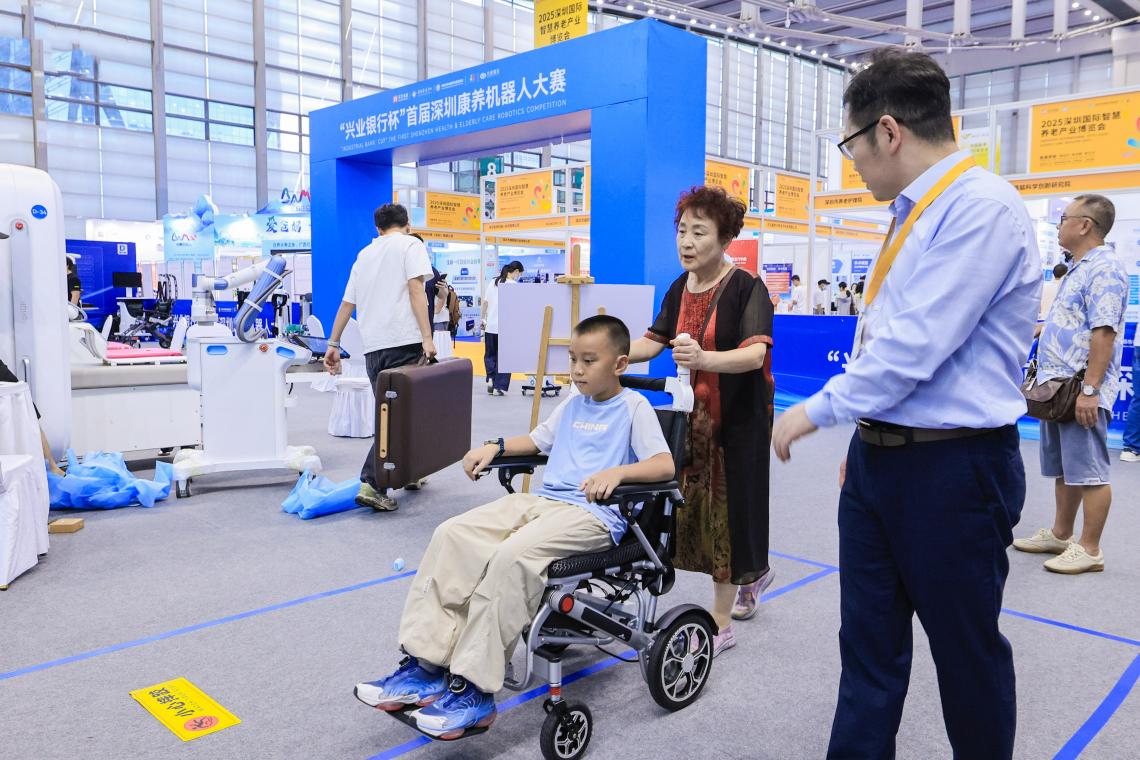
CREW is recognised by a judging panel comprising industry experts, “Senior Experience Officers” and investment representatives for its breakthrough design concept and user experience.
Selected from more than 200 entries submitted by over 100 participating domestic and foreign companies, CREW was recognised by a judging panel comprising industry experts, “Senior Experience Officers” and investment representatives for its breakthrough design concept and user experience.
Specifically designed for caregivers, CREW eliminates complicated buttons. Its core innovation lies in “human-robot closed-loop motion control technology”. With a gentle push of the handle, just like operating a normal wheelchair, the system instantly senses the caregiver’s intention and provides stable, smooth power assistance.
During the competition’s hands-on session, CREW received enthusiastic praise from experts and users across the country, especially several “Senior Experience Officers.” They commonly noted that the system was “intuitive with no learning curve,” and its “gentle push for steady movement” truly relieves caregivers from heavy physical strain, making elderly care easier, safer, and more dignified.
Prof Albert Ko, Director of the Office of Service-Learning and Lingnan Entrepreneurship Initiative at Lingnan University, who led the CREW project, remarked: “With an ageing population, wheelchairs have become indispensable for many elderly people. In Hong Kong, it is very common for the elderly to care for the elderly. Using traditional wheelchairs imposes a huge physical burden on caregivers, especially women and older carers, and may even create safety risks. The CREW system addresses this issue, becoming one of the world’s first intelligent electric wheelchair control systems designed specifically for caregivers. Our goal is to offer a solution to this long-overlooked problem, using advanced sensor technology and motion control algorithms to greatly improve the caregiver’s experience.”
Prof Ko further explained that CREW features “Intelligent Load Adaptation”, ensuring an easy and natural pushing experience regardless of the occupant’s weight or terrain, whether flat ground or slopes. The system also integrates safety functions such as uphill assistance, downhill deceleration, and automatic brake-on-release function, completely eliminating the risks of pushing wheelchairs on slopes.
The CREW system has already won multiple international accolades, including Gold Medals at the International Exhibition of Inventions Geneva and the Silicon Valley International Invention Festival (SVIIF).
Prof Ko added: “We are very honoured to receive this award. It not only recognises our technological innovation, but also affirms Lingnan University’s commitment to caring for society and addressing real-world problems through Humanitarian Technology. We believe CREW will not only benefit the caregiving sector, but also has potential to expand into hospitals, warehouses, hotels and other commercial settings that require frequent manual pushing of loads.”
The Lingnan research team is actively seeking collaboration with mainstream wheelchair manufacturers, planning to introduce CREW to the market through a B2B model, either as a standard feature or as an optional add-on, bringing new technological momentum to the health and elderly care industry.
The “Shenzhen International Intelligent Elderly Care Industry Expo ‘Industrial Bank Cup’ The First Shenzhen Health & Elderly Care Robotics Competition” was held under the theme “Smart Technology Empowering Elderly Care Services”, showcasing the latest integration of artificial intelligence with elderly care, and highlighting Shenzhen’s early-mover advantage and strategic planning in this sector.