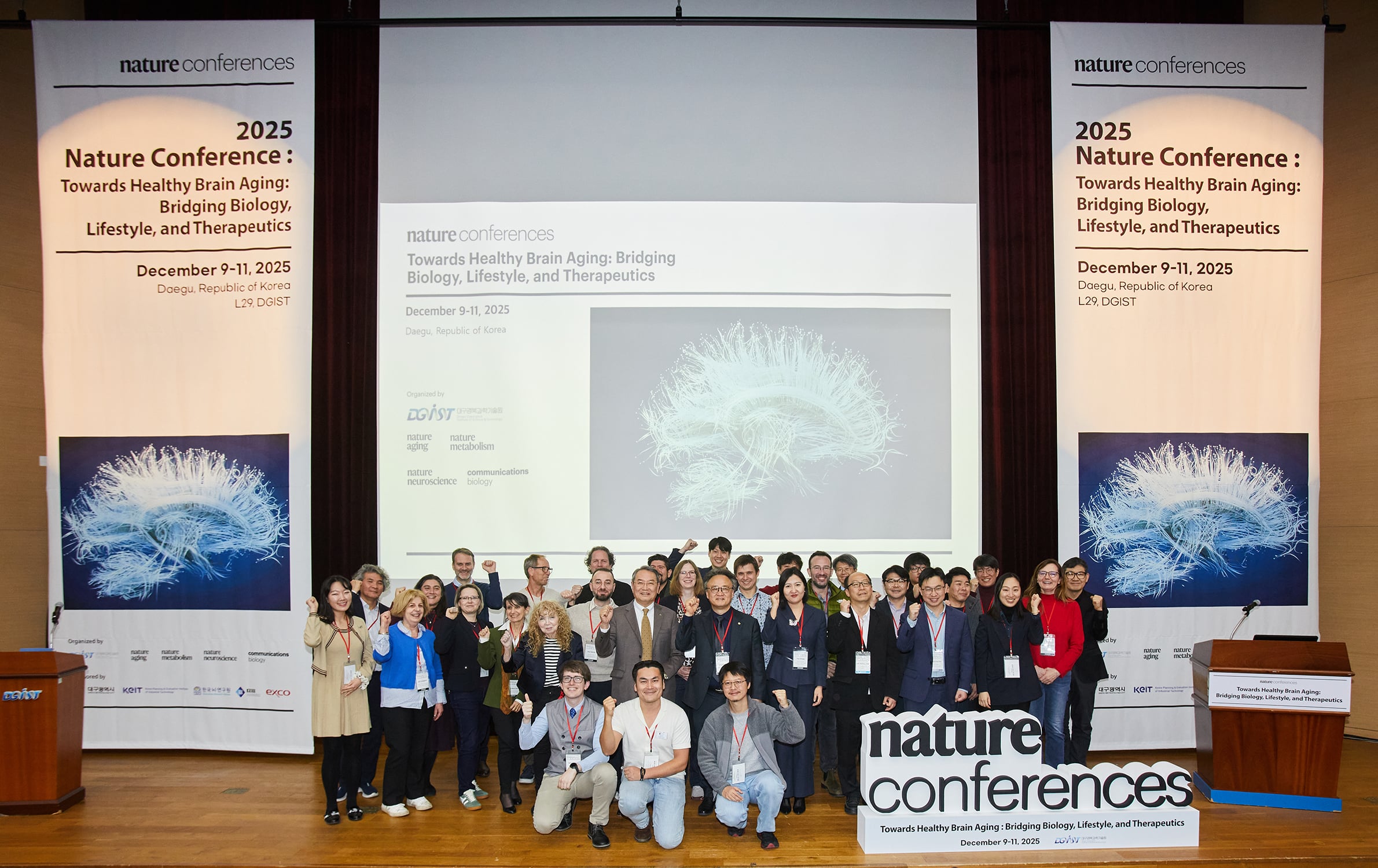
□ DGIST (President Kunwoo Lee) successfully concluded the ‘2025 Nature Conference’, co-hosted with the world-renowned academic journal Nature, from December 9 (Tuesday) to December 11 (Thursday), at the DGIST Auditorium (E7, Room L29). As Korea’s first official Nature conference in the field of bioscience, the event presented global research directions in brain aging and neurodegenerative studies under the theme of ‘Healthy Brain Aging’.
□ During the conference, approximately 350 participants from over 50 countries, representing academia, industry, healthcare, and government institutions, engaged in in-depth discussions on brain health research—one of the most critical issues of the aging era—and strategies for international collaboration. The opening ceremony featured congratulatory remarks by Yongwon Seo, Vice President of the Korea Institute for Advancement of Technology (KIAT), while Hyuk Chae Koo, First Vice Minister of Science and ICT, delivered a video message. In his welcome address, Yongsoon Eun, Vice President for Academic Affairs at DGIST, expressed confidence that DGIST would emerge as a global hub for brain and bioscience research through collaboration with world-leading scientists.
□ The keynote lectures were delivered by Ana Maria Cuervo, Director of the Institute for Aging Research at Albert Einstein College of Medicine, and Tony Wyss-Coray, Professor at Stanford School of Medicine. They presented cutting-edge research on selective autophagy-based aging mechanisms and brain function recovery strategies utilizing blood-borne factors, respectively. Their talks attracted strong interest from attendees for their deep insights into global research trends.
□ The ‘Meet the Editor’ session, featuring seven editors from major Nature journals, emerged as a flagship program of the conference. Through one-on-one consultations, researchers received practical guidance on manuscript structure, international peer-review standards, and future research directions. The session garnered overwhelming interest and closed early due to high demand. In addition, more than 100 poster presentations, selected through abstract review, were presented. Five outstanding posters were ultimately awarded following evaluation by Nature editors.
□ President Kunwoo Lee remarked, “This conference marks a significant turning point in elevating Korea’s bioscience research to a truly global level,” adding that “DGIST will continue to build a strong research environment to foster active international collaboration in the biosciences.” Vice President Yongsoon Eun for Academic Affairs noted, “Brain aging is one of the most urgent scientific challenges facing humanity, and this conference is expected to further strengthen innovative research models and global networks.”
□ The conference was co-organized by DGIST and Nature and supported by the Daegu Metropolitan City, Korea Institute for Advancement of Technology (KIAT), Korea Brain Research Institute (KBRI), Korea Research Institute of Bioscience and Biotechnology (KRIBB), Korea Tourism Organization (KTO), and EXCO Co., Ltd. With the participation of numerous domestic and international institutions, the event concluded successfully as a world-class forum integrating academia and industry.