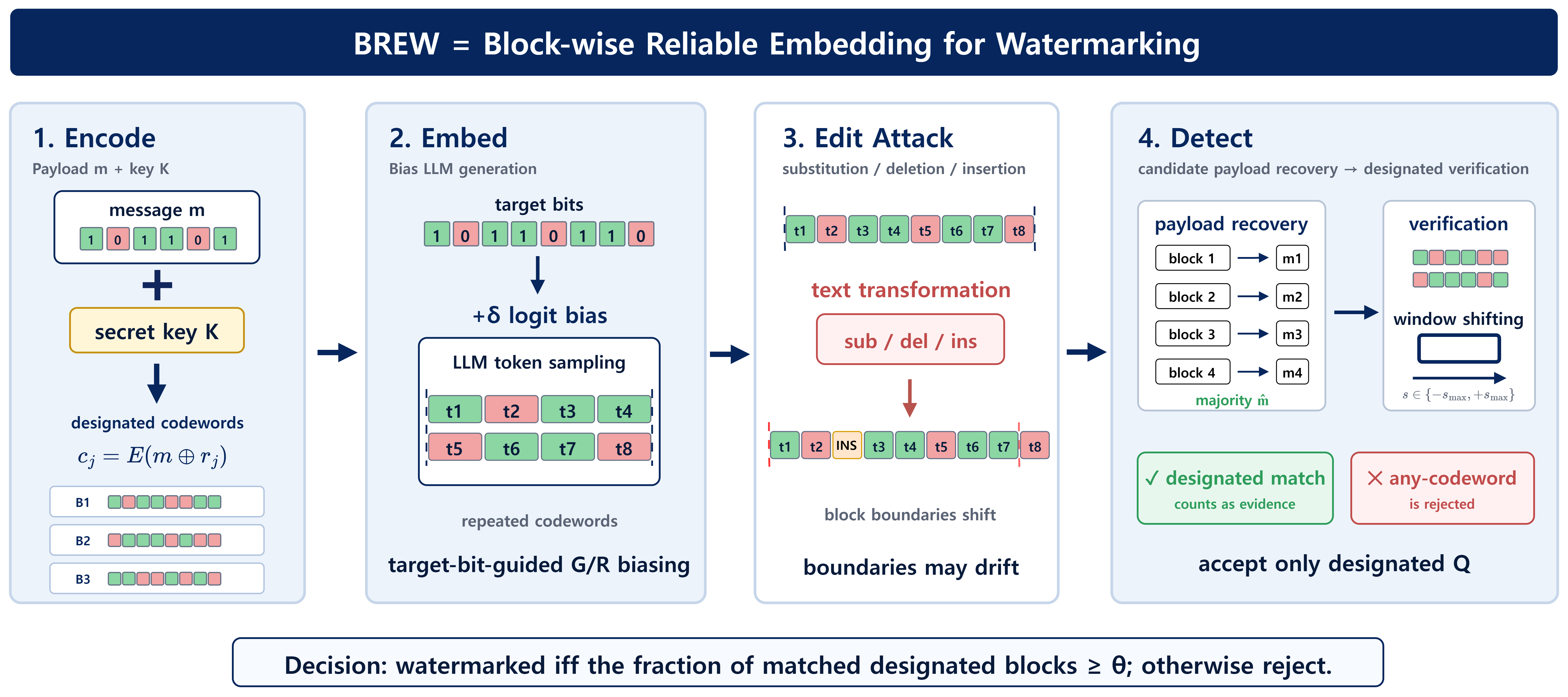
□ The research team led by Prof. Young-Sik Kim of the Department of Electrical Engineering and Computer Science and the Artificial Intelligence Major at DGIST (President Kunwoo Lee) has developed BREW (Block-wise Reliable Embedding for Watermarking), an innovative anti-forgery technology that embeds an invisible, unique digital watermark into AI-generated text. It can clearly verify whether the text was AI-generated and identify its source despite the text being damaged or manipulated. The technology is expected to be a core technology in the global field of AI forensics, enabling to prevent social disruption caused by fake news and protecting digital copyrights.
□ With the rapid spread of generative AI, the importance of technologies accurately verifying the source of AI-generated news articles, documents, assignments, and creative works is growing. However, conventional multi-bit text watermarking technologies have encountered limitations in practical application owing to high false positive rates that incorrectly identify ordinary, non-watermarked text as AI-generated.
□ The research team developed BREW, introducing a method of dividing text into multiple segments (blocks) for independent verification while tracking subtle changes to sentences. Despite malicious attempts being made to erase the watermark by replacing words or subtly altering sentence structure, BREW uses a Window-Shifting technique to restore alignment and reliably track the watermark.
□ Experimental results demonstrated that BREW maintained a high detection rate of 96.5% even when 10% of the words in AI-generated text were replaced with synonyms. In particular, it demonstrated strong performance even on relatively short texts of approximately 200 words and successfully reduced the false positive rate—incorrectly identifying human-written text as AI-generated—to 2%.
□ “This research overcomes the critical flaw of existing technologies that mistakenly identify human-written text as AI-generated and provides a robust solution that effectively defends against malicious attempts to tamper with text,” stated Prof. Young-Sik Kim. “We expect it to play a key role in the global field of AI forensics by helping prevent social disruption caused by fake news and protecting digital copyrights.”
□ This research was conducted by Prof. Young-Sik Kim's research team at DGIST (graduate students Hoeun Kim and Joeun Kim of DGIST, and Prof. Dongsup Jin of the University of Ulsan). The paper presenting the research findings has been accepted by the International Conference on Machine Learning (ICML) 2026, one of the world's premier conferences in AI. The research team will present its findings at ICML 2026, to be held at COEX in Seoul this July.
□ Furthermore, this research was supported by the Institute of Information & Communications Technology Planning & Evaluation (IITP) under the Ministry of Science and ICT through the projects “Development of Quantum-Safe Infrastructure Migration and Quantum Security Verification Technologies” and "Development of V2X Infra Security Core Technologies for Autonomous Vehicle Services."