
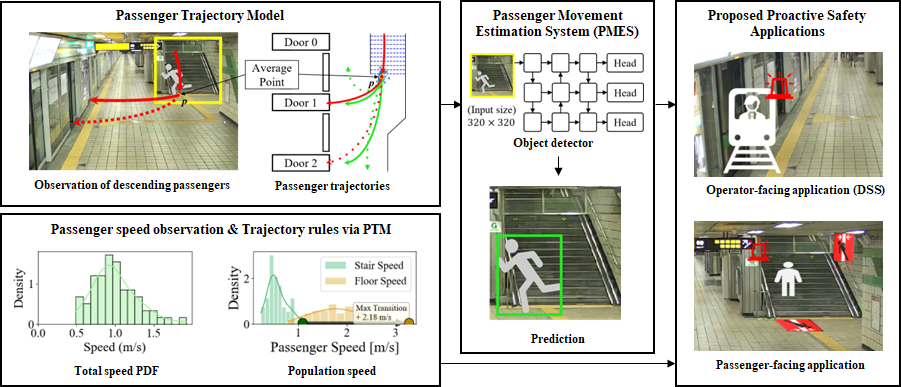

Proactively predicts passengers' risky boarding behaviors with 97.58% accuracy using a single CCTV video frame
Workflow of the proposed research.
H. Jo, Y. Li, L. Lim and J. W. Chong, "Passenger Trajectory Model and Passenger Movement Estimation System for Preventing Passenger Subway Door Accidents," in IEEE Transactions on Intelligent Transportation Systems, doi: 10.1109/TITS.2026.3702710.
A research team led by Professor Jo Woon Chong of the School of Electronic and Electrical Engineering of Sungkyunkwan University (SKKU), in collaboration with researchers from KAIST and Texas Tech University in the United States, has developed the 'Passenger Movement Estimation System (PMES).' This AI based system predicts passenger movements using CCTV footage to prevent subway door entrapment accidents before they occur. Overcoming the limitations of conventional reactive methods, where sensors only trigger after a passenger has entered the danger zone, this study has drawn significant attention from academia and industry for proactively identifying risks before passengers even reach the boarding area. The research findings are scheduled to be published in IEEE Transactions on Intelligent Transportation Systems (top 1.89% in JCR), one of the world's most prestigious international journals in the field of transportation systems.
Professor Chong, who has led research at Sungkyunkwan University on human centered AI, multimodal signal processing, and AI embedded systems, oversaw this study. Hee Jo, the first author and a Ph.D. student, led the data analysis and AI model design. The research team empirically validated a Passenger Trajectory Model (PTM) showing that when a train is present at or approaching the platform, 97.85% of passengers descending the stairs move directly toward the train doors. The research team explained the significance of the study, stating, "Based on these behavioral patterns, we built a system that captures passenger movements using just a single video frame, allowing us to detect risks in advance before passengers reach the train doors."
The research team conducted experiments by classifying passenger movements on station stairs into three categories: Ascending, Descending, and Passing. The results demonstrated that real time classification is possible with a high accuracy of 97.58% using an object detection model. In particular, to maximize practicality, the team proposed SD Net (Subway Door Network), an ultra-lightweight custom model that operates smoothly even in limited computing environments. Furthermore, based on these analysis results, they enhanced the system's completeness by developing a Decision Support System (DSS) that guides train operators on the optimal door closing timing, alongside guidelines for passenger warning alarms.
This study is particularly meaningful as the fruit of a global, interdisciplinary collaboration among experts in diverse fields, including civil and environmental engineering (Professor Lisa Lim, KAIST) and electrical and computer engineering (Researcher Yifan Li, Texas Tech University). Based on these findings, the research team presented scientific evidence that transportation systems can move beyond simply operating surveillance CCTVs to establishing proactive response mechanisms that secure passenger safety and minimize train delays. This is expected to serve as a new milestone in preventing persistent subway door accidents in subway environments equipped with platform screen doors (PSDs) or automated control systems.
Advertisement